
What is the difference between fully threaded and partially threaded fastener bolts
author: www.qishine.com
2026-03-08

Bolts are common fasteners in our daily lives, from furniture assembly to bridge construction, they are indispensable. But have you noticed that some bolts have threads along their entire length, while others only have threads on part of it? This is precisely what we are exploring today: fully threaded bolts versus partially threaded bolts. Understanding their differences can help you make more appropriate choices in various scenarios.

Fully Threaded Hex Bolt VS Partially Threaded Hex Bolt
I. Getting to Know the Two Main Types: Fully Threaded Bolts vs. Partially Threaded Bolts
1. Fully Threaded Fastener
Appearance: Threads run from just below the bolt head all the way to the end of the shank.
Characteristics: 100% thread coverage, resembling a "fully threaded" rod.
1. Fully Threaded Fastener
Appearance: Threads run from just below the bolt head all the way to the end of the shank.
Characteristics: 100% thread coverage, resembling a "fully threaded" rod.

Measurement of the full-threaded bolt length
2. Partially Threaded Bolts (Also Known as Partly Threaded Bolts)
Appearance: The shank is divided into two parts—a non-threaded plain shank section near the head and a threaded section at the end.
Characteristics: Threads cover only part of the shank, and the diameter of the plain shank section is slightly larger than the major diameter of the threads.
Appearance: The shank is divided into two parts—a non-threaded plain shank section near the head and a threaded section at the end.
Characteristics: Threads cover only part of the shank, and the diameter of the plain shank section is slightly larger than the major diameter of the threads.

Names of Various Parts of a Bolt
II. Core Differences: More Than Just "With or Without Threads"
The differences between them go far beyond appearance, extending to design philosophy and mechanical properties:
The differences between them go far beyond appearance, extending to design philosophy and mechanical properties:
| Comparison Aspect | Fully Threaded Bolt | Partially Threaded Bolt |
| Thread Coverage | Entire length of the shank | Only the end portion of the shank |
| Plain Shank Section | None | Present, and with a larger diameter |
| Primary Load-Bearing Method | The entire shank bears loads, but shear strength is weaker | The plain shank primarily bears shear forces, while the threaded section handles tension and fastening |
| Application Focus | Connection and fastening | Combines positioning, shear resistance, and fastening |

Partially Threaded Bolt vs Fully Threaded Bolt
Website: www.qishine.com
Email: qishine@qishine.com
Tel: 0592-5225595
Email: qishine@qishine.com
Tel: 0592-5225595
WhatsApp: +86 15960259563
III. Advantages, Disadvantages, and Application Scenarios
Choosing which type of bolt depends on your specific needs.
Fully Threaded Bolts
Advantages:
Flexible adjustment: Nuts can be tightened at any position along the shank, suitable for applications with uncertain connection thickness or requiring adjustments.
Easy installation: No need to precisely align the starting point of the threads.
Lower cost: Relatively simpler manufacturing process.
Advantages:
Flexible adjustment: Nuts can be tightened at any position along the shank, suitable for applications with uncertain connection thickness or requiring adjustments.
Easy installation: No need to precisely align the starting point of the threads.
Lower cost: Relatively simpler manufacturing process.
Disadvantages:
Weak shear resistance: The grooves of the threads act as "notches," making them prone to stress concentration and fracture under shear forces perpendicular to the bolt axis.
Preload precision: Slightly more complex to control in critical applications requiring precise preload.
Weak shear resistance: The grooves of the threads act as "notches," making them prone to stress concentration and fracture under shear forces perpendicular to the bolt axis.
Preload precision: Slightly more complex to control in critical applications requiring precise preload.
Typical Applications:
General fastening: Connecting components like covers, housings, Car Panel, furniture, or critical machine part and brackets with moderate thickness.
Adjustable applications: Eye bolts, pipe clamps, adjustable feet.
Used with threaded holes: Directly screwed into blind threaded holes in a machine body.
General fastening: Connecting components like covers, housings, Car Panel, furniture, or critical machine part and brackets with moderate thickness.
Adjustable applications: Eye bolts, pipe clamps, adjustable feet.
Used with threaded holes: Directly screwed into blind threaded holes in a machine body.
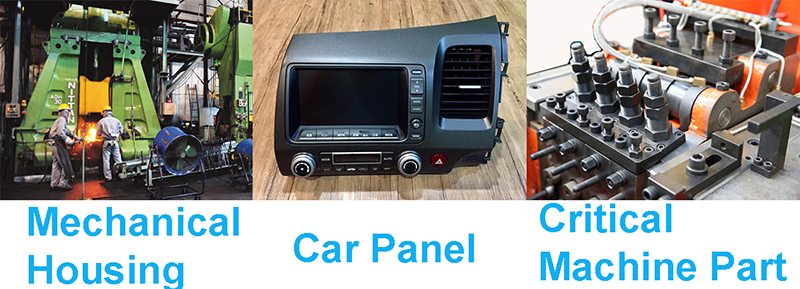
Fully Threaded Bolts application scenarios
Partially Threaded Bolts
Advantages:
Strong shear resistance: The smooth plain shank fits closely with the connection hole, evenly distributing shear forces, and is significantly stronger than the threaded section.
Precise positioning: The plain shank and hole use transitional or small-clearance fits to ensure accurate alignment of connected parts and prevent displacement.
High fatigue strength: More rational stress distribution, making them more durable under vibration and alternating loads.
Better preload control: The nut generates preload only after rotating on the plain shank and contacting the surface, allowing for more precise control.
Advantages:
Strong shear resistance: The smooth plain shank fits closely with the connection hole, evenly distributing shear forces, and is significantly stronger than the threaded section.
Precise positioning: The plain shank and hole use transitional or small-clearance fits to ensure accurate alignment of connected parts and prevent displacement.
High fatigue strength: More rational stress distribution, making them more durable under vibration and alternating loads.
Better preload control: The nut generates preload only after rotating on the plain shank and contacting the surface, allowing for more precise control.
Disadvantages:
Fixed design: Requires strict matching of the total thickness of connected parts to the length of the plain shank.
Slightly higher cost: More machining steps involved.
Fixed design: Requires strict matching of the total thickness of connected parts to the length of the plain shank.
Slightly higher cost: More machining steps involved.
Typical Applications:
Critical locations bearing shear forces: Bridge and steel structure joints, hinge points in heavy machinery.
Critical locations bearing shear forces: Bridge and steel structure joints, hinge points in heavy machinery.
Applications requiring precise positioning: Precision machine tools, molds, automotive suspension systems.
High-vibration environments: Engines, construction machinery, rail connections.
Hinge connections: The plain shank acts as a rotating axis, while the threaded section is secured with a nut.
Hinge connections: The plain shank acts as a rotating axis, while the threaded section is secured with a nut.

Partially Threaded Bolt application scenarios
IV. How to Choose? Keep These Three Key Points in Mind
1. Consider the Type of Force:
If the connection primarily experiences tensile forces (pulling parts apart) or requires general fastening, both types can be used, with fully threaded bolts being more common.
If there are significant shear forces (parts tending to slide relative to each other), partially threaded bolts must be used, with the plain shank bearing the load.
1. Consider the Type of Force:
If the connection primarily experiences tensile forces (pulling parts apart) or requires general fastening, both types can be used, with fully threaded bolts being more common.
If there are significant shear forces (parts tending to slide relative to each other), partially threaded bolts must be used, with the plain shank bearing the load.
2. Consider Connection Requirements:
If flexible adjustment of thickness is needed or for lifting applications, choose fully threaded bolts.
If precise alignment and positioning of parts are required, choose partially threaded bolts.
If flexible adjustment of thickness is needed or for lifting applications, choose fully threaded bolts.
If precise alignment and positioning of parts are required, choose partially threaded bolts.
3. Consider the Operating Environment:
For ordinary static environments, fully threaded bolts are economical and practical.
For dynamic environments with high vibration and fatigue loads, partially threaded bolts are safer and more reliable.
For ordinary static environments, fully threaded bolts are economical and practical.
For dynamic environments with high vibration and fatigue loads, partially threaded bolts are safer and more reliable.
Summary
In simple terms, fully threaded bolts are "all-rounders," excelling in flexible fastening, while partially threaded bolts are "specialists," indispensable in critical applications requiring shear resistance, precise positioning, and fatigue endurance.
In simple terms, fully threaded bolts are "all-rounders," excelling in flexible fastening, while partially threaded bolts are "specialists," indispensable in critical applications requiring shear resistance, precise positioning, and fatigue endurance.
The next time you choose a bolt, don’t just look at the diameter and length. Take an extra second to think: What forces primarily act on this connection? Do the parts need alignment? Is the operating environment highly vibrating? By clarifying these questions, you can easily make an informed choice between fully threaded and partially threaded bolts, ensuring every connection is both secure and safe.
Remember, selecting the correct fastener is one of the lowest-cost yet most critical steps in mechanical design and maintenance to ensure safety and performance.
Qishine is ideal choice for EPC companies and project contractors.
Website: www.qishine.com
Email: qishine@qishine.com
Tel: 0592-5225595
Website: www.qishine.com
Email: qishine@qishine.com
Tel: 0592-5225595
WhatsApp: +86 15960259563
How to Choose Between Coarse-Threaded and Fine-Threaded Bolts
How to Distinguish Between 304 and 316 Fasteners
Related Article

Insights from a Case Study on Exporting B8M Fasteners.Recently, during our final outgoing inspection of a batch of B8M stainless steel fasteners destined for Portugal, we discovered varying degrees of burrs on the edges of the bolt hex heads.
How to Efficiently Remove Burrs from Bolt Edges

Insulating Gasket Procurement Pitfalls: From "Price Traps" to "Supplier Selection"
What pitfalls should you watch out for when purchasing insulating gaskets

As a classic modified PTFE gasket material from Garlock, Gylon 3500 is widely used in petrochemical, chemical, and other industries for its excellent resistance to strong acids, solvents, and anti-creep properties.
How to Buy Genuine Gylon 3500 Insulating Gaskets at Competitive Prices in China

