
Thread Angle Showdown: 60° for Strength, 55° for Sealing
author: www.qishine.com
2026-05-05

> Summary: The 5° Difference
> - 60° Thread (Metric/UNF): The industrial workhorse. Optimized for fastening strength and low-cost mass production. Generates minimal radial force. Used in general bolts/screws. Non-sealing.
> - 60° Thread (Metric/UNF): The industrial workhorse. Optimized for fastening strength and low-cost mass production. Generates minimal radial force. Used in general bolts/screws. Non-sealing.
> - 55° Thread (Whitworth/BSP): The sealing specialist. Uses a shallower flank to allow plastic flow for metal-to-metal sealing in high-pressure pipes. Dominates petrochemical and marine systems.
> - Golden Rule: Never mix them. 60° is for solid joints; 55° is for leak-proof pipes. Choose based on your existing system standard (ISO, BSP, or NPT).
At first glance, a five-degree difference in thread angle may seem minor. In reality, it reflects two distinct engineering philosophies shaped by over a century of industrial evolution. The 60° angle prioritizes manufacturing efficiency and universal applicability, while the 55° angle focuses on sealing integrity and reliability. Understanding this difference is the first step toward correct engineering selection.
I. 60° Thread Angle: The Workhorse of Modern Industry
The 60° thread angle is the most widely used type today, tracing its origins to the mid‑19th century. American engineer William Sellers introduced the “Sellers thread” with a 60° angle in 1864. Around the same time, German and Swiss engineers independently adopted the 60° form. This geometry was eventually embraced by the International Organization for Standardization (ISO) and evolved into today’s ISO metric thread (designation M) and the American Unified thread (UNC/UNF).
The 60° thread angle is the most widely used type today, tracing its origins to the mid‑19th century. American engineer William Sellers introduced the “Sellers thread” with a 60° angle in 1864. Around the same time, German and Swiss engineers independently adopted the 60° form. This geometry was eventually embraced by the International Organization for Standardization (ISO) and evolved into today’s ISO metric thread (designation M) and the American Unified thread (UNC/UNF).
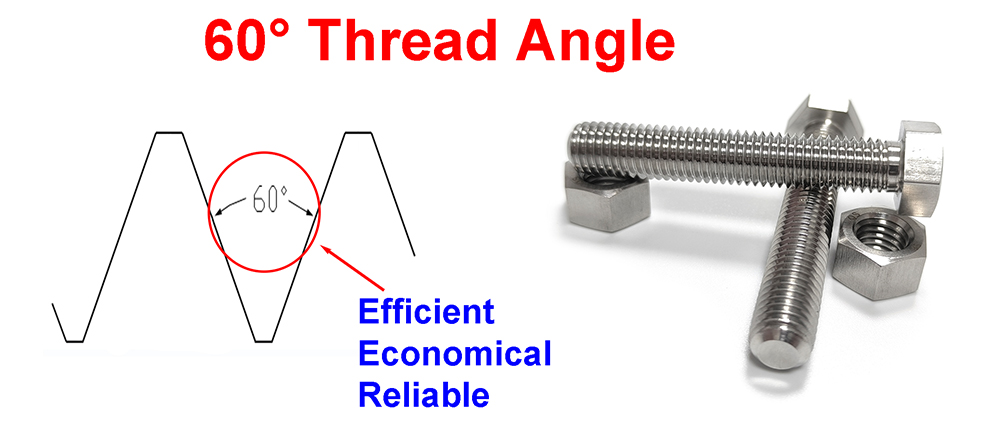
60° Thread Angle: Efficient, Economical, Reliable
The logic behind the 60° angle is rooted in manufacturing economy. Geometrically, the 60° triangular cross‑section yields a simple cutting tool shape that is easy to grind and inspect. The triangular form offers self‑centering ability. With clearances at the crest and root (metric threads require a defined root radius), stresses are better distributed and the risk of root cracks is reduced. Moreover, the 60° flank is relatively steep. Under axial load, it generates a smaller radial force component, so the nut is less likely to split. Assembly is more forgiving of lubrication, and the torque‑preload relationship is stable.
In short, the 60° angle is designed for general‑purpose fastening — efficient, economical, and proven reliable over a hundred years.
II. 55° Thread Angle: The Sealing Specialist
The 55° thread angle was Britain’s contribution to standardization. In 1841, Joseph Whitworth introduced the Whitworth thread standard (BSW/BSF), bringing order to the chaotic thread forms of the time. He chose 55°.
The 55° thread angle was Britain’s contribution to standardization. In 1841, Joseph Whitworth introduced the Whitworth thread standard (BSW/BSF), bringing order to the chaotic thread forms of the time. He chose 55°.

55° Thread Angle: Having both Connection and Sealing functions
Why 55°? Not arbitrarily. Practical experience showed that the gentler 55° flank, compared to 60°, distributes normal contact stress more evenly along the thread flank under the same axial load, offering a slight improvement in static strength. But the real value of the Whitworth thread emerged in its evolution into pipe threads. When a thread must both connect and seal, the 55° angle’s advantage becomes clear: the shallower flank allows the crest and root to undergo controlled plastic flow during tightening, creating a metal‑to‑metal close fit that is essential for high‑pressure fluid service.
Thus, the 55° angle was perfected from Whitworth threads (BSW) into British Standard Pipe threads (BSP series, designations G, R, etc.) — embodying a deliberate pursuit of precision fit and sealing integrity. (Note: American National Pipe Thread (NPT) uses a 60° derivative, but it relies on a tapered fit and sealants to achieve sealing, which is a different design philosophy from the dry‑seal concept of BSP.)
III. Key Differences and Applications
- Load & stress distribution: The 60° thread produces a smaller radial force component, offering good resistance to loosening. The 55° thread distributes stress more evenly, giving a marginal advantage in static strength — though this is not significant with modern high‑strength materials.
- Load & stress distribution: The 60° thread produces a smaller radial force component, offering good resistance to loosening. The 55° thread distributes stress more evenly, giving a marginal advantage in static strength — though this is not significant with modern high‑strength materials.
- Manufacturing & interchangeability: 60° is the global leader. Tools are widely available, costs are low, and interchangeability is excellent. 55° threads are rarely used for general fasteners today, but they remain indispensable in pipe connections.
- Sealing principle: 55° British Standard Pipe threads can achieve a seal by themselves (e.g., using a precision‑machined cylindrical internal thread with a tapered external thread). 60° NPT threads normally require sealant or filler. Consequently, 55° BSP threads still dominate in petrochemical, marine, plumbing, and similar piping systems.
IV. Selection Guide
For experienced fastener suppliers and engineers, follow these principles:
1. General mechanical fastening: Choose 60° metric (ISO) or Unified threads. This offers the lowest cost and the least risk.
For experienced fastener suppliers and engineers, follow these principles:
1. General mechanical fastening: Choose 60° metric (ISO) or Unified threads. This offers the lowest cost and the least risk.
2. Piping system connections: First, determine whether it is a pressure piping or a purely mechanical connection. For a fluid‑tight seal, follow the existing system standard: use 55° British G/R threads for BSP systems, or 60° NPT threads for American systems. China’s national standards prefer the British pipe thread system, but note that standard metric M threads are not inherently sealing — they require gaskets or O‑rings.
3. Repair and replacement: Never mix thread types. M, BSP, and NPT threads must not be forced together. Even where diameters are close, the 55°‑vs‑60° mismatch will permanently damage the threads, leading to leakage or fracture.
Warning: Forcing a 60° bolt into a 55° nut will result in less than 30% thread engagement.
FAQ
Q1: Can I screw a 55° thread into a 60° thread?
A: No. The flank angle mismatch causes point-loading at the crest, leading to immediate galling and permanent thread damage even if diameters match.
Q1: Can I screw a 55° thread into a 60° thread?
A: No. The flank angle mismatch causes point-loading at the crest, leading to immediate galling and permanent thread damage even if diameters match.
Q2: Which is better for hydraulic sealing, 55° or 60°?
A: 55° (BSP) is superior for dry-sealing. It allows controlled plastic deformation for metal-to-metal contact, while 60° NPT requires sealant or PTFE tape.
A: 55° (BSP) is superior for dry-sealing. It allows controlled plastic deformation for metal-to-metal contact, while 60° NPT requires sealant or PTFE tape.
Q3: Why is 60° the global standard for bolts?
A: Because it produces lower radial force, reduces nut-splitting risk, and features simple tooling for mass production at low cost.
A: Because it produces lower radial force, reduces nut-splitting risk, and features simple tooling for mass production at low cost.
Q4: Is Whitworth the same as BSP?
A: Yes, Whitworth is the parent standard (55°). BSP (G/R threads) is the direct pipe-thread evolution of this 55° geometry.
A: Yes, Whitworth is the parent standard (55°). BSP (G/R threads) is the direct pipe-thread evolution of this 55° geometry.
Qishine is ideal choice for EPC companies and project contractors.
Website: www.qishine.com
Email: qishine@qishine.com
Tel: 0592-5225595
WhatsApp: +86 15960259563
+86 15985833169
Website: www.qishine.com
Email: qishine@qishine.com
Tel: 0592-5225595
WhatsApp: +86 15960259563
+86 15985833169
Stainless Steel vs Carbon Steel Pipes
Do You Know the Names of All the Parts of Heavy Hex Nuts
Related Article

Insights from a Case Study on Exporting B8M Fasteners.Recently, during our final outgoing inspection of a batch of B8M stainless steel fasteners destined for Portugal, we discovered varying degrees of burrs on the edges of the bolt hex heads.
How to Efficiently Remove Burrs from Bolt Edges

Insulating Gasket Procurement Pitfalls: From "Price Traps" to "Supplier Selection"
What pitfalls should you watch out for when purchasing insulating gaskets

As a classic modified PTFE gasket material from Garlock, Gylon 3500 is widely used in petrochemical, chemical, and other industries for its excellent resistance to strong acids, solvents, and anti-creep properties.
How to Buy Genuine Gylon 3500 Insulating Gaskets at Competitive Prices in China

