Qishine Industry /News /News /What do the green and yellow colors of the metal spiral-wound gasket ring represent /
What do the green and yellow colors of the metal spiral-wound gasket ring represent
author: www.qishine.com
2026-03-02
According to internationally and domestically recognized gasket color identification standards, the color on the outer ring (also known as the centering ring or locating ring) of a spiral-wound gasket is primarily used to quickly identify the material of the gasket's internal metal winding (usually the metal strip).
In simple terms:
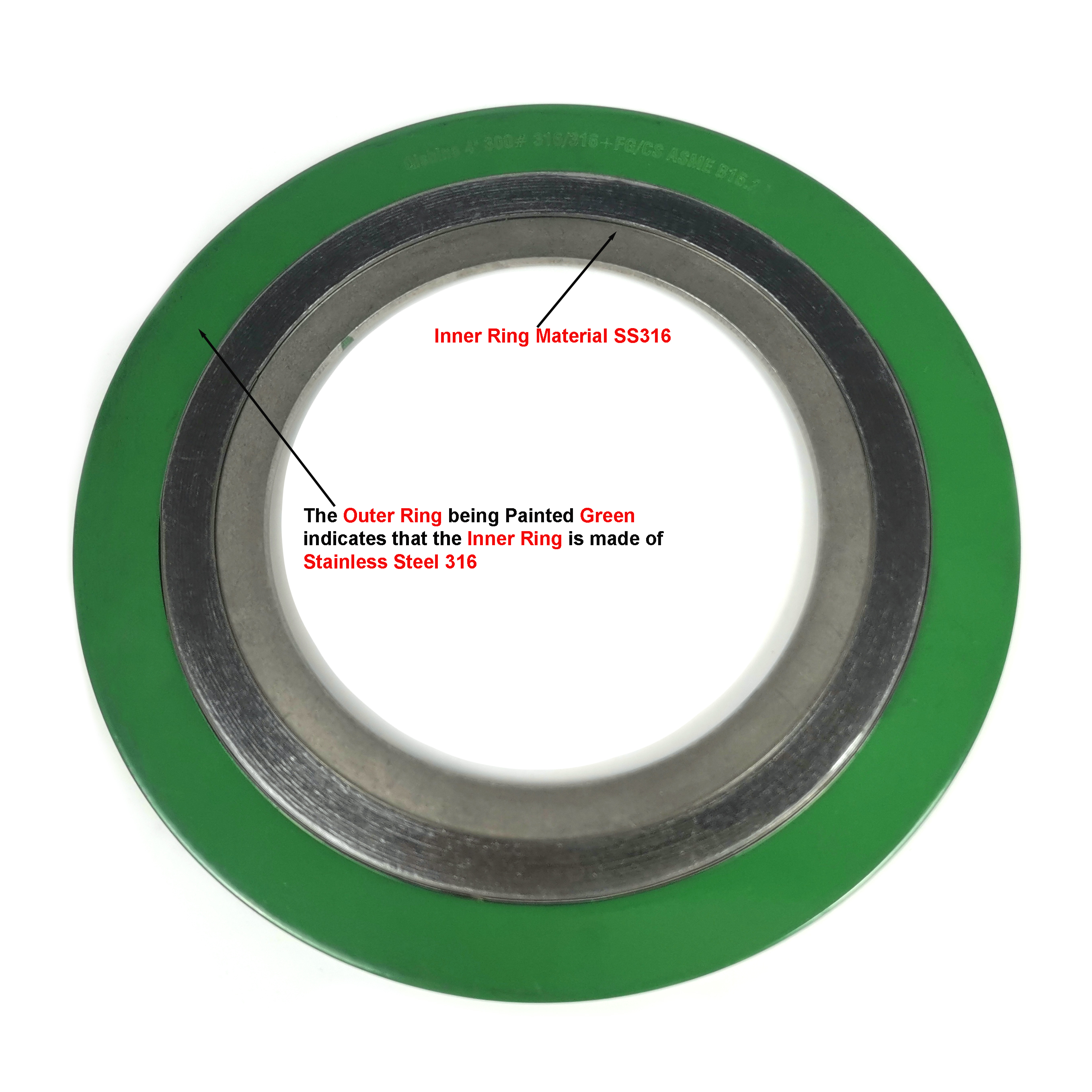
A green outer ring indicates that the metal winding material of the spiral-wound gasket is SS 316 / 316L stainless steel (austenitic stainless steel).
A yellow outer ring indicates that the metal winding material is SS 304 / 304L stainless steel.

The Outer ring being Painted Yellow indicates that the Inner ring is made of SS304

The Outer ring being Painted Green indicates that the Inner ring is made of SS316
1. Why are colors used for differentiation?
In industrial production, especially in high-pressure and high-temperature pipeline flange connections in sectors such as petrochemicals, power, and chemical industries, gaskets of different materials and performance characteristics are required to handle various media (e.g., corrosive chemicals) and working conditions (temperature, pressure). To prevent the use of incorrect materials during installation, which could lead to safety hazards (such as corrosion leaks), international standards (e.g., ASME, ISO) and domestic standards (e.g., GB/T) have adopted an intuitive color-coding system. This system involves spraying color codes on the gasket's outer ring or V-shaped metal strip, facilitating quick on-site identification and quality inspection.
2. Specific materials and applications represented by green and yellow
Green outer ring (representing SS 316/316L):
Material characteristics: 316 stainless steel contains 2-3% molybdenum (Mo), which gives it better resistance to chloride corrosion and pitting compared to 304 stainless steel. It also offers higher temperature resistance.
Typical applications: Used in pipeline flanges handling seawater, brine, chloride solutions, strongly oxidizing acids (e.g., nitric acid, phosphoric acid), or high-temperature corrosive media. It is a very common material in chemical and marine environments.
Green outer ring (representing SS 316/316L):
Material characteristics: 316 stainless steel contains 2-3% molybdenum (Mo), which gives it better resistance to chloride corrosion and pitting compared to 304 stainless steel. It also offers higher temperature resistance.
Typical applications: Used in pipeline flanges handling seawater, brine, chloride solutions, strongly oxidizing acids (e.g., nitric acid, phosphoric acid), or high-temperature corrosive media. It is a very common material in chemical and marine environments.
Yellow outer ring (representing SS 304/304L):
Material characteristics: 304 stainless steel is the most common and versatile austenitic stainless steel, offering good corrosion resistance and formability. However, its resistance to chloride corrosion is inferior to that of 316.
Typical applications: Widely used for media with generally low corrosivity, such as hot water, steam, non-oxidizing acids (e.g., dilute sulfuric acid), petroleum products, and natural gas. Due to its lower cost compared to 316, it is often the preferred choice when conditions permit.
Qishine is ideal choice for EPC companies and project contractors.
Website: www.qishine.com
Email: qishine@qishine.com
Tel: 0592-5225595
Email: qishine@qishine.com
Tel: 0592-5225595
WhatsApp: +86 15960259563
+86 15985833169
3. Reasons for color selection (symbolic meaning of green and yellow)
The choice of colors is not arbitrary but follows a certain logic and symbolic meaning to aid memory:
Green: Often associated with "safety" and "go." The 316 material offers higher performance and better corrosion resistance, ensuring safety in more demanding environments (especially those containing chloride ions). Therefore, green is used to identify this "safer" or "upgraded" option.
The choice of colors is not arbitrary but follows a certain logic and symbolic meaning to aid memory:
Green: Often associated with "safety" and "go." The 316 material offers higher performance and better corrosion resistance, ensuring safety in more demanding environments (especially those containing chloride ions). Therefore, green is used to identify this "safer" or "upgraded" option.
Yellow: An eye-catching) color for warning or caution. The 304 material may be susceptible to stress corrosion cracking in chloride-containing environments. Using yellow serves as a reminder for engineers and installers to pay attention to whether the medium is suitable for its application range, preventing misuse in chloride-containing environments.
4. Important Notes
This color code only represents the metal winding material: The sealing performance of a spiral-wound gasket is determined by both the metal winding and the filler material (usually non-metallic materials such as graphite, asbestos, PTFE, etc.). The color does not indicate the filler material.
Other colors may exist: Besides green and yellow, other colors represent different metal materials, for example:
- Blue: Represents SS 321 stainless steel.
- Aluminum (silver): Represents carbon steel.
- Red: Represents Hastelloy B-2.
- Purple: Represents Monel 400.
- Black: May represent Inconel 600/625, etc.
This color code only represents the metal winding material: The sealing performance of a spiral-wound gasket is determined by both the metal winding and the filler material (usually non-metallic materials such as graphite, asbestos, PTFE, etc.). The color does not indicate the filler material.
Other colors may exist: Besides green and yellow, other colors represent different metal materials, for example:
- Blue: Represents SS 321 stainless steel.
- Aluminum (silver): Represents carbon steel.
- Red: Represents Hastelloy B-2.
- Purple: Represents Monel 400.
- Black: May represent Inconel 600/625, etc.
Always refer to standard specifications or manufacturer markings: Although the color coding is highly standardized, in critical applications, it is essential to double-check the gasket's label, material report, and engineering design documents to confirm the material.
Materials
| Ring & Strip Materials | ||||||
| Materials | Minimum | Maximum | Abberviation |
Guide Ring Color Code
|
||
| F | C | F | C | |||
| SS304 | -320 | -195 | 1400 | 760 | 304 | Yellow |
| SS316L | -150 | -100 | 1400 | 760 | 316L | Green |
| SS347L | -150 | -100 | 1400 | 760 | 347L | Maroon |
| SS321 | -320 | -195 | 1400 | 760 | 321 | Turquoise |
| SS347 | -320 | -195 | 1700 | 925 | 347 | Blue |
| Carbon Steel | -40 | -40 | 1000 | 540 | CRS | Silver |
| Alloy 20 | -300 | -185 | 1400 | 760 | A-20 | Black |
| Hastelloy B3 | -300 | -185 | 2000 | 1090 | HAST B | Brown |
| Hastelloy C276 | -300 | -185 | 2000 | 1090 | HAST C | Beige |
| Incoloy 800 | -150 | -100 | 1600 | 870 | IN 800 | White |
| Incoloy 825 | -150 | -100 | 1600 | 870 | IN 825 | White |
Summary
| Outer Ring Color | Represented Metal Winding Material | Main Characteristics | Color Symbolic Meaning |
| Green | SS 316 / 316L | Strong chloride corrosion resistance, excellent overall performance | Safety, upgrade, suitable for demanding environments |
| Yellow | SS 304 / 304L | General-purpose stainless steel, resistant to general corrosion | Caution, reminder to avoid use in chloride-containing environments |
Therefore, when you see these two types of gaskets on-site, you can immediately tell by the outer ring color: the green-ringed gasket has metal material that is more corrosion-resistant than the yellow one and is typically used in more severe operating conditions. This is a very practical and important visual quality management tool in the engineering field.

How do we determine the filler material by the color of the color band in spiral wound gasket
What is the difference between Type C and Type D metal spiral wound gaskets
Related Article
Insights from a Case Study on Exporting B8M Fasteners.Recently, during our final outgoing inspection of a batch of B8M stainless steel fasteners destined for Portugal, we discovered varying degrees of burrs on the edges of the bolt hex heads.
How to Efficiently Remove Burrs from Bolt Edges
Insulating Gasket Procurement Pitfalls: From "Price Traps" to "Supplier Selection"
What pitfalls should you watch out for when purchasing insulating gaskets
As a classic modified PTFE gasket material from Garlock, Gylon 3500 is widely used in petrochemical, chemical, and other industries for its excellent resistance to strong acids, solvents, and anti-creep properties.
How to Buy Genuine Gylon 3500 Insulating Gaskets at Competitive Prices in China
