
What are the common Types of Thread
author: www.qishine.com
2026-03-05

In mechanical engineering applications, threaded connections and drives are among the most common and critical components. The thread profile—the axial cross-sectional shape of the thread—determines its mechanical properties, friction characteristics, and manufacturing complexity. Selecting the appropriate thread profile is fundamental to ensuring equipment reliability, longevity, and cost-effectiveness.
Here is an analysis of four common standard thread profiles:
1. V-Thread (Triangular Thread / Unified Thread)
This is the most widely used thread profile, primarily intended for fastening connections.
1. V-Thread (Triangular Thread / Unified Thread)
This is the most widely used thread profile, primarily intended for fastening connections.
Profile Characteristics: The cross-section is triangular. Depending on the standardization system, the thread angle mainly comes in two types: the internationally used Metric thread (60-degree thread angle) and the Whitworth thread (55-degree thread angle), primarily used in inch-based countries.
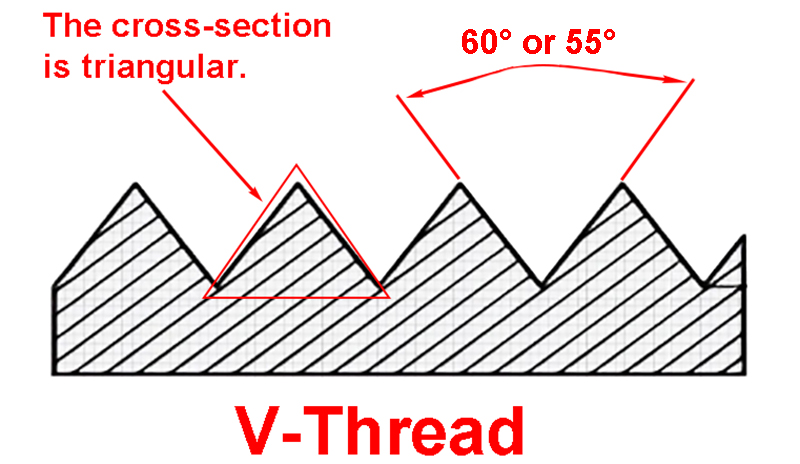
V-Thread: The cross-section is triangular
Engineering Characteristics:
Good Self-Locking: The large thread angle creates significant wedging action and friction, providing good anti-loosening properties in vibration-prone environments (although additional locking measures are often still required).
Good Self-Locking: The large thread angle creates significant wedging action and friction, providing good anti-loosening properties in vibration-prone environments (although additional locking measures are often still required).
High Root Strength: The 60° or 55° angle results in a relatively thick thread root (the area of stress concentration), ensuring reliable connection strength.
Mature Manufacturing: Due to its high volume of use, manufacturing processes (such as rolling, thread forming, and cutting) are highly mature and cost-effective. It is suitable for a wide range of sizes.
Application Scenarios: Almost all standard fasteners, such as bolts, nuts, and screws.
Application Scenarios: Almost all standard fasteners, such as bolts, nuts, and screws.
2. Square Thread
This is one of the earliest forms of threads used for power transmission, often regarded as the "originator of power transmission."
This is one of the earliest forms of threads used for power transmission, often regarded as the "originator of power transmission."
Profile Characteristics: The flanks are perpendicular straight sides, resulting in a square or rectangular cross-section. The tooth thickness equals half the pitch.
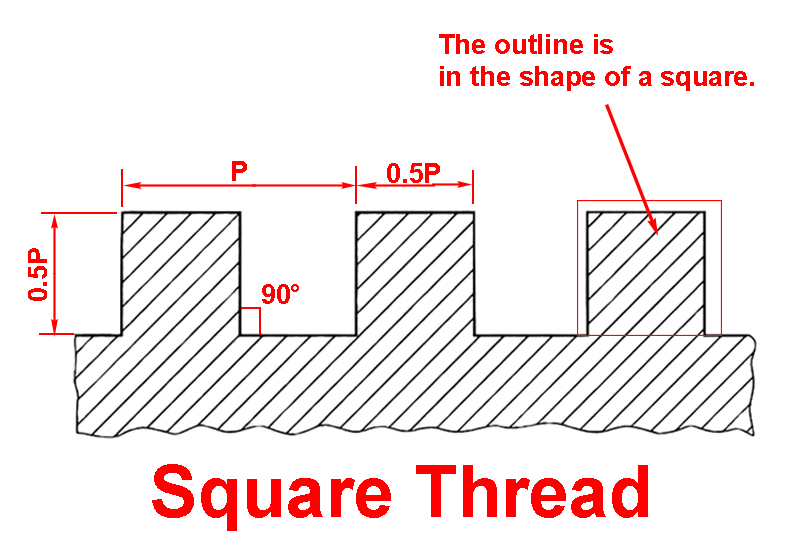
Square Thread: the outline is in the shape of a square
Engineering Characteristics:
Extremely High Efficiency: Due to the nearly vertical flanks (typically 0 degrees), there is minimal radial force component on the nut, with most force converted to axial thrust. Consequently, square threads offer the highest mechanical efficiency among all thread types.
Extremely High Efficiency: Due to the nearly vertical flanks (typically 0 degrees), there is minimal radial force component on the nut, with most force converted to axial thrust. Consequently, square threads offer the highest mechanical efficiency among all thread types.
High Load Capacity: The robust tooth root provides substantial shear strength, making it suitable for heavy loads.
Manufacturing and Maintenance Challenges: Manufacturing is more complex. It is difficult to produce with standard dies or taps and often requires single-point machining on a lathe using a form tool. Additionally, wear-induced play cannot be eliminated through axial nut adjustment, potentially reducing transmission precision over time and leading to impact.
Application Scenarios: Due to its high efficiency and load capacity, it is often used in applications requiring rotary-to-linear motion with high efficiency, such as vises, jacks, and smaller presses.
Qishine is ideal choice for EPC companies and project contractors.
Website: www.qishine.com
Email: qishine@qishine.com
Tel: 0592-5225595
WhatsApp: +86 15960259563
+86 15985833169
Email: qishine@qishine.com
Tel: 0592-5225595
WhatsApp: +86 15960259563
+86 15985833169
3. Trapezoidal Thread
As the "workhorse" of power transmission threads, it effectively balances strength, manufacturability, and efficiency.
As the "workhorse" of power transmission threads, it effectively balances strength, manufacturability, and efficiency.
Profile Characteristics: The profile is an isosceles trapezoid. The included angle between the flanks is typically 30° for Metric trapezoidal threads (designation Tr) and 29° for the inch-based Acme thread. The top and bottom of the teeth are flat.
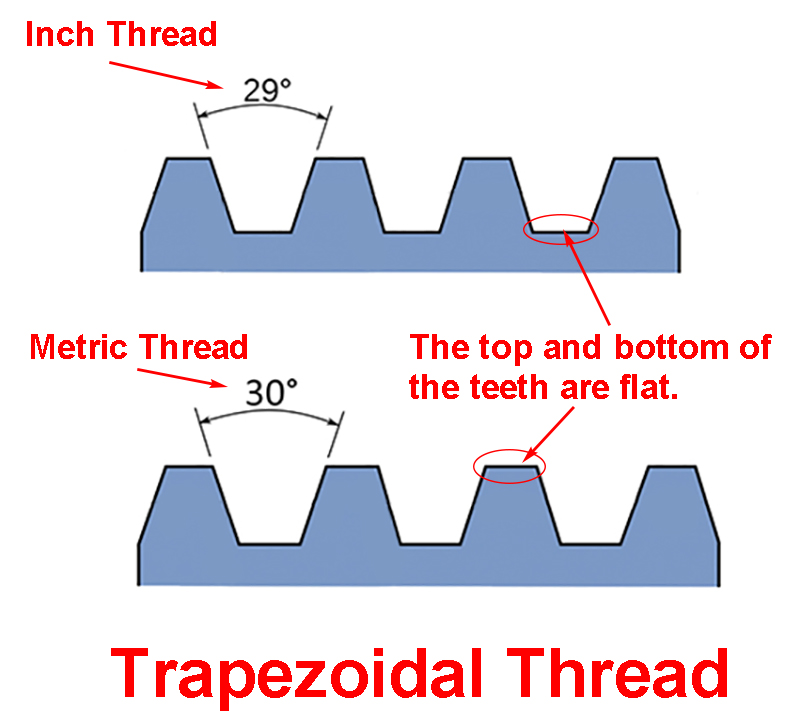
Trapezoidal Thread: the top and bottom of the teeth are flat.
Engineering Characteristics:
Balancing Manufacturability and Wear Resistance: Compared to square threads, the slight flank slope (15° from vertical) allows the use of split nuts and enables compensation for wear-induced play through adjustments—a significant improvement over square threads.
Balancing Manufacturability and Wear Resistance: Compared to square threads, the slight flank slope (15° from vertical) allows the use of split nuts and enables compensation for wear-induced play through adjustments—a significant improvement over square threads.
Heat Dissipation and Lubrication: The larger surface area not only enhances load capacity but also aids heat dissipation. The flat crests and roots can retain lubricant, improving lubrication and reducing the friction coefficient (slightly higher than square threads, but significantly lower than V-threads).
High Standardization: Trapezoidal threads are internationally standardized for power transmission, with established series sizes and tolerance classes, facilitating design and procurement.
Application Scenarios: Widely used in machine tool leadscrews (e.g., lathe feeds), hoists, lifting platforms, gate valve stems, and other power transmission applications requiring bi-directional loading and good positioning accuracy.
4. Sawtooth Thread
This is a specialized profile optimized for applications with high stress in one specific direction. It is sometimes mistaken for an asymmetrical trapezoidal thread.
This is a specialized profile optimized for applications with high stress in one specific direction. It is sometimes mistaken for an asymmetrical trapezoidal thread.
Profile Characteristics: It combines features of square and V-threads, resulting in an asymmetrical trapezoid. Typically, the load-bearing flank (subjected to the main force) is nearly vertical (e.g., 3° to 7°), while the non-load-bearing flank has a steeper angle (e.g., 30° to 45°).
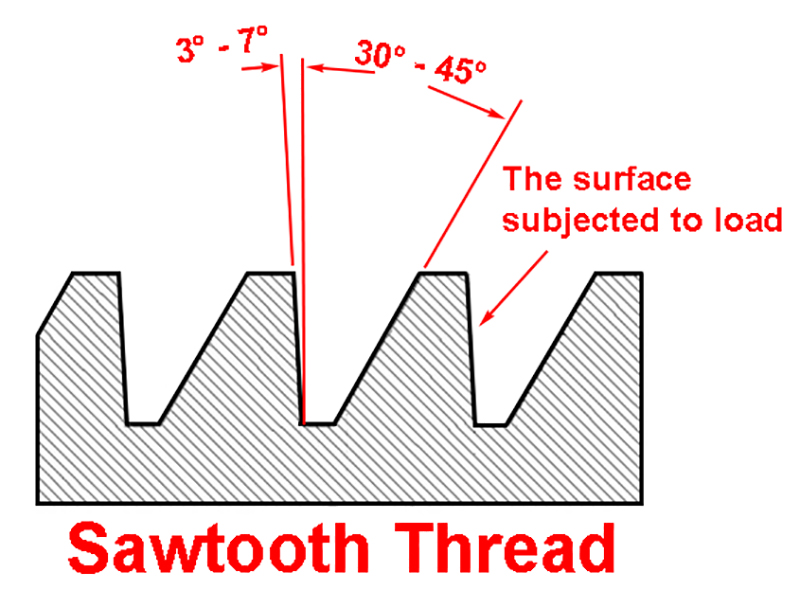
Sawtooth Thread: the surface subjected to load
Engineering Characteristics:
Champion of Unidirectional Loads: This unique design provides both the high efficiency of a square thread (on the near-vertical load flank) and the root strength of a V-thread. The near-vertical load flank ensures efficiency and minimal radial pressure, while the steep angle on the non-load-bearing flank reinforces the tooth root, enabling it to withstand extremely high unidirectional axial forces.
Champion of Unidirectional Loads: This unique design provides both the high efficiency of a square thread (on the near-vertical load flank) and the root strength of a V-thread. The near-vertical load flank ensures efficiency and minimal radial pressure, while the steep angle on the non-load-bearing flank reinforces the tooth root, enabling it to withstand extremely high unidirectional axial forces.
Optimized Stress Distribution: Compared to square threads, buttress threads often incorporate larger root radii or supportive angles, effectively reducing stress concentration.
Irreplaceable in Specific Industries: It is indispensable for certain heavy-duty applications. Manufacturing complexity is relative; in high-volume production (e.g., thread rolling), costs can be manageable.
Application Scenarios: Primarily used where extreme pressure is applied in one direction. Classic examples include heavy-duty jacks, large presses, screw-down mechanisms in rolling mills, and the breech mechanisms of some firearms.
Application Scenarios: Primarily used where extreme pressure is applied in one direction. Classic examples include heavy-duty jacks, large presses, screw-down mechanisms in rolling mills, and the breech mechanisms of some firearms.
Summary Table
| Thread Type | Core Advantage | Core Disadvantage | Primary Application |
| V-Thread | Good self-locking, excellent manufacturability, low cost | Lowest mechanical efficiency | General Purpose Fastening |
| Square Thread | Highest efficiency, high load capacity | Difficult to manufacture, cannot compensate for wear | Light-Duty, High-Efficiency Manual Drives (e.g., Vises) |
| Sawtooth Thread | Extremely high unidirectional load capacity, good efficiency | Not suitable for reverse loading (uni-directional), slightly more complex to manufacture | Heavy-Duty Unidirectional Power Transmission (e.g., Jacks, Presses) |
| Trapezoidal Thread | Excellent balance of strength/efficiency/manufacturability, wear compensation possible | Lower efficiency than square threads | General Power Transmission Drives (e.g., Machine tool leadscrews, Valves) |
Recommendation:
When selecting a thread profile, considerations should extend beyond just strength. Be sure to evaluate:
1. Load Characteristics: Is the load bidirectional or unidirectional? Is vibration present?
2. Motion Requirements: Is it for static fastening or dynamic motion? How critical is efficiency?
3. Manufacturing and Maintenance: Is interchangeability with common parts required? How will wear be adjusted for over the product's life?
When selecting a thread profile, considerations should extend beyond just strength. Be sure to evaluate:
1. Load Characteristics: Is the load bidirectional or unidirectional? Is vibration present?
2. Motion Requirements: Is it for static fastening or dynamic motion? How critical is efficiency?
3. Manufacturing and Maintenance: Is interchangeability with common parts required? How will wear be adjusted for over the product's life?
Website: www.qishine.com
Email: qishine@qishine.com
Tel: 0592-5225595
WhatsApp: +86 15960259563
+86 15985833169
Email: qishine@qishine.com
Tel: 0592-5225595
WhatsApp: +86 15960259563
+86 15985833169
Is it necessary to coat Stainless Steel Fasteners with Aluminum
3 Common Types of Metal Steel Tubes Pipes
Related Article

Insights from a Case Study on Exporting B8M Fasteners.Recently, during our final outgoing inspection of a batch of B8M stainless steel fasteners destined for Portugal, we discovered varying degrees of burrs on the edges of the bolt hex heads.
How to Efficiently Remove Burrs from Bolt Edges

Insulating Gasket Procurement Pitfalls: From "Price Traps" to "Supplier Selection"
What pitfalls should you watch out for when purchasing insulating gaskets

As a classic modified PTFE gasket material from Garlock, Gylon 3500 is widely used in petrochemical, chemical, and other industries for its excellent resistance to strong acids, solvents, and anti-creep properties.
How to Buy Genuine Gylon 3500 Insulating Gaskets at Competitive Prices in China

