
V-Basic Ring vs W-Basic Ring for Spiral Wound Gaskets
author: www.qishine.com
2026-02-28

Introduction: A Century of Technical Heritage
The concept of the spiral wound gasket, introduced by Flexitallic in 1912, revolutionized the field of industrial sealing. This innovative design stemmed from the urgent need for reliable sealing in American refineries facing increasingly harsh high-temperature and high-pressure environments. Over a century later, spiral wound gaskets remain an indispensable sealing solution for critical industries such as petrochemicals, power generation, and nuclear energy.
The concept of the spiral wound gasket, introduced by Flexitallic in 1912, revolutionized the field of industrial sealing. This innovative design stemmed from the urgent need for reliable sealing in American refineries facing increasingly harsh high-temperature and high-pressure environments. Over a century later, spiral wound gaskets remain an indispensable sealing solution for critical industries such as petrochemicals, power generation, and nuclear energy.
The basic ring, serving as the "heart" of a spiral wound gasket, directly determines its sealing performance and service life. Today, as a seasoned supplier in the spiral wound gasket field, QISHINE will provide an in-depth analysis of the two mainstream basic ring structures—V-type and W-type—to assist you in making the optimal choice for your practical applications.
1. The Basic Ring: The Engineering Core of Spiral Wound Gaskets
The basic ring of a spiral wound gasket is not a single entity but a precision-engineered multilayer composite structure.
The basic ring of a spiral wound gasket is not a single entity but a precision-engineered multilayer composite structure.
Core Components:
Metal Winding Strip: Typically made from alloys like 304/316 stainless steel, titanium, Inconel, providing mechanical strength and temperature adaptability.
Metal Winding Strip: Typically made from alloys like 304/316 stainless steel, titanium, Inconel, providing mechanical strength and temperature adaptability.
Filler Material: Non-metallic materials like graphite, PTFE, ceramic fiber, providing elasticity and sealability.
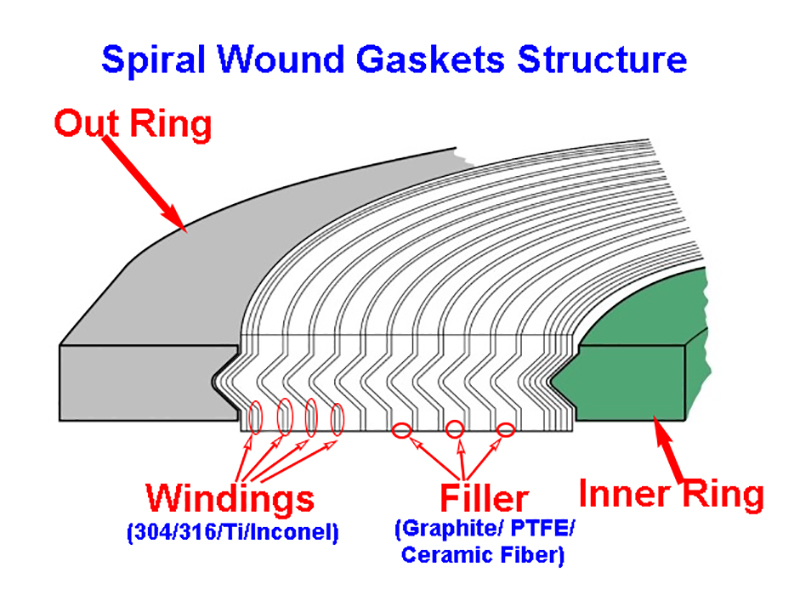
Spiral Wound Gaskets structure
Precision Winding Process: Alternately winding the metal strip and filler material into a specific cross-sectional shape.
Inner/Outer Ring Design (Optional): Carbon steel or stainless steel rings provide mechanical positioning and anti-blowout protection.
This "metal-nonmetal-metal" layered structure creates a unique sealing mechanism: the metal strip provides mechanical strength and resilience, while the filler material ensures tight conformity to micro-scale sealing surfaces.
2. V-Basic Ring Spiral Wound Gasket: The Enduring Appeal of Classic Design
Structural Characteristics:
The cross-section of the V-basic ring features a distinct "V" shaped profile. The metal strip is wound at a specific angle, forming a continuous series of peaks and valleys.
Structural Characteristics:
The cross-section of the V-basic ring features a distinct "V" shaped profile. The metal strip is wound at a specific angle, forming a continuous series of peaks and valleys.

Force diagram of V-shaped wrapping band
Technical Advantages:
1. Excellent Resilience: The V-shaped geometry effectively stores elastic potential energy when compressed, maintaining stable sealing force during temperature and pressure fluctuations.
1. Excellent Resilience: The V-shaped geometry effectively stores elastic potential energy when compressed, maintaining stable sealing force during temperature and pressure fluctuations.
2. Superior Compression Adaptability: Easy to compress during installation, capable of filling microscopic irregularities on flange faces.
3. Favorable Stress Distribution: The V-angle optimizes the stress transfer path, reducing localized stress concentration.
4. Proven & Reliable Performance: A century of application history validates its stability and predictability.
Suitable Environments:
Medium to High-Pressure Service: Typical application range from PN25-PN100 (Class 150-600).
Medium to High-Pressure Service: Typical application range from PN25-PN100 (Class 150-600).
Wide Temperature Range: -200°C to +800°C (dependent on filler material).
Diverse Media: Steam, oil & gas, chemical media, etc.
Diverse Media: Steam, oil & gas, chemical media, etc.
Flange Types: Suitable for various flanges like Raised Face (RF), Male-Female (MFM).
Recommendation: For approximately 80% of sealing points in conventional refinery and chemical plants, the V-basic ring is a safe and economical choice.
3. W-Basic Ring: The High-Performance Engineering Solution
Structural Characteristics:
The W-basic ring employs a more complex "double-V" or "W" shaped cross-sectional design, essentially combining two V-structures, resulting in a denser arrangement of peaks and valleys.
The W-basic ring employs a more complex "double-V" or "W" shaped cross-sectional design, essentially combining two V-structures, resulting in a denser arrangement of peaks and valleys.

W-Shaped Spiral Wound Gasket: Equivalent to the combination of two V-shaped structures, resulting in a more dense arrangement of peaks and valleys.
Technical Advantages:
1. Higher Sealing Specific Pressure: More peak contact points per unit area provide stronger initial sealing.
1. Higher Sealing Specific Pressure: More peak contact points per unit area provide stronger initial sealing.
2. Exceptional Anti-Relaxation Properties: The multiple resilient structures offer greater resistance to creep and stress relaxation.
3. Extreme Condition Adaptability: Maintains more stable sealing under severe thermal cycling and pressure fluctuations.
4. Longer Service Life: Redundant structural design extends maintenance cycles.
Suitable Environments:
Ultra-High Pressure Service: Critical applications above PN160 (Class 900-2500).
Extreme Thermal Cycling: Units with frequent start-ups/shutdowns or severe temperature swings.
Ultra-High Pressure Service: Critical applications above PN160 (Class 900-2500).
Extreme Thermal Cycling: Units with frequent start-ups/shutdowns or severe temperature swings.
Hazardous Media Sealing: Applications requiring zero leakage for toxic, flammable, or explosive media.
Critical Equipment: Reactors, high-temperature heat exchangers, main steam systems, etc.
Expert Advice: In high-end sectors like nuclear power, deep-sea oil & gas, and supercritical power generation, the W-basic ring is becoming the standard configuration.
4. Technical Comparison: V-Type vs. W-Type Head-to-Head
| Comparison Dimension | V-Basic Ring | W-Basic Ring |
| Cross-section Density | Medium, typically 5-7 peaks/inch | High, 8-12 peaks/inch |
| Initial Sealing Pressure | 25-40 MPa | 40-70 MPa |
| Recovery Rate | 15-25% | 10-20% |
| Anti-Relaxation | Good | Excellent |
| Required Compression Rate | 25-35% | 20-30% |
| Manufacturing Cost | 15-25% lower | Higher |
| Suitable Pressure | Medium to High Pressure | Ultra-High Pressure |
| Thermal Cycling Suitability | Good | Excellent |
Key Findings:
The W-type shows clear performance advantages under extreme conditions, but costs 20-40% more.
The W-type shows clear performance advantages under extreme conditions, but costs 20-40% more.
The V-type offers the best cost-performance for standard conditions.
The choice between them is not about "better or worse," but about "suitability."
The choice between them is not about "better or worse," but about "suitability."
Qishine is ideal choice for EPC companies and project contractors.
Website: www.qishine.com
Email: qishine@qishine.com
Tel: 0592-5225595
Email: qishine@qishine.com
Tel: 0592-5225595
WhatsApp: +86 15960259563
5. Conclusion: How to Make an Informed Choice
Based on our detailed technical analysis, we summarize the following selection guide for you:
Based on our detailed technical analysis, we summarize the following selection guide for you:
Choose the V-Basic Ring:
Your service conditions are below PN100 (Class 600).
Temperature and pressure are relatively stable.
Budget constraints are stricter.
Good installation tolerance is required.
Your service conditions are below PN100 (Class 600).
Temperature and pressure are relatively stable.
Budget constraints are stricter.
Good installation tolerance is required.
Choose the W-Basic Ring:
Facing high pressure above PN160 (Class 900).
Service involves severe thermal cycling.
Facing high pressure above PN160 (Class 900).
Service involves severe thermal cycling.
The media is highly hazardous.
Equipment maintenance costs far exceed gasket costs.
Equipment maintenance costs far exceed gasket costs.
Universal Principle: Never select a gasket type based on price alone. The cost of a single leak incident could exceed the total cost of all gaskets over the entire lifecycle of the equipment.
6. Interactive Zone: Enhancing Your Equipment Safety
"Small gasket, significant responsibility"—this is the most profound lesson from QISHINE's 15 years of industry experience. A gasket worth tens of dollars may be protecting equipment worth millions, or even the safety of an entire plant.
"Small gasket, significant responsibility"—this is the most profound lesson from QISHINE's 15 years of industry experience. A gasket worth tens of dollars may be protecting equipment worth millions, or even the safety of an entire plant.
Want to learn more professional sealing knowledge?
Follow our technical column for weekly industry insights.
Contact us for free professional technical support.
Follow our technical column for weekly industry insights.
Contact us for free professional technical support.
What specific sealing challenges are you facing? Feel free to email us your service conditions (temperature, pressure, media), and QISHINE will provide personalized selection advice.
Remember: The correct sealing choice is not a cost, but an investment—an investment in safety, in continuous production, and in peace of mind.
How should we tighten flange bolts
How to Determine the Number of Bolt Holes in a Flange
Related Article

Insights from a Case Study on Exporting B8M Fasteners.Recently, during our final outgoing inspection of a batch of B8M stainless steel fasteners destined for Portugal, we discovered varying degrees of burrs on the edges of the bolt hex heads.
How to Efficiently Remove Burrs from Bolt Edges

Insulating Gasket Procurement Pitfalls: From "Price Traps" to "Supplier Selection"
What pitfalls should you watch out for when purchasing insulating gaskets

As a classic modified PTFE gasket material from Garlock, Gylon 3500 is widely used in petrochemical, chemical, and other industries for its excellent resistance to strong acids, solvents, and anti-creep properties.
How to Buy Genuine Gylon 3500 Insulating Gaskets at Competitive Prices in China

