
Insulating Gasket Kit Components Breakdown What Every Procurement Engineer Must Check Before Ordering
author: www.qishine.com
2026-03-04

1-Minute Read
An insulating gasket kit is not just a gasket. It’s a five-piece system: the main insulating gasket, insulating washers, full-length sleeves, plated steel washers, and studs/nuts. Each part stops electrical current from passing through flange bolts – which prevents galvanic corrosion and protects cathodic protection systems. When buying, don't mix brands or guess bolt lengths. Match materials to your fluid temperature, pressure, and flange standard (ASME, DIN, JIS). Always ask for insulation resistance test reports. A complete, correctly specified kit costs more upfront but saves years of pipeline repairs.
Detailed Explanation of Insulating Gasket Kit Components: An Essential Guide for Procurement Personnel
I. Overview: What is an Insulating Gasket Kit?
An insulating gasket kit is a specialized system designed for pipeline flange connections, primarily used to prevent electrochemical corrosion (stray current corrosion), provide electrical isolation, and control current conduction. It is widely applied in pipeline systems within the petroleum, natural gas, chemical, offshore platform, and power industries, especially at junctions of different metallic materials or pipelines requiring cathodic protection.
I. Overview: What is an Insulating Gasket Kit?
An insulating gasket kit is a specialized system designed for pipeline flange connections, primarily used to prevent electrochemical corrosion (stray current corrosion), provide electrical isolation, and control current conduction. It is widely applied in pipeline systems within the petroleum, natural gas, chemical, offshore platform, and power industries, especially at junctions of different metallic materials or pipelines requiring cathodic protection.

Insulation Gasket Kit Installation Instruction
A complete insulating gasket kit ensures reliable electrical insulation while maintaining the mechanical fastening strength of the flange connection. This significantly extends the service life of the pipeline system and reduces maintenance costs.
II. Detailed Explanation of Core Components in an Insulating Gasket Kit
1. Insulating Flange Gasket
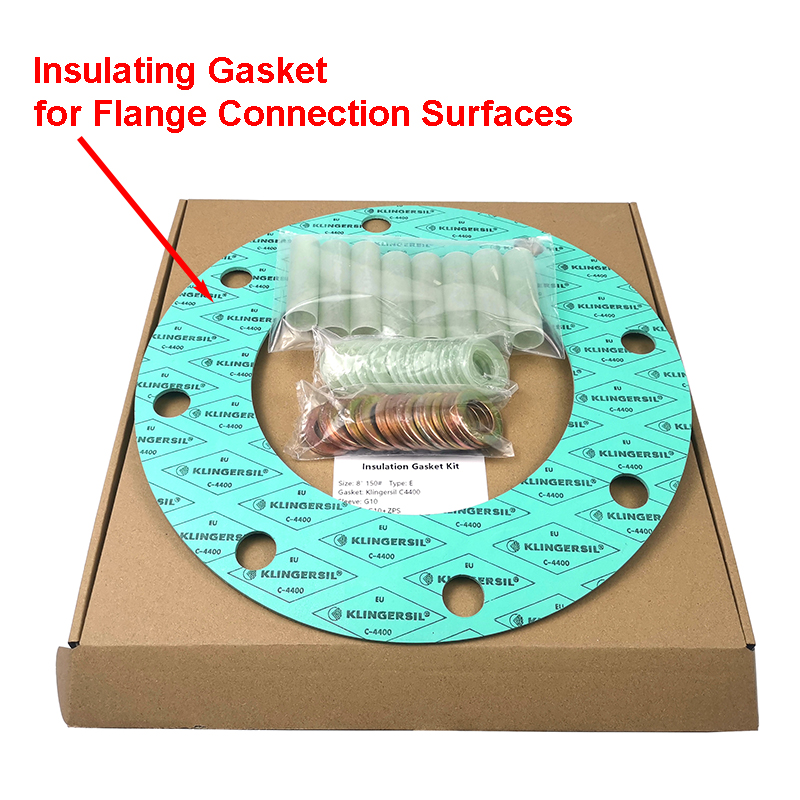
1. Insulating Flange Gasket
Klinger C4400 Insulation Gasket Kit
- Function: Serves as the primary insulating layer between flange mating surfaces, blocking the current path between the two flanges.
- Materials: Typically made of high-strength polymer materials (e.g., PTFE, PEEK, reinforced phenolic resin, or specialized rubber, such as Klinger C4430/C4400, Gylon 3500), offering excellent insulation, pressure resistance, and chemical stability.
- Key Procurement Parameters: Dimensions (inner diameter, outer diameter, thickness), pressure rating, temperature range, media compatibility, insulation resistance value (typically ≥1 MΩ).
2. Insulating Washers (One Per Nut)
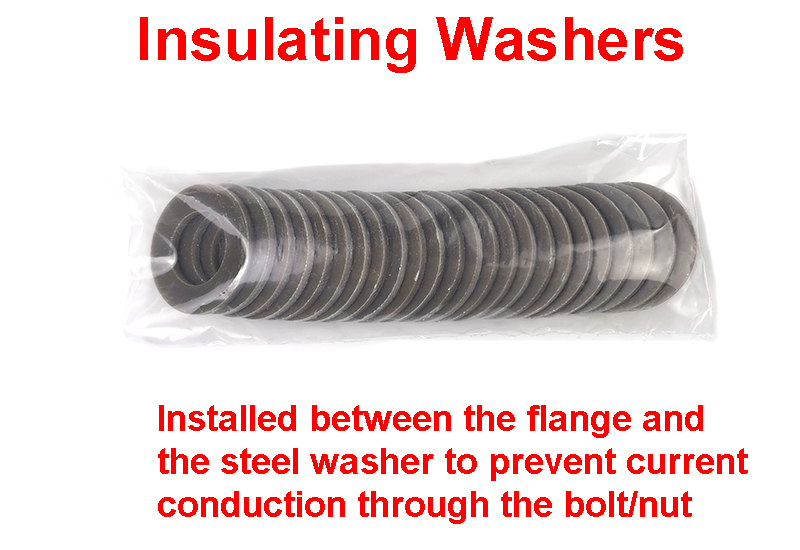
Insulating Washers installed between the flange and the steel washer to prevent current conduction through the bolt/ nut.
- Function: Installed between the flange and the steel washer/ Nut to prevent current conduction through the bolt/nut.
- Materials: Usually made of hard insulating materials (e.g., nylon, POM, or bakelite), with high compressive strength.
- Procurement Note: Must precisely match the bolt size. Often standard parts, but insulation performance and creep resistance should be considered.
3. Full-Length Insulating Sleeves (One Per Bolt Hole)
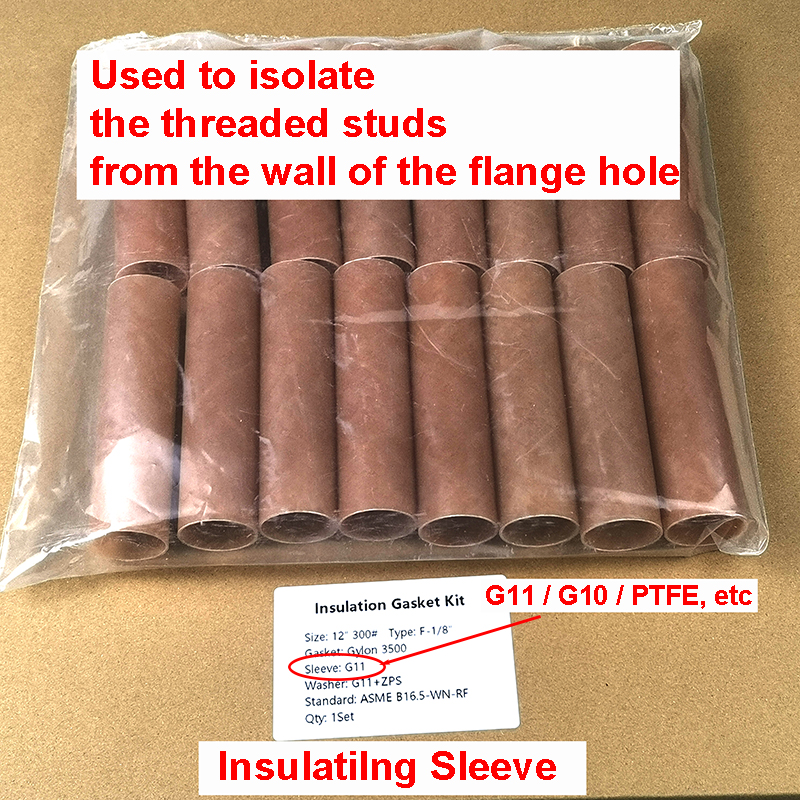
Insulating sleeve used to isolate the threaded studs from the wall of the flange hole
- Function: Sleeves placed over the studs to isolate them from the flange bore walls, preventing the studs from becoming current pathways.
- Features: Cover the entire length of the bolt, ensuring no metal contact between the bolt and flange at any point.
- Materials: Commonly made of PTFE, polyethylene, or high-temperature-resistant plastic sleeves.
- Procurement Points: Inner diameter must match the bolt diameter; length should slightly exceed the total flange thickness to ensure complete isolation.
4. Plated Steel Washers (One Per Nut)
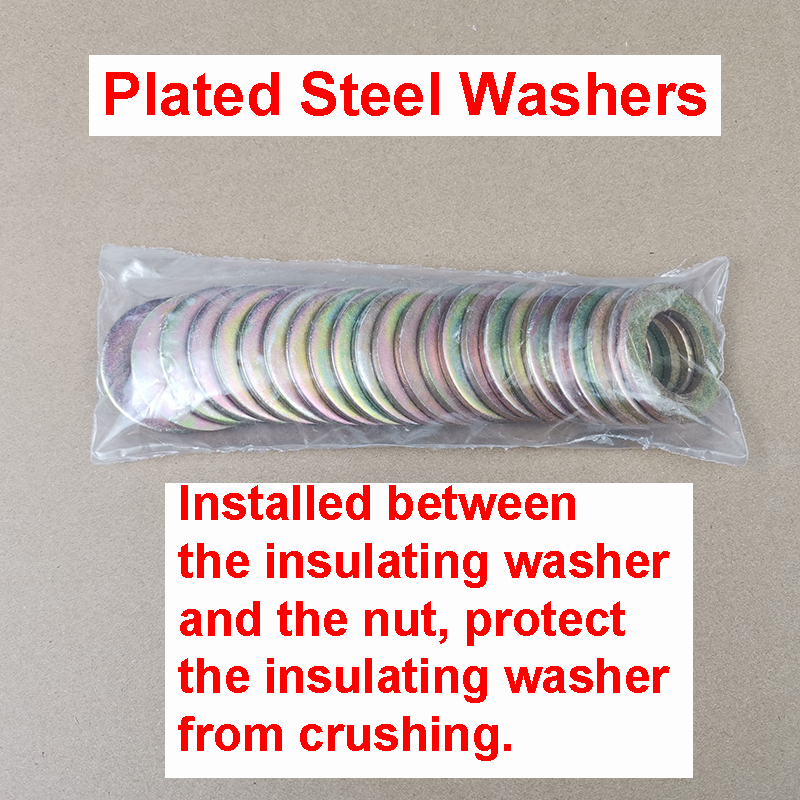
Plated steel washers installed between the insulating washer and the nut, protect the insulating washer from crushing.
- Function: Installed between the insulating washer and the nut to distribute the nut tightening pressure, protect the insulating washer from crushing, and provide an even load-bearing surface.
- Characteristics: Surface-plated (e.g., zinc or cadmium) for rust prevention, with moderate hardness.
- Procurement Tip: Typically standard flat washers, but ensure their hardness and surface treatment meet the insulating kit requirements.

Stud Bolts and Nuts Provide clamping force for the flange connection
- Function: Provide clamping force for the flange connection.
- Description: Stud bolts have threads on both ends, often fully threaded; nuts are typically heavy hex nuts.
- Materials: Usually made of high-strength alloy steel (e.g., ASTM A193 B7), with zinc plating or other anti-corrosion treatments.
- Key Data: Bolt diameter, length, thread specifications, material grade, and tensile strength.
- Description: Stud bolts have threads on both ends, often fully threaded; nuts are typically heavy hex nuts.
- Materials: Usually made of high-strength alloy steel (e.g., ASTM A193 B7), with zinc plating or other anti-corrosion treatments.
- Key Data: Bolt diameter, length, thread specifications, material grade, and tensile strength.
Qishine is ideal choice for EPC companies and project contractors.
Website: www.qishine.com
Email: qishine@qishine.com
Tel: 0592-5225595
Email: qishine@qishine.com
Tel: 0592-5225595
WhatsApp: +86 15985833169
III. Supplementary Components (Common Extended Parts)
A complete insulation solution may sometimes include the following components. Confirm with the design requirements during procurement:
- Insulating Gasket Kit Alignment Ring/Positioning Tab: Assists with alignment during installation to ensure the insulating gasket is centered.
A complete insulation solution may sometimes include the following components. Confirm with the design requirements during procurement:
- Insulating Gasket Kit Alignment Ring/Positioning Tab: Assists with alignment during installation to ensure the insulating gasket is centered.
- Outer Protective Cover/Sealing Cap: Covers the external bolt ends to prevent moisture and dust ingress, enhancing insulation durability.
- Conductive Jumper Wire (Optional): Used when the system requires safe grounding, bridging both sides of the insulating kit to provide a controlled grounding path.
- Label/Identification Plate: Marks the insulation location for future inspection and maintenance.
IV. Procurement Checklist: Key Considerations
1. Define Operating Conditions:
- Flange standards (ASME, DIN, JIS, etc.), dimensions, and pressure ratings (Class).
- Media temperature, pressure, and chemical properties.
- Environmental conditions (indoor, outdoor, offshore, corrosive atmosphere, etc.).
1. Define Operating Conditions:
- Flange standards (ASME, DIN, JIS, etc.), dimensions, and pressure ratings (Class).
- Media temperature, pressure, and chemical properties.
- Environmental conditions (indoor, outdoor, offshore, corrosive atmosphere, etc.).
2. Material Compatibility:
- Insulating materials must withstand media temperature and chemical corrosion.
- Metal component materials should be compatible with the pipeline system to avoid galvanic corrosion.
- Insulating materials must withstand media temperature and chemical corrosion.
- Metal component materials should be compatible with the pipeline system to avoid galvanic corrosion.
3. Performance Certification:
- Request insulation resistance test reports from suppliers (typically according to ASTM F1173 or similar standards).
- For critical applications, ensure products comply with requirements such as NACE MR0175/ISO 15156 for resistance to sulfide stress cracking.
- Request insulation resistance test reports from suppliers (typically according to ASTM F1173 or similar standards).
- For critical applications, ensure products comply with requirements such as NACE MR0175/ISO 15156 for resistance to sulfide stress cracking.
4. Complete Kit Supply:
- Ensure all components are matched as a complete set to avoid insulation failure due to mismatched parts.
- Precisely calculate bolt length: Flange thickness + gasket thickness + washer thickness + nut thickness + allowance for thread protrusion.
- Ensure all components are matched as a complete set to avoid insulation failure due to mismatched parts.
- Precisely calculate bolt length: Flange thickness + gasket thickness + washer thickness + nut thickness + allowance for thread protrusion.
5. Supplier Qualifications:
- Prioritize suppliers with industry experience and technical support capabilities.
- Confirm their quality management system (e.g., ISO 9001 certification) and product traceability.
- Prioritize suppliers with industry experience and technical support capabilities.
- Confirm their quality management system (e.g., ISO 9001 certification) and product traceability.
V. Summary
Although an insulating gasket kit consists of multiple small components, each is crucial, working together to form a reliable insulation barrier. During procurement, avoid focusing solely on the main gasket and neglecting other accessories. It must be selected and inspected as an integrated system. Correctly selecting a high-quality insulating gasket kit can effectively prevent corrosion, enhance system safety, and deliver significant lifecycle cost savings.
Although an insulating gasket kit consists of multiple small components, each is crucial, working together to form a reliable insulation barrier. During procurement, avoid focusing solely on the main gasket and neglecting other accessories. It must be selected and inspected as an integrated system. Correctly selecting a high-quality insulating gasket kit can effectively prevent corrosion, enhance system safety, and deliver significant lifecycle cost savings.
It is recommended to thoroughly communicate with engineering design or maintenance departments before procurement to clarify technical specifications. Consider inviting qualified suppliers for technical briefings to ensure the selected product fully meets practical application requirements.
Disclaimer: This content is compiled based on general engineering practices. Specific procurement decisions should be made in accordance with project design specifications and the latest standards.
FAQ
Q1: Can I reuse an insulating gasket kit after flange disassembly?
No. The gasket and sleeves compress permanently. Always replace the entire kit after opening a flange.
Q1: Can I reuse an insulating gasket kit after flange disassembly?
No. The gasket and sleeves compress permanently. Always replace the entire kit after opening a flange.
Q2: What is the minimum insulation resistance I should accept?
Typically ≥1 MΩ at 500 V DC per ASTM F1173. For critical offshore or H₂S service, ask for higher values.
Typically ≥1 MΩ at 500 V DC per ASTM F1173. For critical offshore or H₂S service, ask for higher values.
Q3: Do I need conductive jumper wires with every kit?
Only if your design requires a controlled grounding path. Otherwise, adding one defeats the insulation purpose.
Only if your design requires a controlled grounding path. Otherwise, adding one defeats the insulation purpose.
Q4: How do I calculate bolt length for a kit?
Flange thickness + gasket thickness + steel washer + insulating washer + nut height + 2–3 thread pitches as protrusion.
Flange thickness + gasket thickness + steel washer + insulating washer + nut height + 2–3 thread pitches as protrusion.
Q5: Can I use PTFE gaskets at high temperatures?
PTFE works up to ~260°C. Above that, use PEEK or reinforced phenolic resin – check the supplier’s temp curve.
PTFE works up to ~260°C. Above that, use PEEK or reinforced phenolic resin – check the supplier’s temp curve.
Q6: Do I need special tools for installation?
Use a torque wrench with controlled tightening sequence (cross-pattern). No hammer or impact tools on insulating washers.
Use a torque wrench with controlled tightening sequence (cross-pattern). No hammer or impact tools on insulating washers.
How to Determine the Number of Bolt Holes in a Flange
Why is it that sometimes the inner diameter of an insulating gasket is smaller than the nominal diameter of a pipe flange
Related Article

Insights from a Case Study on Exporting B8M Fasteners.Recently, during our final outgoing inspection of a batch of B8M stainless steel fasteners destined for Portugal, we discovered varying degrees of burrs on the edges of the bolt hex heads.
How to Efficiently Remove Burrs from Bolt Edges

Insulating Gasket Procurement Pitfalls: From "Price Traps" to "Supplier Selection"
What pitfalls should you watch out for when purchasing insulating gaskets

As a classic modified PTFE gasket material from Garlock, Gylon 3500 is widely used in petrochemical, chemical, and other industries for its excellent resistance to strong acids, solvents, and anti-creep properties.
How to Buy Genuine Gylon 3500 Insulating Gaskets at Competitive Prices in China

