
How to Select Insulation Gasket Materials Based on Application Temperature
author: www.qishine.com
2026-03-06

As critical components in industrial equipment, insulation gaskets must not only provide effective electrical insulation but also withstand temperature challenges in various working environments. Selecting the appropriate insulation gasket material is essential for ensuring the safe operation of equipment, preventing leaks, and extending service life. This article provides an in-depth analysis of the temperature characteristics and application scenarios of eight common insulation gasket materials.
Gasket of Material
|
Material |
Dielectric Strength (volts/mil) |
Compressive Strength (PSI) |
Water absorption (%) |
Tensile Strength (PSI) |
Temp (℃) |
|
G-7 |
350 |
40000 |
0.07 |
25000 |
-196-232 |
|
G-10 |
550 |
50000 |
0.1 |
45000 |
-196-138 |
|
G-11 |
550 |
50000 |
0.1 |
43000 |
-196-176 |
|
Phenolic |
500 |
25000 |
1.6 |
20000 |
-54-104 |
|
CR+Phenolic |
500 |
25000 |
1.6 |
20000 |
-54-79 |
|
RPTFE(Gylon 3500) |
350 |
2300 |
0.01 |
1450 |
-196-260 |
|
Klingersil C4430 |
254 |
7200 |
3 |
2466 |
175-200 |
|
Klingersil C4400 |
550 |
7200 |
3 |
2176 |
200-400 |
1. G-7 Insulation Gasket: The All-Rounder for Ultra-Low to Medium Temperatures
Temperature Range: -196°C to 232°C
Temperature Range: -196°C to 232°C
G-7 is a glass fiber-reinforced silicone resin composite material with exceptional temperature adaptability. Its most notable feature is its ability to withstand extreme temperature fluctuations, from liquid nitrogen temperatures (-196°C) up to 232°C. It exhibits a low thermal expansion coefficient and excellent stability. It maintains good flexibility and insulation properties in ultra-low-temperature environments while demonstrating superior anti-aging characteristics at high temperatures.

G-7 insulation Gasket
Application Scenarios: LNG equipment, cryogenic storage tanks, aerospace, and industrial equipment requiring resistance to extreme temperature changes.
2. G-10 Isolation Gasket: A Versatile Choice for Low-Temperature Insulation
Temperature Range: -196°C to 138°C
Temperature Range: -196°C to 138°C
G-10 is an epoxy resin-impregnated glass fiber laminate with high mechanical strength and excellent electrical properties. Although its high-temperature tolerance is relatively limited (138°C), it performs reliably in low-temperature environments and offers outstanding dimensional stability and low moisture absorption.

G10 Isolation gasket is an epoxy resin-impregnated glass fiber laminate with high mechanical strength and excellent electrical properties
Application Scenarios: Insulation for electronic devices, low-temperature laboratory equipment, and insulation support components requiring high mechanical strength.
3. G-11 Insulation Gasket: The Upgraded Version for Medium Temperatures
Temperature Range: -196°C to 176°C
Temperature Range: -196°C to 176°C

G11 Insulation Gasket Temperature Range: -196°C to 176°C
As an improved version of G-10, G-11 maintains good low-temperature performance while increasing high-temperature tolerance to 176°C. It offers better thermal stability, making it suitable for environments with greater temperature fluctuations.
Application Scenarios: Motor insulation, transformers, and insulation components for medium-temperature industrial equipment.
4. Phenolic Resin Insulation Gasket: Traditional Medium-Temperature Material
Temperature Range: -54°C to 104°C
Temperature Range: -54°C to 104°C
Phenolic resin is one of the earliest synthetic resins, offering good mechanical strength, chemical resistance, and electrical insulation properties. However, its temperature range is relatively limited, and it tends to become brittle under sustained high temperatures.
Application Scenarios: Automotive components, household appliances, and insulation gaskets for industrial equipment operating below 100°C.

Phenolic Resin Insulation Gasket Temperature Range: -54°C to 104°C
5. Neoprene-Filled Phenolic Resin Insulation Gasket: Suitable for Chemical Environments
Temperature Range: -54°C to 79°C
Temperature Range: -54°C to 79°C
This material combines the rigidity of phenolic resin with the elasticity of neoprene rubber, providing good sealing performance and moderate chemical resistance. However, its upper temperature limit is relatively low, making it unsuitable for high-temperature applications.
Application Scenarios: Chemical equipment and low-to-medium temperature insulation applications requiring a certain degree of elastic sealing.
6. Modified PTFE (Gylon 3500 Insulation Gasket): The King of Wide Temperature Range and Chemical Resistance
Temperature Range: -196°C to 260°C
Temperature Range: -196°C to 260°C
Gylon 3500 is a specially modified PTFE material that combines the excellent chemical inertness of traditional PTFE with improved mechanical properties. Its temperature range is extremely wide, and it is resistant to almost all chemical media. Its creep resistance is superior to standard PTFE.

Gylon 3500 inslation gasket Temperature Range: -196°C to 260°C
Application Scenarios: Highly corrosive environments, pharmaceutical equipment, food processing, and demanding applications requiring an extremely wide temperature range and chemical inertness.
7. Klingersil C4430 Insulation Gasket: Specialized Medium-to-High Temperature Material
Temperature Range: 175-200°C (continuous) / 300°C (short-term)
Temperature Range: 175-200°C (continuous) / 300°C (short-term)
This is a compressed sealing material specifically designed for medium-to-high temperature environments, made from organic fibers, synthetic rubber, and fillers. It offers good compression resilience and sealing performance, remaining stable under sustained high temperatures.
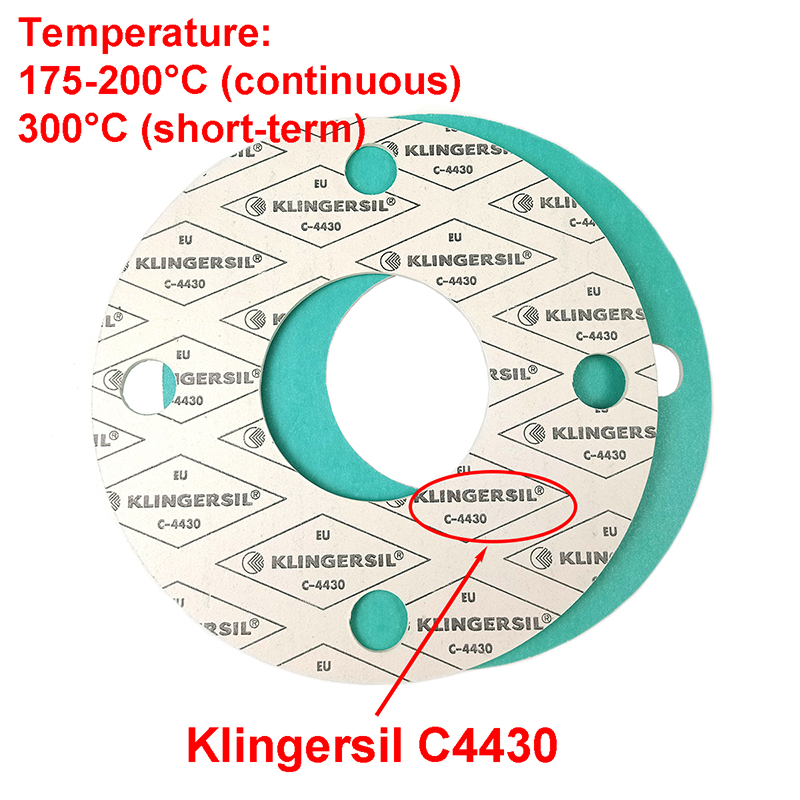
Kligersil C4430 Temperature Range: 175-200°C (continuous) / 300°C (short-term)
Application Scenarios: Engine gaskets, boiler sight glasses, and heat exchange equipment operating continuously at around 200°C.
8. Klingersil C4400 Insulation Gasket: High-Performance High-Temperature Solution
Temperature Range: 200°C (continuous) / 300°C (short-term) / 430°C (extreme)
Temperature Range: 200°C (continuous) / 300°C (short-term) / 430°C (extreme)
As a premium product for high-temperature insulation gasket materials, C4400 uses a special formulation to withstand higher continuous operating temperatures. Even at extreme testing temperatures of 430°C, it maintains structural integrity, making it an ideal replacement for traditional asbestos gaskets.

Klingersil C4400 Insulation gasket Temperature Range: 200°C (continuous) / 300°C (short-term) / 430°C (extreme)
Application Scenarios: High-temperature valves, turbines, exhaust systems, industrial furnaces, and other high-temperature, high-pressure equipment.
Selection Guidelines and Practical Recommendations
1. Determine Actual Temperature Requirements: Consider not only the operating temperature but also the frequency of temperature fluctuations, peak temperatures, and duration.
1. Determine Actual Temperature Requirements: Consider not only the operating temperature but also the frequency of temperature fluctuations, peak temperatures, and duration.
2. Evaluate Comprehensive Performance: In addition to temperature tolerance, assess whether the material’s chemical resistance, mechanical strength, compressibility, and electrical properties meet application requirements.
3. Safety Margin Principle: The actual application temperature should be 10-20% lower than the material’s rated temperature to ensure long-term reliability and safety.
4. Consider Special Environments: For applications with frequent temperature cycling, thermal shock, or requiring both insulation and sealing, choose materials with a low thermal expansion coefficient and good elastic recovery.
5. Compliance and Standards: Ensure the selected material complies with industry standards and safety regulations, particularly in strictly regulated industries such as food, pharmaceuticals, and aerospace.
Conclusion
Selecting an insulation gasket material is an engineering decision that requires comprehensive consideration of temperature range, chemical environment, mechanical requirements, and cost-effectiveness. From ultra-low-temperature G-7 to high-temperature-specific Klingersil C4400, each material has its unique advantages and application areas. The right choice not only ensures the safe operation of equipment but also reduces maintenance costs and improves system reliability. In practical applications, it is recommended to communicate detailed working conditions with material suppliers and conduct sample testing when necessary to find the most suitable insulation gasket solution.
Selecting an insulation gasket material is an engineering decision that requires comprehensive consideration of temperature range, chemical environment, mechanical requirements, and cost-effectiveness. From ultra-low-temperature G-7 to high-temperature-specific Klingersil C4400, each material has its unique advantages and application areas. The right choice not only ensures the safe operation of equipment but also reduces maintenance costs and improves system reliability. In practical applications, it is recommended to communicate detailed working conditions with material suppliers and conduct sample testing when necessary to find the most suitable insulation gasket solution.
Qishine is ideal choice for EPC companies and project contractors.
Website: www.qishine.com
Email: qishine@qishine.com
Tel: 0592-5225595
Email: qishine@qishine.com
Tel: 0592-5225595
WhatsApp: +86 15960259563
Why is it that sometimes the inner diameter of an insulating gasket is smaller than the nominal diameter of a pipe flange
Bolt Size Guide: How to Measure Diameter, Pitch & Length Correctly
Related Article

Insights from a Case Study on Exporting B8M Fasteners.Recently, during our final outgoing inspection of a batch of B8M stainless steel fasteners destined for Portugal, we discovered varying degrees of burrs on the edges of the bolt hex heads.
How to Efficiently Remove Burrs from Bolt Edges

Insulating Gasket Procurement Pitfalls: From "Price Traps" to "Supplier Selection"
What pitfalls should you watch out for when purchasing insulating gaskets

As a classic modified PTFE gasket material from Garlock, Gylon 3500 is widely used in petrochemical, chemical, and other industries for its excellent resistance to strong acids, solvents, and anti-creep properties.
How to Buy Genuine Gylon 3500 Insulating Gaskets at Competitive Prices in China

