
How to Quickly Distinguish Stainless Steel from Carbon Steel Bolts
author: www.qishine.com
2026-02-28

4 Quick Identification Techniques (From Easiest to Most Advanced)
Technique 1: Magnet Test (Fastest, 3 seconds)
Technique 2: Visual and Marking Inspection (1 minute of careful observation)
Technique 3: Spark Test (Most visual, requires tools)
Technique 4: Chemical Reagent Test (Most professional and accurate)
Technique 1: Magnet Test (Fastest, 3 seconds)
Technique 2: Visual and Marking Inspection (1 minute of careful observation)
Technique 3: Spark Test (Most visual, requires tools)
Technique 4: Chemical Reagent Test (Most professional and accurate)

Common high-strength carbon steel fasteners
Introduction: Why is it Essential to Accurately Distinguish Between the Two?
In mechanical warehouses or construction sites, you often encounter this scenario: two boxes of similar-looking bolts are mixed together, their labels long lost. Can you quickly identify which are stainless steel Fastener and which are carbon steel? This seemingly simple question actually concerns equipment safety, project quality, and cost control.
In mechanical warehouses or construction sites, you often encounter this scenario: two boxes of similar-looking bolts are mixed together, their labels long lost. Can you quickly identify which are stainless steel Fastener and which are carbon steel? This seemingly simple question actually concerns equipment safety, project quality, and cost control.

Stainless Steel Fastener
Choosing the wrong bolt can lead to serious consequences. In a coastal city's guardrail installation project, the construction team mistakenly used carbon steel bolts instead of stainless steel. Within just six months, the bolts were extensively corroded, compromising the safety of the entire guardrail system. The rework cost was up to three times the original investment. Such mistakes not only cause economic losses but can also lead to safety incidents.
This article provides you with four quick identification methods that require no professional equipment, helping you accurately distinguish between stainless steel and Carbon Steel Bolts within 3 minutes, thereby avoiding the risks associated with material selection errors.
4 Quick Identification Techniques (From Easiest to Most Advanced)
Technique 1: Magnet Test (Fastest, 3 seconds)
Technique 1: Magnet Test (Fastest, 3 seconds)
Procedure:
1. Prepare a strong magnet (neodymium magnet is recommended for stronger magnetism).
2. Touch the magnet to the bolt head or side.
3. Feel the strength of attraction: note if it's a "strong pull" or a "slight pull."
1. Prepare a strong magnet (neodymium magnet is recommended for stronger magnetism).
2. Touch the magnet to the bolt head or side.
3. Feel the strength of attraction: note if it's a "strong pull" or a "slight pull."
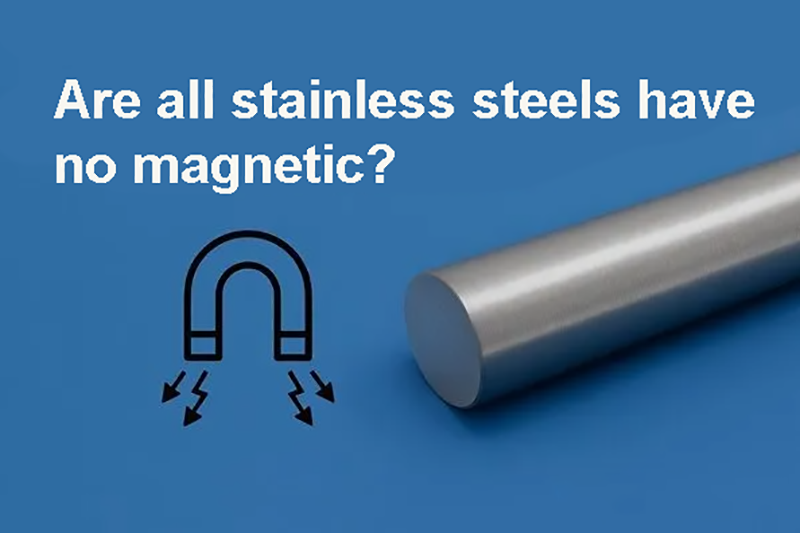
Not all stainless steel is non-magnetic.
Interpretation:
Strong pull: Very likely carbon steel (or martensitic stainless steel).
Weak pull / No pull: Likely austenitic stainless steel (e.g., 304, 316).
Strong pull: Very likely carbon steel (or martensitic stainless steel).
Weak pull / No pull: Likely austenitic stainless steel (e.g., 304, 316).
Best for: Quick preliminary screening in warehouses, sorting large batches. Experienced technicians can make a judgment per bolt in under 5 seconds using this method.
Limitation: This method cannot distinguish between carbon steel and martensitic stainless steel; confirmation with other methods is needed.
Technique 2: Visual and Marking Inspection (1 minute of careful observation)
When the magnet test is inconclusive, closely examining the appearance and markings provides more clues.

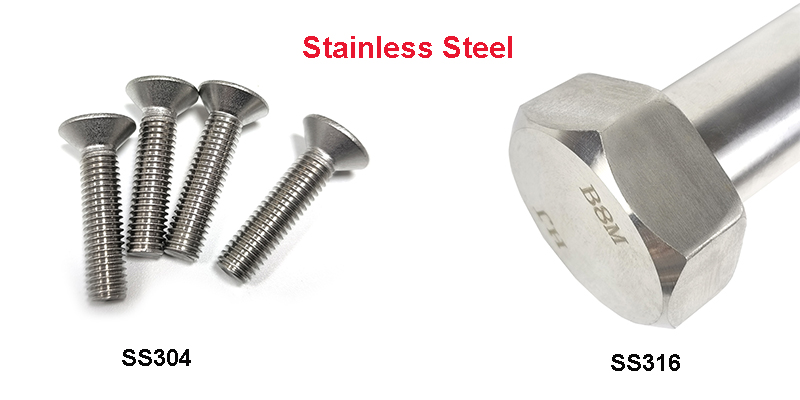
Surface Characteristic Comparison:
Typical Carbon Steel Features:
Black oxide finish: matte black surface.
Galvanized finish: shiny silver (electro-galvanized) or yellowish iridescent color (Dacromet/zinc flake).
Cut surface appears grayish-white.
Black oxide finish: matte black surface.
Galvanized finish: shiny silver (electro-galvanized) or yellowish iridescent color (Dacromet/zinc flake).
Cut surface appears grayish-white.
Typical Stainless Steel Features:
Base metal color: matte silver-white (304) or slightly grayish tint (316).
Surface is more uniform and finer, lacking a coated texture.
Cut surface appears shiny silver.
Base metal color: matte silver-white (304) or slightly grayish tint (316).
Surface is more uniform and finer, lacking a coated texture.
Cut surface appears shiny silver.
Head Marking Interpretation (One of the most reliable evidences):
Strength Grade Markings:
Carbon Steel: Numerical, e.g., 4.8, 8.8, 10.9, 12.9.
Stainless Steel: Letter-number combination, e.g., A2-70, A4-80.
Material Abbreviations: Look for markings like "A2," "A4," "SS" (Stainless Steel), "INOX" (international stainless steel marking).
Strength Grade Markings:
Carbon Steel: Numerical, e.g., 4.8, 8.8, 10.9, 12.9.
Stainless Steel: Letter-number combination, e.g., A2-70, A4-80.
Material Abbreviations: Look for markings like "A2," "A4," "SS" (Stainless Steel), "INOX" (international stainless steel marking).
Usage Trace Clues: Check for signs of rust. Carbon steel corrosion is typically widespread, flaky, yellowish-brown rust. Stainless steel, even when corroded, usually shows localized reddish-brown pitting and is relatively rare.
Website: www.qishine.com
Email: qishine@qishine.com
Tel: 0592-5225595
Email: qishine@qishine.com
Tel: 0592-5225595
WhatsApp: +86 15960259563
+86 15985833169
Technique 3: Spark Test (Most visual, requires tools)
When the above methods are still inconclusive, the spark test provides visual evidence.
Safety Prep: Always wear safety glasses and gloves. Perform in a well-ventilated area with the bolt securely clamped.

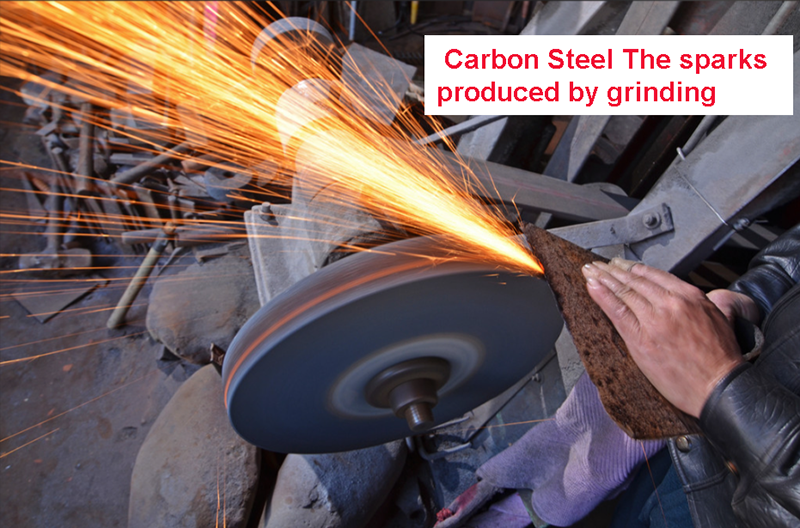
We can determine whether it is carbon steel or stainless steel by observing the sparks produced during the grinding process.
Spark Characteristic Comparison:
Carbon Steel Sparks:
Sparks are long, dense, and profuse, like fireworks.
Color is bright, appearing brilliant white/yellow.
Many branches, appearing tree-like.
Accompanied by crackling or popping sounds.
Carbon Steel Sparks:
Sparks are long, dense, and profuse, like fireworks.
Color is bright, appearing brilliant white/yellow.
Many branches, appearing tree-like.
Accompanied by crackling or popping sounds.
Stainless Steel Sparks:
Sparks are short, sparse, and less numerous.
Color is darker, appearing dark red or orange.
Fewer branches, mostly linear streaks.
Silent or with slight hissing sounds.
Sparks are short, sparse, and less numerous.
Color is darker, appearing dark red or orange.
Fewer branches, mostly linear streaks.
Silent or with slight hissing sounds.
Best for: Machine shops, maintenance sites. This method requires experience; practice with bolts of known material first.
Technique 4: Chemical Reagent Test (Most professional and accurate)
For critical applications or procurement inspection, chemical testing provides the most reliable judgment.

Professional Stainless Steel Testing Solution
Reagent Choices:
1. Professional stainless steel identification fluid (detects manganese, nickel, molybdenum content).
2. Simple substitute: 5% Copper Sulfate solution.
1. Professional stainless steel identification fluid (detects manganese, nickel, molybdenum content).
2. Simple substitute: 5% Copper Sulfate solution.
Procedure:
1. Clean a small area on the bolt surface with sandpaper or solvent.
2. Apply a drop of the test fluid.
3. Wait 30-60 seconds and observe the reaction.
4. Compare the resulting color to the provided chart to determine the material.
1. Clean a small area on the bolt surface with sandpaper or solvent.
2. Apply a drop of the test fluid.
3. Wait 30-60 seconds and observe the reaction.
4. Compare the resulting color to the provided chart to determine the material.
Color Interpretation (Varies by reagent; follow kit instructions):
Rapid change to red/purple: High manganese steel (possibly 201 stainless steel).
Slow change to a specific color: Indicates 304 or 316 stainless steel (different colors for different grades).
Little to no color change: Likely carbon steel.
Rapid change to red/purple: High manganese steel (possibly 201 stainless steel).
Slow change to a specific color: Indicates 304 or 316 stainless steel (different colors for different grades).
Little to no color change: Likely carbon steel.
Professional Advice: This method is most suitable for critical occasions like procurement acceptance and quality inspection, effectively preventing material fraud.
Core Knowledge Foundation: 3 Fundamental Differences Between Stainless vs. Carbon Steel
Before diving into the identification methods, understanding these essential differences is helpful. This knowledge underpins the science behind the techniques.
1. Composition & Corrosion Resistance Mechanism (Understand in 30 seconds)
Stainless steel's "stainless" property comes from its chromium content (typically ≥10.5%). Chromium reacts with oxygen to form an extremely thin, dense, and invisible layer of chromium oxide "passive film" on the surface. This film is self-repairing, providing lasting, active protection.
Stainless steel's "stainless" property comes from its chromium content (typically ≥10.5%). Chromium reacts with oxygen to form an extremely thin, dense, and invisible layer of chromium oxide "passive film" on the surface. This film is self-repairing, providing lasting, active protection.
In contrast, carbon steel is primarily iron and carbon, possessing no inherent rust resistance. Common carbon steel bolts rely on surface treatments (like galvanizing, black oxide) for protection. However, this passive protection, once damaged, allows rapid corrosion.
2. The Truth About Magnetic Differences
The magnet test is the most common preliminary method but must be understood correctly:
Austenitic Stainless Steel (most common like 304, 316): Typically non-magnetic or only weakly magnetic.
Carbon Steel & Martensitic Stainless Steel (e.g., 410): Strongly magnetic.
The magnet test is the most common preliminary method but must be understood correctly:
Austenitic Stainless Steel (most common like 304, 316): Typically non-magnetic or only weakly magnetic.
Carbon Steel & Martensitic Stainless Steel (e.g., 410): Strongly magnetic.
Important Note: Some stainless steels may exhibit weak magnetism after cold working (e.g., thread rolling). Therefore, magnetism is a clue, not an absolute standard.
3. Cost & Strength Comparison
Price is another significant difference: Stainless steel bolts of the same specification are typically 2-5 times more expensive than carbon steel, due to raw material costs and higher processing difficulty.
Price is another significant difference: Stainless steel bolts of the same specification are typically 2-5 times more expensive than carbon steel, due to raw material costs and higher processing difficulty.
There's a common strength misconception: Many think stainless steel is "stronger." In reality, high-strength carbon steel bolts (e.g., Grade 12.9) have significantly higher ultimate tensile strength than common stainless steel bolts (e.g., A2-70). Selection requires balancing corrosion resistance and strength needs for the application.
Website: www.qishine.com
Email: qishine@qishine.com
Tel: 0592-5225595
Email: qishine@qishine.com
Tel: 0592-5225595
WhatsApp: +86 15960259563
+86 15985833169
3 Common Scenario Identification Workflows
Scenario 1: Rapid Warehouse Sorting (Large Quantity)
Efficiency is key when facing hundreds of mixed bolts.
Recommended Workflow: Magnet Test (initial screening) → Visual Inspection (secondary check) → Sample Spark Test (final verification).
Target Speed: 5-10 seconds per bolt, accuracy >95%.
Scenario 1: Rapid Warehouse Sorting (Large Quantity)
Efficiency is key when facing hundreds of mixed bolts.
Recommended Workflow: Magnet Test (initial screening) → Visual Inspection (secondary check) → Sample Spark Test (final verification).
Target Speed: 5-10 seconds per bolt, accuracy >95%.
Scenario 2: Procurement Inspection (Preventing Counterfeits)
When purchasing stainless steel bolts, preventing carbon steel substitution is crucial.
Recommended Workflow: Check Markings (first gate) → Magnet Test (second gate) → Reagent Spot Check (final confirmation).
Special Focus: Verify consistency between material certificates and physical items. Pay extra attention to unmarked bolts.
When purchasing stainless steel bolts, preventing carbon steel substitution is crucial.
Recommended Workflow: Check Markings (first gate) → Magnet Test (second gate) → Reagent Spot Check (final confirmation).
Special Focus: Verify consistency between material certificates and physical items. Pay extra attention to unmarked bolts.
Scenario 3: On-site Replacement During Repair (Single Item Judgment)
Quickly finding a matching replacement during repairs.
Quickly finding a matching replacement during repairs.
Recommended Workflow: Observe the original service environment → Compare visual appearance → Perform simple magnet test for confirmation.
Core Principle: Strive to match the original bolt or base material to avoid galvanic corrosion.
Core Principle: Strive to match the original bolt or base material to avoid galvanic corrosion.
Selection Guide: When to Use Which Bolt?
Scenarios Where Stainless Steel is a Must:
1. Damp/Outdoor Environments: Rooftop railings, balcony brackets, outdoor signage.
2. Chemical Exposure Environments: Chemical plant equipment, lab racks, swimming pool areas.
3. Food & Medical Fields: Kitchen equipment, food machinery, medical devices.
4. Highly Corrosive Environments: Coastal buildings, ships, salt spray test equipment.
Scenarios Where Stainless Steel is a Must:
1. Damp/Outdoor Environments: Rooftop railings, balcony brackets, outdoor signage.
2. Chemical Exposure Environments: Chemical plant equipment, lab racks, swimming pool areas.
3. Food & Medical Fields: Kitchen equipment, food machinery, medical devices.
4. Highly Corrosive Environments: Coastal buildings, ships, salt spray test equipment.
Scenarios Where Carbon Steel is Acceptable:
1. Dry Indoor Environments: Furniture assembly, equipment in dry server rooms, interior decor.
2. Hidden Structures: Internal frameworks, non-load-bearing structures, temporary supports.
3. High-Strength Requirements: Automotive chassis, heavy machinery (requires Comply with anti-corrosion treatment / combined with anti-corrosion treatment).
4. Budget-Sensitive Projects: Temporary structures, low-cost projects, short-term use equipment.
1. Dry Indoor Environments: Furniture assembly, equipment in dry server rooms, interior decor.
2. Hidden Structures: Internal frameworks, non-load-bearing structures, temporary supports.
3. High-Strength Requirements: Automotive chassis, heavy machinery (requires Comply with anti-corrosion treatment / combined with anti-corrosion treatment).
4. Budget-Sensitive Projects: Temporary structures, low-cost projects, short-term use equipment.
Frequently Asked Questions (FAQ)
Q1: If a magnet doesn't stick, is it definitely good stainless steel?
Not necessarily. Besides austenitic stainless steel, some copper alloys and aluminum alloys are also non-magnetic. Also, 201 stainless steel, which has lower nickel content and poorer corrosion resistance, can be non-magnetic. The most reliable method combines marking identification and reagent testing.
Q1: If a magnet doesn't stick, is it definitely good stainless steel?
Not necessarily. Besides austenitic stainless steel, some copper alloys and aluminum alloys are also non-magnetic. Also, 201 stainless steel, which has lower nickel content and poorer corrosion resistance, can be non-magnetic. The most reliable method combines marking identification and reagent testing.
Q2: Why are stainless steel bolts sometimes more expensive?
The price difference stems mainly from three aspects: raw material costs (volatile prices of alloys like nickel, chromium), processing difficulty (stainless steel is harder, causing more tool wear), and the premium for corrosion resistance. For long-term use or critical locations, this investment is worthwhile.
The price difference stems mainly from three aspects: raw material costs (volatile prices of alloys like nickel, chromium), processing difficulty (stainless steel is harder, causing more tool wear), and the premium for corrosion resistance. For long-term use or critical locations, this investment is worthwhile.
Q3: Can bolts of the two materials be mixed?
Strongly discouraged. When stainless steel and carbon steel are in direct contact in a damp environment, they form a "galvanic couple," where the carbon steel (anode) corrodes rapidly. If mixing is unavoidable, use insulating washers or coatings to separate them.
Strongly discouraged. When stainless steel and carbon steel are in direct contact in a damp environment, they form a "galvanic couple," where the carbon steel (anode) corrodes rapidly. If mixing is unavoidable, use insulating washers or coatings to separate them.
Q4: Simplest method for home repairs?
The "Magnet + Visual" combo is recommended: First, use the magnet test—strongly magnetic is likely carbon steel. For weakly or non-magnetic ones, then observe color and markings. This method suits 90% of home repair scenarios.
The "Magnet + Visual" combo is recommended: First, use the magnet test—strongly magnetic is likely carbon steel. For weakly or non-magnetic ones, then observe color and markings. This method suits 90% of home repair scenarios.
Summary & Actionable Advice
Quick Identification Rhyme:
> "Look, then test with a magnet's hold,
> Grind for sparks, a story told.
> For certainty, a reagent's key,
> Prevents mistakes for all to see.
> First check marks and surface hue,
> Magnet gives the second clue.
> For vital tasks, sparks will fly,
> For purchases, test fluid apply."
Quick Identification Rhyme:
> "Look, then test with a magnet's hold,
> Grind for sparks, a story told.
> For certainty, a reagent's key,
> Prevents mistakes for all to see.
> First check marks and surface hue,
> Magnet gives the second clue.
> For vital tasks, sparks will fly,
> For purchases, test fluid apply."
Three Golden Rules:
1. Safety First Principle: In corrosive environments or critical structures, err on the side of choosing stainless steel over risking carbon steel.
2. Matched Usage Principle: New bolt material should try to do / as much as possible match the original bolts or the materials being joined.
3. Systematic Marking Principle: Store bolts of different materials separately, label them clearly, and maintain a material record.
1. Safety First Principle: In corrosive environments or critical structures, err on the side of choosing stainless steel over risking carbon steel.
2. Matched Usage Principle: New bolt material should try to do / as much as possible match the original bolts or the materials being joined.
3. Systematic Marking Principle: Store bolts of different materials separately, label them clearly, and maintain a material record.
Immediate Action Steps:
1. Equip your toolbox with a strong neodymium magnet.
2. Print a common bolt marking reference chart and post it prominently in your warehouse/work area.
3. Conduct a thorough check and categorization of your existing bolt inventory.
4. Establish an inspection process for newly purchased bolts, especially for critical projects.
1. Equip your toolbox with a strong neodymium magnet.
2. Print a common bolt marking reference chart and post it prominently in your warehouse/work area.
3. Conduct a thorough check and categorization of your existing bolt inventory.
4. Establish an inspection process for newly purchased bolts, especially for critical projects.
Mastering these identification techniques will enable you to accurately determine bolt material within minutes and make correct selection decisions. This is not just a practical skill but a crucial safeguard for ensuring project safety and controlling costs.
Qishine is ideal choice for EPC companies and project contractors.
Website: www.qishine.com
Email: qishine@qishine.com
Tel: 0592-5225595
Email: qishine@qishine.com
Tel: 0592-5225595
WhatsApp: +86 15960259563
+86 15985833169
How to Choose Seamless Steel Pipes and Welded Steel Pipes
What Is a Washer - A Complete Guide to Types Materials and Applications
Related Article

Insights from a Case Study on Exporting B8M Fasteners.Recently, during our final outgoing inspection of a batch of B8M stainless steel fasteners destined for Portugal, we discovered varying degrees of burrs on the edges of the bolt hex heads.
How to Efficiently Remove Burrs from Bolt Edges

Insulating Gasket Procurement Pitfalls: From "Price Traps" to "Supplier Selection"
What pitfalls should you watch out for when purchasing insulating gaskets

As a classic modified PTFE gasket material from Garlock, Gylon 3500 is widely used in petrochemical, chemical, and other industries for its excellent resistance to strong acids, solvents, and anti-creep properties.
How to Buy Genuine Gylon 3500 Insulating Gaskets at Competitive Prices in China

