
How to Distinguish Between 304 and 316 Fasteners
author: www.qishine.com
2026-03-08

Core Differences at a Glance: Composition Is Everything
Before diving into the methods of distinction, let's quickly grasp their fundamental differences through the table below:
Before diving into the methods of distinction, let's quickly grasp their fundamental differences through the table below:
| Comparison Item | 304 Stainless Steel Fasteners | 316 Stainless Steel Fasteners |
| Core Composition | Chromium (18%), Nickel (8%) | Chromium (16-18%), Nickel (10-14%), Molybdenum (2-3%) |
| Corrosion Resistance | Good (Suitable for general atmosphere, dry environments) | Excellent (Especially outstanding resistance to chloride ion corrosion, e.g., saltwater, seawater) |
| Most Critical Difference | No Molybdenum | Contains Molybdenum – The core of price and performance difference |
| Pitting Resistance Equivalent Number (PREN) | ~23 | ~29 (Higher value indicates stronger pitting resistance) |
| Typical Application Scenarios | Indoor furniture, appliances, architectural decoration in dry regions, general structural components | Coastal buildings, ship decks, chemical/pharmaceutical equipment, pool facilities, desalination plants |
| Relative Cost | Lower (Preferred for economy) | Higher (Due to the addition of precious metal Molybdenum) |

316 is the "enhanced version" of 304
Have you ever chosen the wrong stainless steel bolts, screws, or nuts, leading to premature rust on outdoor railings or unexpected corrosion in chemical equipment? In the world of fasteners, 304 and 316 stainless steel may seem similar, but they have critical differences. They are widely used in construction, marine applications, chemical industries, and daily life, but the wrong choice can directly lead to project failure, soaring costs, or even safety hazards. Mastering the knowledge to distinguish them is not just a specialized skill but a necessary investment. This article provides you with a clear, practical, and comprehensive guide.
In one sentence: 316 is the "enhanced version" of 304. Its soul lies in the 2-3% molybdenum element, which gives it "super armor" against harsh corrosive environments.
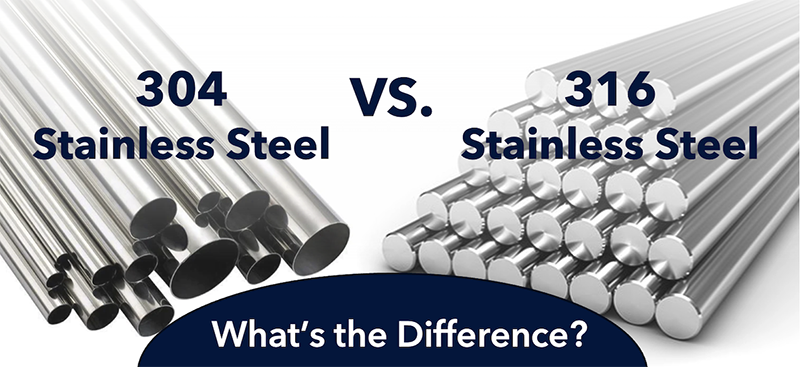
SS304 vs SS316 What's the Difference?
Four Practical Distinguishing Methods: From Professional to Simple
Faced with a batch of unmarked fasteners, how can you tell? Here are four methods in order of decreasing reliability.
Faced with a batch of unmarked fasteners, how can you tell? Here are four methods in order of decreasing reliability.
Method 1: Chemical Composition Testing (Most Authoritative and Accurate)
This is the only scientific method that provides conclusive evidence.
This is the only scientific method that provides conclusive evidence.
Portable XRF Analyzer: Acts like an "element gun," capable of non-destructively detecting chromium, nickel, and molybdenum content within seconds. If it shows significant molybdenum content (typically >2%), it can be judged as 316.
Laboratory Chemical Analysis: Provides the most precise results but is time-consuming and costly, typically used for legal arbitration or major quality identification.
Key Point: Look for the trace of Molybdenum (Mo). It is the "ID card" of 316.
Website: www.qishine.com
Email: qishine@qishine.com
Tel: 0592-5225595
Email: qishine@qishine.com
Tel: 0592-5225595
WhatsApp: +86 15960259563
+86 15985833169
Method 2: Physical Markings and Document Tracing (Most Direct and Efficient)
This should be the first step when purchasing or inspecting.
This should be the first step when purchasing or inspecting.
Head Laser/Stamped Markings: Responsible manufacturers typically laser engrave or stamp "304" or "316" on the bolt head or nut side.
Color Coding: Some manufacturers use colored marker rings, e.g., a green nylon washer or coating might indicate 316 material.
Check Documentation: Always request and verify the Material Test Certificate (Mill Certificate/CMTR). This is the most legally valid proof, clearly stating the steel grade and chemical composition.
Method 3: Service Environment Testing (Empirical Method, but Requires Time)
If you are not in a hurry, you can conduct comparative observation by simulating or using the actual environment.
If you are not in a hurry, you can conduct comparative observation by simulating or using the actual environment.
Salt Spray Test: Place suspected 304 and 316 samples together in a salt spray test chamber. Typically, within the same time frame, 304 will show reddish-brown rust first, while 316 will remain clean longer.
Field Comparison: Place both sample types side-by-side in a corrosive environment (e.g., coastal) for several weeks or months, observing the difference in corrosion.
Note: This method can demonstrate performance differences but cannot be used for instant judgment during procurement.
Method 4: Magnetic Test (Auxiliary Reference, Requires Cautious Interpretation)
The saying "use a magnet to test stainless steel" is common, but it is almost useless for distinguishing between 304 and 316.
The saying "use a magnet to test stainless steel" is common, but it is almost useless for distinguishing between 304 and 316.
Austenitic Stainless Steel Property: Both 304 and 316 belong to the austenitic structure, which is essentially non-magnetic or weakly magnetic.
Effect of Cold Working: Cold heading, thread rolling, and other manufacturing processes for bolts and screws can induce partial martensitic transformation, resulting in weak magnetism. Therefore, their response to a magnet may be similar.
Conclusion: The magnetic test cannot be used as a basis for distinguishing 304 from 316. It can only be used to quickly rule out cheap magnetic stainless steels (e.g., some 400 series).
Common Misconceptions Clarified: Avoiding Cognitive Traps
Q1: Is the more expensive one necessarily 316?
Not necessarily. Price is influenced by brand, manufacturing process, purchase volume, and other factors. Unscrupulous vendors may sell 304 as 316 at a high price. Price is a reference; documentation (material certificates) and markings are the basis.
Q1: Is the more expensive one necessarily 316?
Not necessarily. Price is influenced by brand, manufacturing process, purchase volume, and other factors. Unscrupulous vendors may sell 304 as 316 at a high price. Price is a reference; documentation (material certificates) and markings are the basis.

We can distinguish SS304 from SS316 by the marking.
Q2: Can 304 and 316 be distinguished directly by sight or touch?
Almost impossible. In the uncorroded, new condition, their appearance (luster) and feel are almost identical. Relying solely on sensory judgment is highly unreliable.
Almost impossible. In the uncorroded, new condition, their appearance (luster) and feel are almost identical. Relying solely on sensory judgment is highly unreliable.

316's advantage lies only in corrosion resistance
Q3: Is 316 superior to 304 in all aspects?
No. 316's advantage lies only in corrosion resistance (especially against chlorides). Their mechanical strength, hardness, etc., are essentially the same according to standards. For dry indoor environments, using 304 is completely sufficient and more economical.
No. 316's advantage lies only in corrosion resistance (especially against chlorides). Their mechanical strength, hardness, etc., are essentially the same according to standards. For dry indoor environments, using 304 is completely sufficient and more economical.
Q4: How to avoid suppliers providing inferior substitutes?
1. Choose reputable suppliers: Check their qualifications and customer reviews.
1. Choose reputable suppliers: Check their qualifications and customer reviews.
2. Specify material clearly in contracts: Clearly state the standard grade in the purchase contract, e.g., "ASTM A193 Gr. B8 (304)" or "A193 Gr. B8M (316)".
3. Sample incoming materials for re-inspection: For critical projects, samples can be sent to a third-party testing agency for rapid XRF screening.
Conclusion and Actionable Advice
The core of distinguishing between 304 and 316 fasteners lies in the molybdenum element, while the fundamental choice depends on the service environment.
The core of distinguishing between 304 and 316 fasteners lies in the molybdenum element, while the fundamental choice depends on the service environment.
Core Summary: They cannot be easily distinguished by sight or magnet. The most reliable immediate method is checking product markings and material certificates; the most scientific verification method is XRF chemical composition analysis.
Selection Flowchart: When facing a choice, you can follow this logic:
Assess the environment → Does it contain chlorides (seawater, salt spray, de-icing salts, chemicals) or high humidity? → Yes, choose 316; No, choose 304.
Assess the environment → Does it contain chlorides (seawater, salt spray, de-icing salts, chemicals) or high humidity? → Yes, choose 316; No, choose 304.
Final Recommendation: When you have doubts about the corrosiveness of the service environment, or when the project has high requirements for long-term safety and maintenance costs, choosing 316 is usually a safer, more forward-thinking decision. Paying a little extra cost brings long-lasting peace of mind and security.
Remember, making the right choice in fasteners is the solid foundation for ensuring the structural integrity of the entire project.
Qishine is ideal choice for EPC companies and project contractors.
Website: www.qishine.com
Email: qishine@qishine.com
Tel: 0592-5225595
Email: qishine@qishine.com
Tel: 0592-5225595
WhatsApp: +86 15960259563
+86 15985833169
What is the difference between fully threaded and partially threaded fastener bolts
How to Choose Seamless Steel Pipes and Welded Steel Pipes
Related Article

Insights from a Case Study on Exporting B8M Fasteners.Recently, during our final outgoing inspection of a batch of B8M stainless steel fasteners destined for Portugal, we discovered varying degrees of burrs on the edges of the bolt hex heads.
How to Efficiently Remove Burrs from Bolt Edges

Insulating Gasket Procurement Pitfalls: From "Price Traps" to "Supplier Selection"
What pitfalls should you watch out for when purchasing insulating gaskets

As a classic modified PTFE gasket material from Garlock, Gylon 3500 is widely used in petrochemical, chemical, and other industries for its excellent resistance to strong acids, solvents, and anti-creep properties.
How to Buy Genuine Gylon 3500 Insulating Gaskets at Competitive Prices in China

