
How to Determine the Number of Bolt Holes in a Flange
author: www.qishine.com
2026-03-04

A steel flange is a steel annular disc-shaped component used to connect pipes, valves, and equipment. It is bolted and sealed to achieve detachable connections in piping systems. As a critical component of industrial piping systems, it is widely used in fields such as petroleum, chemical industry, power generation, and shipbuilding.
The selection of the number of flange bolt holes is a key aspect of flange design, primarily dependent on the following core factors:
1. Flange Standard and Type
Standard Specifications: Different standards (e.g., ASME B16.5, EN 1092-1, HG/T 20592-20635, etc.) specify the standard number of bolt holes, their diameter, and the bolt circle diameter for flanges of specific pressure ratings and sizes. This is the primary basis.
1. Flange Standard and Type
Standard Specifications: Different standards (e.g., ASME B16.5, EN 1092-1, HG/T 20592-20635, etc.) specify the standard number of bolt holes, their diameter, and the bolt circle diameter for flanges of specific pressure ratings and sizes. This is the primary basis.
Flange Type: The number of bolt holes for integral flanges, weld neck flanges, slip-on flanges, Weld Neck flanges, Threaded Flange, Blind Flange,etc., typically adheres to the provisions of the corresponding standards.
Types of Pipe Flanges

Common types of pipe flanges
2. Design Pressure and Design Temperature
Pressure Rating (Class or PN): This is one of the most critical factors. Higher pressure ratings require greater sealing clamping force, which typically necessitates more or larger-diameter bolts to provide sufficient bolt load. Therefore, high-pressure flanges usually have more bolt holes than low-pressure flanges.
Temperature: High temperatures can reduce the strength of bolt materials and may cause differential thermal expansion between the flange and bolts. Under high-temperature conditions, it may be necessary to increase the number of bolts to achieve more uniform clamping and better sealing.
Pressure Rating (Class or PN): This is one of the most critical factors. Higher pressure ratings require greater sealing clamping force, which typically necessitates more or larger-diameter bolts to provide sufficient bolt load. Therefore, high-pressure flanges usually have more bolt holes than low-pressure flanges.
Temperature: High temperatures can reduce the strength of bolt materials and may cause differential thermal expansion between the flange and bolts. Under high-temperature conditions, it may be necessary to increase the number of bolts to achieve more uniform clamping and better sealing.
Dimension Illustration Weld Neck Flange

Weld Neck Flange: Dimension parameter illustration
150 LB RF Welding Neck Flange

300 LB RF Welding Neck Flange
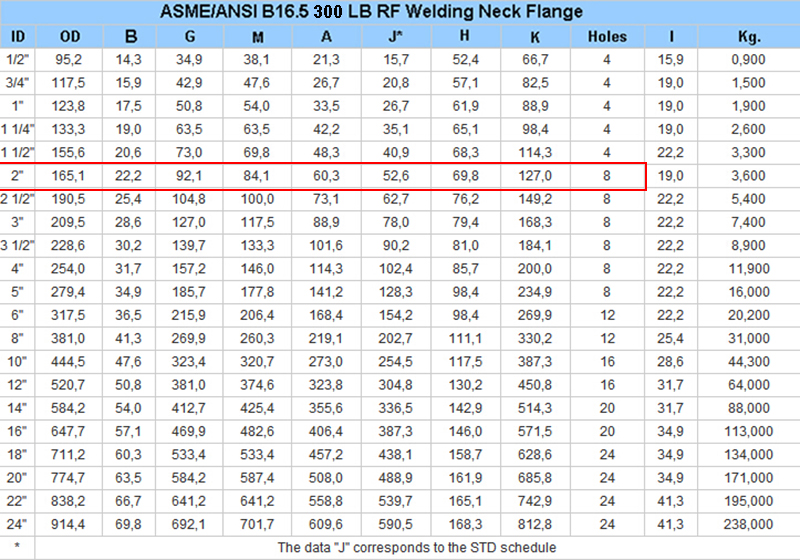
3. Flange Diameter and Structure
Nominal Diameter (DN): Larger diameters result in a longer bolt circle circumference. Under the same requirements for bolt spacing, a larger number of bolts can naturally be accommodated.
Nominal Diameter (DN): Larger diameters result in a longer bolt circle circumference. Under the same requirements for bolt spacing, a larger number of bolts can naturally be accommodated.
Flange Thickness and Stiffness: If the flange plate is relatively thin or lacks rigidity, increasing the number of bolts can help reduce flange deformation and achieve more uniform gasket loading.
European standard flange size table

4. Sealing Requirements and Gasket Type
Sealing Face Type: Different sealing faces, such as raised face (RF), male-female face (MFM), tongue-and-groove face (TG), and ring joint face (RJ), have varying requirements for clamping force distribution. For example, ring joint face flanges, typically used for high pressure and high temperature, have strict regulations regarding the number and size of bolt holes.
Sealing Face Type: Different sealing faces, such as raised face (RF), male-female face (MFM), tongue-and-groove face (TG), and ring joint face (RJ), have varying requirements for clamping force distribution. For example, ring joint face flanges, typically used for high pressure and high temperature, have strict regulations regarding the number and size of bolt holes.
Gasket Material and Width: Wider or less rigid gaskets require more uniform and dense clamping force to prevent leakage, which may necessitate more bolts.
5. Bolt Size and Strength
The number of bolt holes is directly related to the effective cross-sectional area and material strength of individual bolts. For a given required total load:
Using high-strength, large-diameter bolts may allow for a relatively smaller number.
Using low-strength, small-diameter bolts may require an increase in number.
The design must balance the number and size of bolts with the available wrench operating space.
The number of bolt holes is directly related to the effective cross-sectional area and material strength of individual bolts. For a given required total load:
Using high-strength, large-diameter bolts may allow for a relatively smaller number.
Using low-strength, small-diameter bolts may require an increase in number.
The design must balance the number and size of bolts with the available wrench operating space.
6. Operation and Maintenance Requirements
Wrench Clearance: There must be sufficient clearance between adjacent bolt holes to allow for tightening and disassembly using tools. This determines the maximum possible number of bolts.
Wrench Clearance: There must be sufficient clearance between adjacent bolt holes to allow for tightening and disassembly using tools. This determines the maximum possible number of bolts.
Standardization and Interchangeability: To facilitate procurement, inventory management, and installation, preference is usually given to the hole numbers specified in standards rather than opting for special designs.
7. External Loads
If the piping system is subjected to significant bending moments, shear forces, or vibration, it may be necessary to increase the number of bolts or adjust their arrangement to resist these external loads and prevent flange leakage or failure.
If the piping system is subjected to significant bending moments, shear forces, or vibration, it may be necessary to increase the number of bolts or adjust their arrangement to resist these external loads and prevent flange leakage or failure.
Qishine is ideal choice for EPC companies and project contractors.
Website: www.qishine.com
Email: qishine@qishine.com
Tel: 0592-5225595
Email: qishine@qishine.com
Tel: 0592-5225595
WhatsApp: +86 15985833169
Summary and Design Process
In practical engineering, the number of flange holes is not an independent variable but the result of system design. The typical design process is as follows:
In practical engineering, the number of flange holes is not an independent variable but the result of system design. The typical design process is as follows:
1. Determine Operating Conditions: Clarify the medium, design pressure, and design temperature.
2. Select Standard and Materials: Based on project specifications or regional practices, select the flange standard, sealing face type, and gasket.
3. Preliminary Selection of Flange Rating and Size: Based on pressure and diameter, preliminarily select a pressure rating (e.g., Class 150, PN16) from the standard.
4. Calculate Required Bolt Load: Calculate the minimum required total bolt load based on the end force generated by internal pressure and the clamping force required for gasket sealing.
5. Select Bolts and Determine Quantity: Select bolt material and specification. Calculate the total required cross-sectional area at the bolt root based on the required total load. Then, considering the number of bolt holes and bolt circle diameter specified in the standard, finally determine a bolt hole configuration that meets the load requirements and conforms to the standard provisions.
Ultimately, for standard flanges, the number of bolt holes is a function corresponding to the pressure rating (Class/PN) and nominal diameter (DN) in the standard tables. Designers primarily select by consulting these tables. Detailed calculation and design based on the above factors are only necessary for non-standard or special-condition flanges.
V-Basic Ring vs W-Basic Ring for Spiral Wound Gaskets
Insulating Gasket Kit Components Breakdown What Every Procurement Engineer Must Check Before Ordering
Related Article

Insights from a Case Study on Exporting B8M Fasteners.Recently, during our final outgoing inspection of a batch of B8M stainless steel fasteners destined for Portugal, we discovered varying degrees of burrs on the edges of the bolt hex heads.
How to Efficiently Remove Burrs from Bolt Edges

Insulating Gasket Procurement Pitfalls: From "Price Traps" to "Supplier Selection"
What pitfalls should you watch out for when purchasing insulating gaskets

As a classic modified PTFE gasket material from Garlock, Gylon 3500 is widely used in petrochemical, chemical, and other industries for its excellent resistance to strong acids, solvents, and anti-creep properties.
How to Buy Genuine Gylon 3500 Insulating Gaskets at Competitive Prices in China

