
How to Choose the Marking Method for Fasteners
author: www.qishine.com
2026-02-28

I. Four Common Methods for Fastener Marking
1. Cold heading forming (Forming Synchronous Marking)
Applicable Scenarios & Objects
Heads or sides of standard fasteners like bolts, nuts, screws
Synchronous marking during mass standardized production
Content mandated by regulations like property class, material identification
1. Cold heading forming (Forming Synchronous Marking)
Applicable Scenarios & Objects
Heads or sides of standard fasteners like bolts, nuts, screws
Synchronous marking during mass standardized production
Content mandated by regulations like property class, material identification

Cold Heading Forming: Permanent Optimum; Suitable for Mass Producion.
Marking Effect & Characteristics
Directly formed by the die during cold forging or hot forging, for example on a Corrosion-Resistant Stud Bolt
Characters can be raised (convex) or indented (concave)
Mark is integrally formed with the part, no subsequent processing step
Depth typically 0.1-0.3mm, adjustable based on specifications
Directly formed by the die during cold forging or hot forging, for example on a Corrosion-Resistant Stud Bolt
Characters can be raised (convex) or indented (concave)
Mark is integrally formed with the part, no subsequent processing step
Depth typically 0.1-0.3mm, adjustable based on specifications
Core Advantages
Best permanence, mark lasts the material's lifetime
Lowest per-unit cost
Good consistency
Best permanence, mark lasts the material's lifetime
Lowest per-unit cost
Good consistency
Disadvantages & Limitations
Only suitable for mass production; high mold investment cost
Marking content cannot be changed; poor flexibility
Not economical for non-standard parts or small batches
Only suitable for mass production; high mold investment cost
Marking content cannot be changed; poor flexibility
Not economical for non-standard parts or small batches
2. Steel Stamping / Dot-Matrix Stamping Head (Impact Marking)
Applicable Scenarios & Objects
Fasteners with thick walls (diameter ≥ M12)
High-strength fasteners after heat treatment (Class 10.9 and above)
Single-piece or small-batch production scenarios
High-demand industries like nuclear power, aerospace
Applicable Scenarios & Objects
Fasteners with thick walls (diameter ≥ M12)
High-strength fasteners after heat treatment (Class 10.9 and above)
Single-piece or small-batch production scenarios
High-demand industries like nuclear power, aerospace
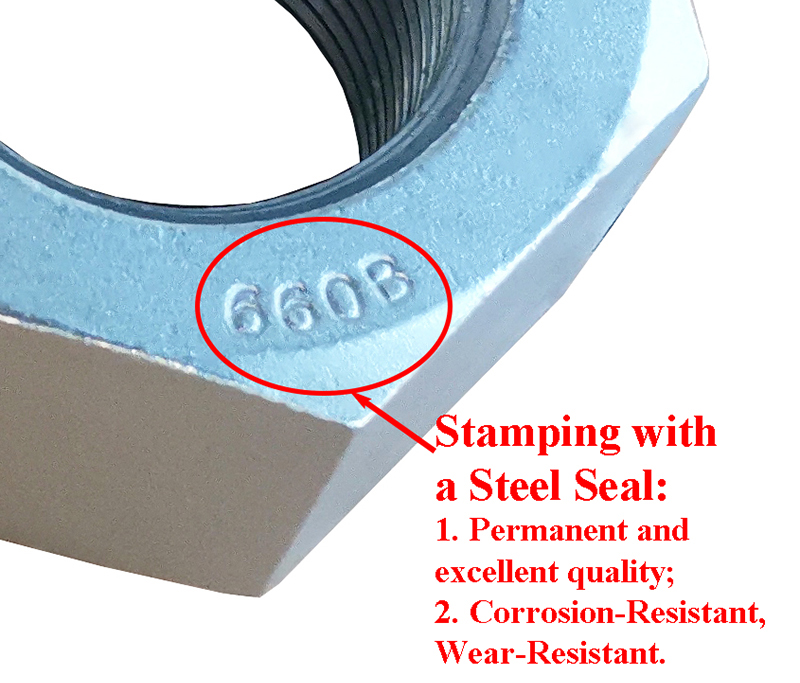
Stamping with a Steel Seal: 1. Permanent and excellent quality; 2. Corrosion-Resistant, Wear-Resistant
Marking Effect & Characteristics
Characters formed by impact-created dot or spherical depressions
Marking depth typically 0.1-0.6mm (adjusted based on diameter)
Creates permanent mechanical deformation; wear-resistant, high-temperature resistant
Can be used on curved surfaces like the circumference of a bolt head
Characters formed by impact-created dot or spherical depressions
Marking depth typically 0.1-0.6mm (adjusted based on diameter)
Creates permanent mechanical deformation; wear-resistant, high-temperature resistant
Can be used on curved surfaces like the circumference of a bolt head
Core Advantages
Excellent permanence, suitable for harsh environments
Corrosion resistant; mark remains identifiable after coating
Excellent permanence, suitable for harsh environments
Corrosion resistant; mark remains identifiable after coating
Disadvantages & Limitations
May cause local stress concentration
Can easily cause deformation in small-diameter or thin-walled fasteners
Manual operation is inefficient; consistency depends on operator skill
May cause local stress concentration
Can easily cause deformation in small-diameter or thin-walled fasteners
Manual operation is inefficient; consistency depends on operator skill
3. Pneumatic Marking Machine (Micro-Impact Dot Matrix)
Applicable Scenarios & Objects
Medium/small batch, multi-variety fasteners such as Metric Hex Bolt
Integration into automated production lines
Marking on curved or inclined surfaces
Products requiring serial number traceability
Applicable Scenarios & Objects
Medium/small batch, multi-variety fasteners such as Metric Hex Bolt
Integration into automated production lines
Marking on curved or inclined surfaces
Products requiring serial number traceability
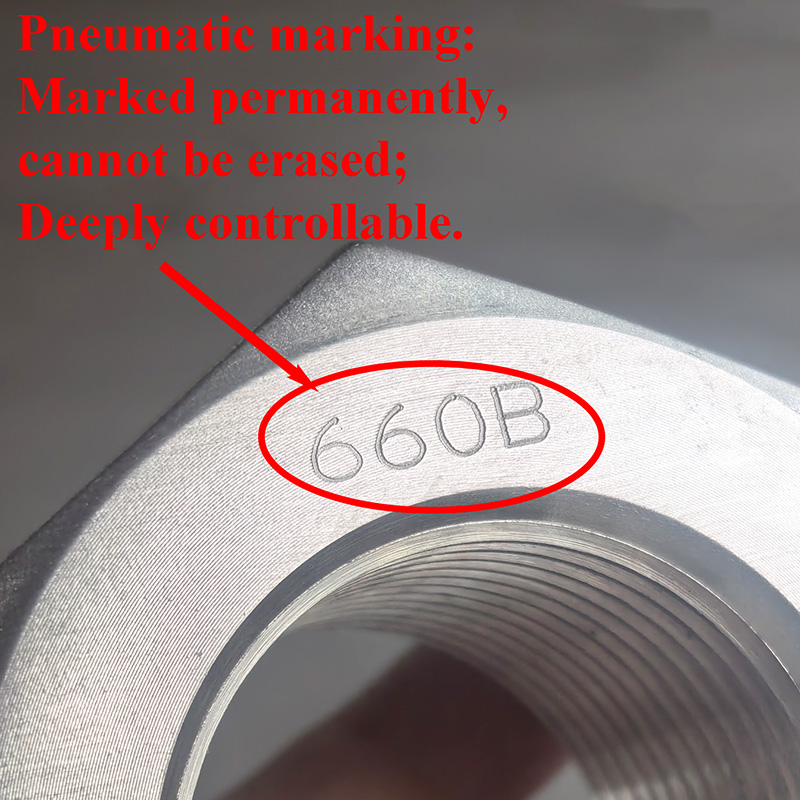
Pneumatic marking: Marked Permanently, cannot be erased; deeply controllable.

Marking Effect & Characteristics
High-frequency micro-impacts (50-200Hz) form continuous dot matrix
Large controllable depth range (0.01-1.0mm)
Can mark full characters, graphics, QR codes
Non-contact (some models are light-contact)
High-frequency micro-impacts (50-200Hz) form continuous dot matrix
Large controllable depth range (0.01-1.0mm)
Can mark full characters, graphics, QR codes
Non-contact (some models are light-contact)
4. Laser Marking (Non-Contact)
Applicable Scenarios & Objects
Precision fasteners
Marking after surface coating or treatment
Small-diameter fasteners
Applications for QR code traceability systems, including for parts like the ASME B18.2.4.1M 8S Hex Nut
Applicable Scenarios & Objects
Precision fasteners
Marking after surface coating or treatment
Small-diameter fasteners
Applications for QR code traceability systems, including for parts like the ASME B18.2.4.1M 8S Hex Nut
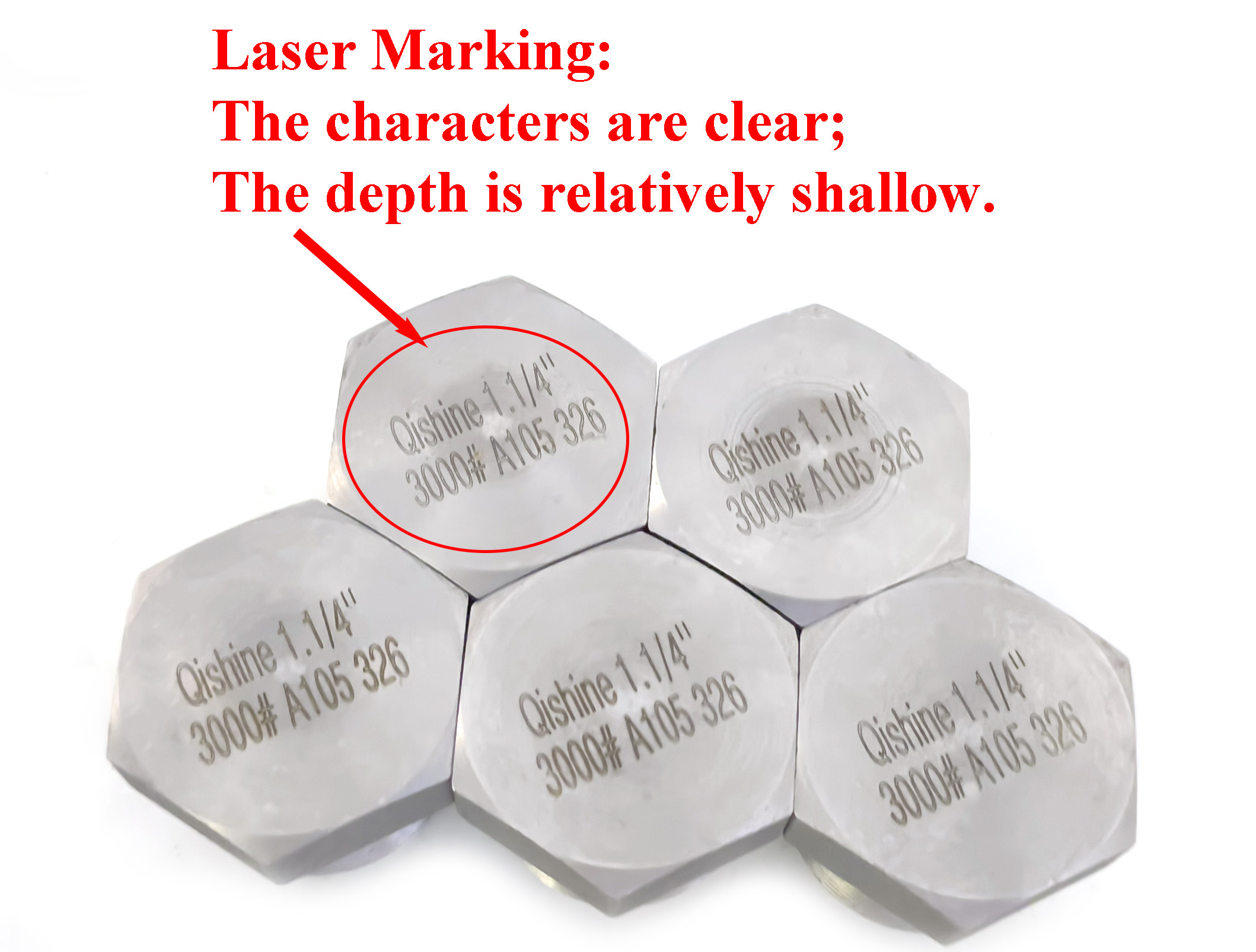
Laser Marking: The characters are clear; The depth is relatively shallow.
Marking Effect & Characteristics
Completely non-contact, no mechanical stress
Creates contrast via oxidation/discoloration/micro-etching
Precision up to 0.01mm; very small characters remain clear
Can mark complex graphics, Data Matrix codes
Completely non-contact, no mechanical stress
Creates contrast via oxidation/discoloration/micro-etching
Precision up to 0.01mm; very small characters remain clear
Can mark complex graphics, Data Matrix codes
Core Advantages
Fastest marking speed, suitable for large volumes
Highest flexibility, content can be changed anytime
Fastest marking speed, suitable for large volumes
Highest flexibility, content can be changed anytime
Disadvantages & Limitations
Requires special parameters for highly reflective materials (polished stainless steel)
Mark has no depth; may wear off in high-abrasion environments
Requires special parameters for highly reflective materials (polished stainless steel)
Mark has no depth; may wear off in high-abrasion environments
Qishine is ideal choice for EPC companies and project contractors.
Website: www.qishine.com
Email: qishine@qishine.com
Tel: 0592-5225595
Email: qishine@qishine.com
Tel: 0592-5225595
WhatsApp: +86 15960259563
II. Decision Framework for Fastener Marking
1. Material Characteristics Priority Principle
Low-carbon steel/Alloy steel: All methods suitable; prefer cold forging or pneumatic.
Stainless steel: Laser works best; avoid steel stamping to prevent passivation layer damage.
Titanium alloy/High-temperature alloys: Laser is the first choice.
Aluminum/Copper alloys: Control pressure to prevent deformation; pneumatic is better than steel stamping.
Surface-treated parts: Prefer laser for zinc/chrome plating; Dacromet coating allows pneumatic marking.
1. Material Characteristics Priority Principle
Low-carbon steel/Alloy steel: All methods suitable; prefer cold forging or pneumatic.
Stainless steel: Laser works best; avoid steel stamping to prevent passivation layer damage.
Titanium alloy/High-temperature alloys: Laser is the first choice.
Aluminum/Copper alloys: Control pressure to prevent deformation; pneumatic is better than steel stamping.
Surface-treated parts: Prefer laser for zinc/chrome plating; Dacromet coating allows pneumatic marking.
2. Production Batch Size and Flexibility
Large batch, standardized: Cold forging synchronous marking.
Medium batch, multi-variety: Pneumatic automatic marking system.
Small batch, custom: Manual steel stamping or portable laser.
Large batch, standardized: Cold forging synchronous marking.
Medium batch, multi-variety: Pneumatic automatic marking system.
Small batch, custom: Manual steel stamping or portable laser.
3. Traceability Requirement Level
Basic traceability: Lot number + date; pneumatic is sufficient.
Advanced traceability: Unique serial number; laser for QR codes.
Full lifecycle: Data Matrix code + MES integration; must use laser.
Regulatory mandates: Choose method per industry standards (e.g., nuclear-specified methods).
Basic traceability: Lot number + date; pneumatic is sufficient.
Advanced traceability: Unique serial number; laser for QR codes.
Full lifecycle: Data Matrix code + MES integration; must use laser.
Regulatory mandates: Choose method per industry standards (e.g., nuclear-specified methods).
III. Common Problems and Solutions
Q1: How to choose a marking method for high-strength fasteners (Class 12.9)?
Answer: Prefer synchronous marking during cold forging. If already heat-treated, choose laser (control power to avoid tempering) or special hard alloy steel stamps. Stress testing and hydrogen embrittlement risk assessment are mandatory.
Q1: How to choose a marking method for high-strength fasteners (Class 12.9)?
Answer: Prefer synchronous marking during cold forging. If already heat-treated, choose laser (control power to avoid tempering) or special hard alloy steel stamps. Stress testing and hydrogen embrittlement risk assessment are mandatory.
Q2: How to mark miniature fasteners below M3?
Answer: Desktop fiber laser machines are the only practical solution. Requires customized vibratory bowl feeder systems with visual positioning. Simplify marking content to codes, not full text. 100% magnification inspection after marking is required.
Answer: Desktop fiber laser machines are the only practical solution. Requires customized vibratory bowl feeder systems with visual positioning. Simplify marking content to codes, not full text. 100% magnification inspection after marking is required.
Q3: How to meet diverse standards for export to different countries?
Answer: Establish a "marking requirement database" for automatic switching by destination. The safest approach is to meet the strictest standards (typically nuclear or aerospace) and obtain third-party certification. The flexibility of laser systems is advantageous here.
Answer: Establish a "marking requirement database" for automatic switching by destination. The safest approach is to meet the strictest standards (typically nuclear or aerospace) and obtain third-party certification. The flexibility of laser systems is advantageous here.
Q4: How to mark fasteners that already have a coating?
Answer: Coatings like zinc-nickel can be laser marked effectively. For Dacromet coating, it's recommended to mark before coating or use specific laser wavelengths. Electrophoretic coatings are generally unsuitable for any mechanical marking.
Answer: Coatings like zinc-nickel can be laser marked effectively. For Dacromet coating, it's recommended to mark before coating or use specific laser wavelengths. Electrophoretic coatings are generally unsuitable for any mechanical marking.
Conclusion
Fastener marking is far more than simple "labeling"; it is a frontier field integrating materials science, mechanical analysis, production management, and information technology. Choosing the correct method not only ensures compliance but also enhances product added value and brand image. With the development of Industry 4.0 and the Internet of Things, marking is transforming from a "necessary process" into a "data entry point," becoming a key node in smart manufacturing.
Fastener marking is far more than simple "labeling"; it is a frontier field integrating materials science, mechanical analysis, production management, and information technology. Choosing the correct method not only ensures compliance but also enhances product added value and brand image. With the development of Industry 4.0 and the Internet of Things, marking is transforming from a "necessary process" into a "data entry point," becoming a key node in smart manufacturing.
For in-depth analysis of specific fastener types (e.g., structural steel bolts, wheel hub bolts, engine-specific screws), or assistance in establishing internal marking technical specifications for your enterprise, please provide detailed information for customized solutions.
Website: www.qishine.com
Email: qishine@qishine.com
Tel: 0592-5225595
Email: qishine@qishine.com
Tel: 0592-5225595
WhatsApp: +86 15960259563
Stop Guessing: The Ultimate Cheat Sheet for Reading Flange Markings
6 Commonly Used Butterfly Valves in the Petroleum Industry Pipeline
Related Article

Insights from a Case Study on Exporting B8M Fasteners.Recently, during our final outgoing inspection of a batch of B8M stainless steel fasteners destined for Portugal, we discovered varying degrees of burrs on the edges of the bolt hex heads.
How to Efficiently Remove Burrs from Bolt Edges

Insulating Gasket Procurement Pitfalls: From "Price Traps" to "Supplier Selection"
What pitfalls should you watch out for when purchasing insulating gaskets

As a classic modified PTFE gasket material from Garlock, Gylon 3500 is widely used in petrochemical, chemical, and other industries for its excellent resistance to strong acids, solvents, and anti-creep properties.
How to Buy Genuine Gylon 3500 Insulating Gaskets at Competitive Prices in China

