
Slip-On Flange vs Socket Weld Flange: The 5-Minute Guide to Choosing Right
author: www.qishine.com
2026-03-05

One-Minute Overview
- If the pipe is over 2 inches, go Slip-On.
- Socket Weld is strictly for small-bore piping (≤ DN40 / NPS 2).
- Socket Weld flanges are often the suitable choice when pressure conditions are ≤ PN10.0MPa and pipe sizes are ≤ DN40.
- Slip-On flanges are typically suitable for pressure classes up to Class 300, while Socket Weld flanges can operate stably under higher pressure conditions.
One-Minute Brief: Slip-On vs. Socket Weld Flange
Pressure Limit: Use Slip-On for Class 300 & below. Use Socket Weld for high-pressure up to Class 1500 (size restricted).
Size Range: Slip-On fits DN10–DN600 (wide range). Socket Weld is strictly for small-bore piping (≤ DN40 / NPS 2).
Welding Cost: Slip-On requires 2 fillet welds (higher labor). Socket Weld needs only 1 external weld (faster installation).
Best Application: Choose Socket Weld for high-temp steam or toxic fluids in small lines. Choose Slip-On for general water/oil services where frequent disassembly is needed.
The Golden Rule: If the pipe is over 2 inches, go Slip-On. If under 2 inches and high pressure, go Socket Weld.
Choosing the wrong flange can double your welding costs or even cause leaks under high pressure. If you're debating between Slip-On Flanges (SO) and Socket Weld Flanges (SW), you're not alone. While they look similar, using a Socket Weld where a Slip-On fits (or vice versa) is a common engineering pitfall. Here’s how to decide based on pressure, size, and total installed cost.
01 Flange Overview
1) Slip-On Flange
The Slip-On flange is a common flange type suitable for medium-pressure ranges. This flange achieves connection by inserting the pipe into the flange's inner diameter and welding it. It is widely used in piping systems for chemical, petroleum, machinery, and municipal engineering.
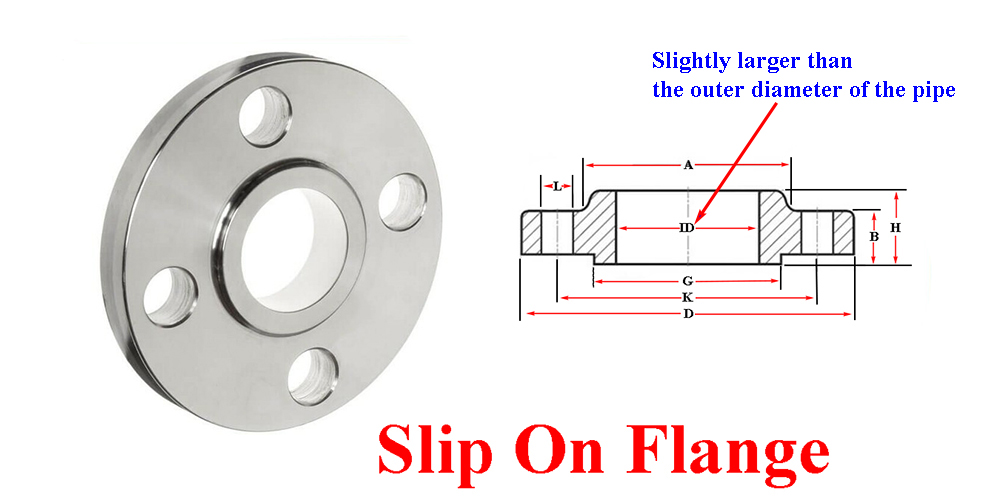
Slip On Flange: Slightly larger than the outer diameter of the pipe
2) Socket Weld Flange
The Socket Weld flange employs a different design concept, incorporating a small internal shoulder. The pipe is pushed against this shoulder for welding. This design creates a more robust connection between the flange and the pipe, making it particularly suitable for small-diameter, high-pressure piping systems.
These two flanges serve distinct roles in industrial piping systems with clear applicable scopes. Socket Weld flanges are often the suitable choice when pressure conditions are ≤ PN10.0MPa and pipe sizes are ≤ DN40.
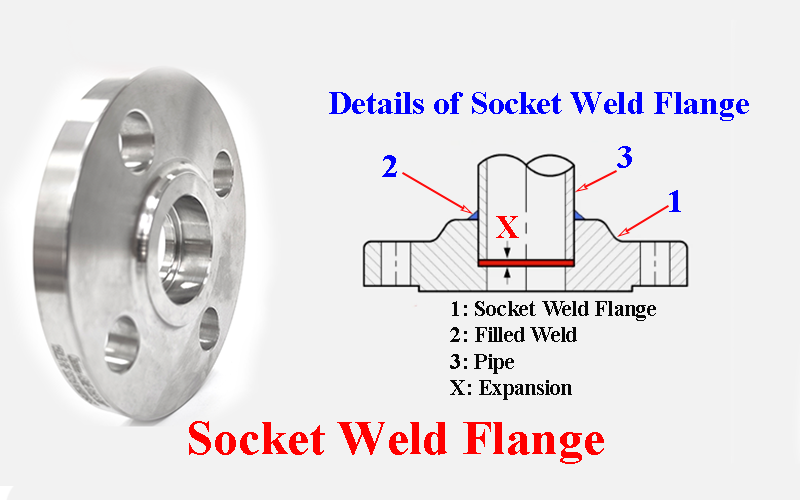
Socket Weld Flange: How to connect to the pipeline
02 Appearance and Shape
The most noticeable visual difference between Slip-On and Socket Weld flanges lies in their internal structure.
1) Slip-On Flange
The bore diameter of a Slip-On flange is typically slightly larger than the pipe's outer diameter, allowing the pipe to slide in easily. The flange features a short hub, which enhances its overall strength and load-bearing capacity. It comes in various face types, including Raised Face (RF), Male & Female (MFM), Tongue & Groove (TG), and Ring Joint (RJ).
2) Socket Weld Flange
The Socket Weld flange has a prominent internal shoulder or recess. The pipe can be inserted and butted against this internal shoulder. This unique design allows for more precise alignment between the pipe and flange, making it easier to maintain pipe position stability during welding.
There is a distinct difference in the applicable size ranges of the two flanges. Slip-On flanges cover a wide range, from DN10 to DN600; Socket Weld flanges are primarily used for small-bore piping, typically suitable for sizes ≤ DN40.
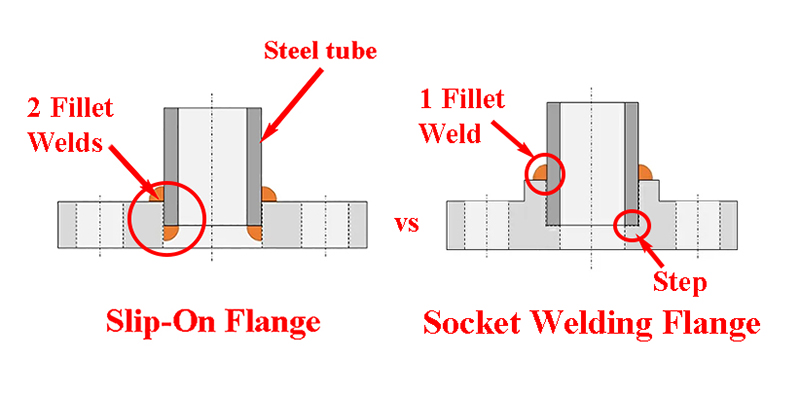
Slip On Flange vs Socket Welding Flange
Website: www.qishine.com
03 Welding Comparison
The welding procedure is one of the most fundamental differences between Slip-On and Socket Weld flanges.
1) Slip-On Flange
Connecting a Slip-On flange requires two fillet welds: one on the inside of the flange hub and another on the outside. While this double welding provides a more reliable connection, it also increases welding workload and material consumption.
2) Socket Weld Flange
Welding for a Socket Weld flange is simpler, requiring only a single external fillet weld to complete the connection. This design simplifies the welding process but also demands higher welding technique and precision.
Due to differences in welding characteristics, the qualification requirements for welders also differ. Welders for Slip-On flanges do not need to possess butt welding qualifications; they only need to be capable of performing fillet welds, which lowers the construction threshold.
Cost Consideration: "While SO flanges are cheaper to buy, they require two fillet welds (inside and outside), which doubles the welding time and consumables compared to SW's single weld. For small-bore pipes (≤DN40), the lower labor cost of SW often offsets its higher material price. Always calculate the Total Installed Cost before purchasing.
However, welding methods become restricted when pipe sizes reach a certain point. According to the ASME B31.1 standard, Slip-On flanges larger than NPS 4 must be connected using double fillet welds.
04 Application Scenarios
Slip-On and Socket Weld flanges have their own areas of emphasis in application.
Pressure class is a key indicator for selecting flange types. Slip-On flanges are typically suitable for pressure classes up to Class 300, while Socket Weld flanges can operate stably under higher pressure conditions.
There are also clear differences in the applicable size ranges. Socket Weld flanges are usually used for small-bore pipes, especially suitable for pipe sizes not exceeding NPS 2.
In contrast, Slip-On flanges have a broader size adaptability, usable in piping systems from DN10 to DN600.
Different industries and systems also have specific codes for flange selection. In power plant boiler external piping systems, Slip-On flanges up to NPS 4 can be used, but must be connected via double fillet welds.
For Socket Weld flanges, they are applicable for pipes not exceeding NPS 3 at Class 600 and below; at Class 1500, they are limited to not exceeding NPS 2.5.
Stop reading specs sheets. Here is the Cheat Sheet for your quick decision:
Slip-On Flange vs. Socket Weld Flange: Characteristic Comparison
| Comparison Dimension | Slip-On Flange (SO) | Socket Weld Flange (SW) |
| Connection Method | Pipe inserted into flange, connected by internal & external fillet welds | Pipe inserted into flange shoulder, connected by single external fillet weld |
| Typical Applicable Pressure | Class 300 and below | Up to Class 1500 (with size restrictions) |
| Typical Applicable Size | DN10 ~ DN600 | DN ≤ 40 (Small-bore piping) |
| Main Application Scenarios | Medium-low pressure piping, situations requiring frequent disassembly | Small-bore high-pressure piping, boiler/pressure vessel connections |
| Welding Requirements | Double fillet welds, welder needs no butt weld qualification | Single fillet weld, requires higher welding precision |
| Main Advantages | Easy alignment, lower cost, flexible installation | High rigidity, minimal welding distortion, good sealing performance |
05 Selection Strategy: Decision-Making Based on Engineering Needs
Choosing between Slip-On and Socket Weld flanges in actual engineering requires a comprehensive evaluation of multiple factors. Socket Weld flanges are often the more suitable choice when system pressure is high (exceeding Class 300) and pipe diameter is small (not exceeding NPS 2).
For piping systems requiring frequent disassembly and inspection, Slip-On flanges may be more suitable due to their ease of alignment and installation flexibility.
Cost factors are also important to consider. Although the procurement cost of a Slip-On flange itself might be lower, considering the welding cost for two fillet welds, the final total installation cost might not differ significantly from that of a Socket Weld flange.
It is noteworthy that some clients and project specifications may explicitly restrict the use of specific flange types. For example, some engineering projects may completely prohibit the use of Socket Weld flanges in process systems, limiting them to utility systems like water and air.
FAQ
Q1: Can Slip-On flanges handle high pressure?
A: No, limited to Class 300 and below. For higher pressure, choose Socket Weld or Weld Neck.
Q2: Why are Socket Weld flanges only used for small pipes?
A: To avoid thermal distortion and fluid trapping. ASME restricts them to NPS 2 and smaller.
Q3: Which is cheaper to install: Slip-On or Socket Weld?
A: Socket Weld costs less in labor—it needs one weld, while Slip-On needs two.
Q4: Do Socket Weld welders need special certification?
A: Yes, they require tighter joint precision and specific ASME Section IX qualification.
Q5: Which flange is better for high-temperature steam lines?
A: Socket Weld, for its high rigidity and minimal distortion in small-bore systems.
FAQ
What is The bore diameter of a Slip-On flange?
The bore diameter of a Slip-On flange is typically slightly larger than the pipe's outer diameter, allowing the pipe to slide in easily.
What is the minimum order quantity for flanges and pipe fittings?
Standard dimensions begin at one piece. Non-standard sizes, special facing types and made-to-order items are quoted individually, so the minimum depends on the drawing.
How long is the usual delivery?
Regular production is normally completed within 30 days. The precise timing depends on size, material and quantity, and items held in stock can be shipped at once.
Which payment terms are available?
We accept established international terms such as T/T and L/C. Final terms are confirmed with the quotation for the order in question.
Qishine is ideal choice for EPC companies and project contractors.
WhatsApp: +86 15985833169
Do you know what the markings on the spiral wound gasket represent
FF RF or RTJ Choose the Right Flange Face or Pay the Price Later
Related Article

Insights from a Case Study on Exporting B8M Fasteners.Recently, during our final outgoing inspection of a batch of B8M stainless steel fasteners destined for Portugal, we discovered varying degrees of burrs on the edges of the bolt hex heads.
How to Efficiently Remove Burrs from Bolt Edges

Insulating Gasket Procurement Pitfalls: From "Price Traps" to "Supplier Selection"
What pitfalls should you watch out for when purchasing insulating gaskets

As a classic modified PTFE gasket material from Garlock, Gylon 3500 is widely used in petrochemical, chemical, and other industries for its excellent resistance to strong acids, solvents, and anti-creep properties.
How to Buy Genuine Gylon 3500 Insulating Gaskets at Competitive Prices in China

