
Four Common Types of Pipe Flange Fastener Torque Wrenches
author: www.qishine.com
2026-03-03

An In-Depth Analysis of Four Common Types of Fastener Torque Wrenches: A Comprehensive Guide from Manual to Hydraulic
As a company with years of experience in supplying fastener products for the petroleum pipeline industry, Qishine is frequently asked how to choose the right torque wrench. Torque wrenches are core tools in the field of precision fastening, and different application scenarios require different types of wrenches. Below, I will provide a comprehensive analysis of these four common types of torque wrenches to help you understand their characteristics, suitable applications, and key usage points.

Common Types of Fastener Torque Wrenches: Hydraulic, Electric, Pneumatic, Manual, etc.
1. Manual Torque Wrench: The Classic Choice for Precise Control
Features and Working Principle
The manual torque wrench is the most basic and common type, controlling the applied torque through preset or indicating methods. Common types include:
Dial Indicator Type: Real-time torque value is displayed via a dial pointer.
Preset (Click) Type: The target torque is set in advance; it produces a "click" sound or automatically releases force when reached.
Features and Working Principle
The manual torque wrench is the most basic and common type, controlling the applied torque through preset or indicating methods. Common types include:
Dial Indicator Type: Real-time torque value is displayed via a dial pointer.
Preset (Click) Type: The target torque is set in advance; it produces a "click" sound or automatically releases force when reached.
Manual Torque Wrench
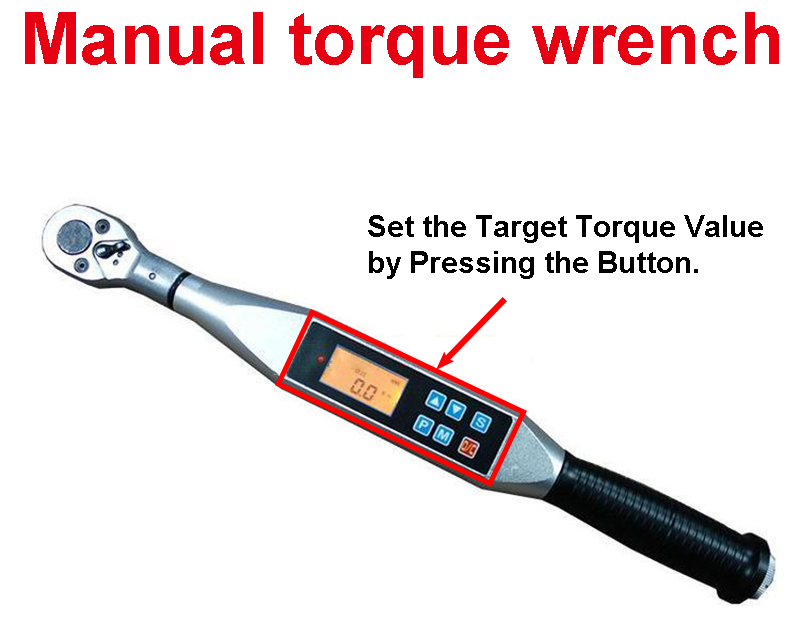
Manual Torque Wrench: set the target torque value by pressing the button
Digital Display Type: Torque is read directly from an electronic display, offering the highest precision. It alerts when the set value is reached and can switch between units like N·m, lb·ft, kgf·cm.
Advantages
High Precision: High-quality manual wrenches can achieve accuracy of ±1-3%.
Low Cost: Lowest initial investment and maintenance costs.
High Precision: High-quality manual wrenches can achieve accuracy of ±1-3%.
Low Cost: Lowest initial investment and maintenance costs.
Flexible and Portable: No external power source required, suitable for various sites.
Simple Maintenance: Simple structure, low failure rate.
Simple Maintenance: Simple structure, low failure rate.
Disadvantages
Operator Dependent: Accuracy is affected by the operator's skill level and consistency.
Lower Efficiency: Not suitable for high-volume fastening operations.
Operator Dependent: Accuracy is affected by the operator's skill level and consistency.
Lower Efficiency: Not suitable for high-volume fastening operations.
Physical Demand: High-torque operations require significant physical effort.
Suitable Environments
Laboratory and R&D: Scenarios requiring small batches and high precision.
Field Maintenance: Automotive repair, equipment maintenance, pipe flange assembly, etc.
Quality Control: Sampling inspection and final torque verification.
Field Maintenance: Automotive repair, equipment maintenance, pipe flange assembly, etc.
Quality Control: Sampling inspection and final torque verification.
2. Pneumatic Torque Wrench: The Industrial Workhorse for Efficient Production
Features and Working Principle
Utilizes compressed air to drive a gear or vane motor, automatically stopping via a clutch mechanism when the preset torque is reached.
Features and Working Principle
Utilizes compressed air to drive a gear or vane motor, automatically stopping via a clutch mechanism when the preset torque is reached.
Pneumatic Torque Wrench

Pneumatic Torque Wrench: the clutch mechanism automatically stops when the preset torque is reached
Advantages
High Efficiency: Quickly completes fastening tasks, significantly boosting production efficiency.
High Efficiency: Quickly completes fastening tasks, significantly boosting production efficiency.
Reduces Labor: High degree of automation reduces operator fatigue.
High Consistency: Minimizes human factors, ensuring consistent batch product quality.
High Consistency: Minimizes human factors, ensuring consistent batch product quality.
Disadvantages
Dependent on Air Supply: Requires a stable compressed air supply system.
Higher Noise: Usually requires hearing protection.
Dependent on Air Supply: Requires a stable compressed air supply system.
Higher Noise: Usually requires hearing protection.
High Initial Investment: Requires an air supply system and piping layout.
Relatively Lower Precision: Typically around ±5%.
Relatively Lower Precision: Typically around ±5%.
Suitable Environments
Production Line Assembly: Batch manufacturing industries like automotive and appliances.
Large Equipment Installation: Fields like wind power, heavy machinery, and pipe flange assembly.
Medium to High Torque Requirements: Suitable for most industrial fastening scenarios.
Large Equipment Installation: Fields like wind power, heavy machinery, and pipe flange assembly.
Medium to High Torque Requirements: Suitable for most industrial fastening scenarios.
3. Electric Torque Wrench: The Modern Smart-Control Solution
Features and Working Principle
Employs an electric motor drive combined with an electronic control system to achieve precise torque control. It represents modern smart manufacturing tools.
Features and Working Principle
Employs an electric motor drive combined with an electronic control system to achieve precise torque control. It represents modern smart manufacturing tools.
Electric Torque Wrench

Electric Torque Wrench: By setting the torque value in advance and combining it with the electronic control system, precise torque control is achieved.
Advantages
High Level of Intelligence: Programmable, with data storage and transmission capabilities.
High Level of Intelligence: Programmable, with data storage and transmission capabilities.
Excellent Precision: Good electric wrenches can achieve accuracy of ±1-2%.
Low Energy Consumption: More energy-efficient and environmentally friendly than pneumatic tools.
Low Energy Consumption: More energy-efficient and environmentally friendly than pneumatic tools.
Lower Noise: More friendly to the working environment.
Disadvantages
Highest Cost: High initial investment and maintenance expenses.
Battery Limitations: Cordless models are limited by battery capacity and lifespan.
Heavier Weight: May increase fatigue during prolonged operation.
Highest Cost: High initial investment and maintenance expenses.
Battery Limitations: Cordless models are limited by battery capacity and lifespan.
Heavier Weight: May increase fatigue during prolonged operation.
Suitable Environments
Smart Factories: Automated production lines integrated with MES systems.
High-Standard Assembly: Industries with stringent quality requirements like aerospace and precision instruments.
Smart Factories: Automated production lines integrated with MES systems.
High-Standard Assembly: Industries with stringent quality requirements like aerospace and precision instruments.
Data Traceability Scenarios: Applications requiring data recording for each fastening point.
4. Hydraulic Torque Wrench: The Professional Tool for Ultra-High Torque
Features and Working Principle
Generates extremely high torque via high-pressure oil from a hydraulic pump driving a hydraulic motor or piston. It is a specialized tool for heavy industrial fields.
Features and Working Principle
Generates extremely high torque via high-pressure oil from a hydraulic pump driving a hydraulic motor or piston. It is a specialized tool for heavy industrial fields.
Hydraulic Torque Wrench

Hydraulic Torque Wrench: by adjusting the pressure or by adjusting the torque value on the wrench body
Advantages
Extremely High Torque Capacity: Can reach tens of thousands of Newton-meters, the only choice for super-large bolts.
Extremely High Torque Capacity: Can reach tens of thousands of Newton-meters, the only choice for super-large bolts.
Stable Precision: Can achieve ±3%, excellent performance among high-torque tools.
Fast Response: Hydraulic transmission responds quickly.
Fast Response: Hydraulic transmission responds quickly.
Disadvantages
Complex System: Requires supporting systems like hydraulic pumps and hoses.
Poor Portability: The system is bulky and difficult to move.
Professional Maintenance: Requires specialized knowledge for maintenance.
Slower Speed: Longer single cycle time.
Complex System: Requires supporting systems like hydraulic pumps and hoses.
Poor Portability: The system is bulky and difficult to move.
Professional Maintenance: Requires specialized knowledge for maintenance.
Slower Speed: Longer single cycle time.
Suitable Environments
Heavy Industry: Wind turbine towers, large pressure vessels, bridge structures.
Energy Sector: Petroleum pipelines, nuclear power equipment, hydroelectric turbines.
Super-Large Bolts: Fastening and disassembly of bolts M36 and larger.
Heavy Industry: Wind turbine towers, large pressure vessels, bridge structures.
Energy Sector: Petroleum pipelines, nuclear power equipment, hydroelectric turbines.
Super-Large Bolts: Fastening and disassembly of bolts M36 and larger.
Qishine is ideal choice for EPC companies and project contractors.
Website: www.qishine.com
Email: qishine@qishine.com
Tel: 0592-5225595
Email: qishine@qishine.com
Tel: 0592-5225595
WhatsApp: +86 15960259563
Comprehensive Comparison and Selection Advice
| Feature | Manual Wrench | Pneumatic Wrench | Electric Wrench | Hydraulic Wrench |
| Precision | High (±1-3%) | Medium (±3-5%) | High (±1-3%) | Medium-High (±3%) |
| Torque Range | Small-Medium | Small-Medium | Small-Medium | Very Large |
| Efficiency | Low | High | High | Medium |
| Torque Adjustment Method | Mechanical/Electronic Setting | Air Pressure/Clutch Adjustment | Digital Programming Control | Hydraulic Pressure Control |
| Adjustment Precision | High | Medium | Very High | Medium-High |
| Adjustment Convenience | Convenient | Fairly Convenient | Very Convenient | Complex |
| Initial Cost | Low | Medium | High | High |
| Maintenance Cost | Low | Medium | High | High |
| Portability | Excellent | Good | Good | Poor |
| Suitable Scenarios | Precision/Repair | Batch Production | Smart Production Lines | Heavy Industry |
Professional Advice on Maintenance and Calibration
Recommended Calibration Intervals:
Manual Wrench: Calibrate every 5,000 uses or annually; verify after each adjustment.
Pneumatic Wrench: Calibrate quarterly or every 10,000 cycles; check the air pressure regulator monthly.
Recommended Calibration Intervals:
Manual Wrench: Calibrate every 5,000 uses or annually; verify after each adjustment.
Pneumatic Wrench: Calibrate quarterly or every 10,000 cycles; check the air pressure regulator monthly.
Electric Wrench: Verify key parameters monthly; perform full calibration every six months.
Hydraulic Wrench: Calibrate before each major project; calibrate the hydraulic pump pressure gauge monthly.
Hydraulic Wrench: Calibrate before each major project; calibrate the hydraulic pump pressure gauge monthly.
Maintenance Related to Torque Adjustment:
1. Manual Wrench: Clean and lubricate the adjustment mechanism to prevent sticking.
1. Manual Wrench: Clean and lubricate the adjustment mechanism to prevent sticking.
2. Pneumatic Wrench: Regularly clean the pressure regulator valve; check for clutch wear.
3. Electric Wrench: Keep software updated; calibrate the sensor zero point.
4. Hydraulic Wrench: Change hydraulic oil regularly; inspect all seals.
Conclusion
Torque adjustment capability is a key consideration when selecting a torque wrench. From simple mechanical adjustment to intelligent digital control, the adjustment method of different wrenches directly relates to ease of use, accuracy retention, and work efficiency.
Torque adjustment capability is a key consideration when selecting a torque wrench. From simple mechanical adjustment to intelligent digital control, the adjustment method of different wrenches directly relates to ease of use, accuracy retention, and work efficiency.
As an experienced supplier, we strongly recommend:
1. Establish Adjustment Records: Record the time, operator, and verification results for each torque adjustment.
1. Establish Adjustment Records: Record the time, operator, and verification results for each torque adjustment.
2. Standardize Adjustment Procedures: Develop standard operating instructions for adjusting each type of wrench.
3. Consider Future Needs: Choose tools with a certain adjustment margin to accommodate process changes.
In the field of precision assembly, the correct tools and accurate torque adjustment are not only a guarantee of efficiency but also a reflection of a quality commitment. With the development of smart manufacturing, the intelligence and datafication of torque adjustment will be an inevitable trend. However, the reliability of mechanical adjustment and the powerful capability of hydraulic adjustment will remain irreplaceable in specific fields.
Why is it not recommended to use spring washers for anti-loosening in high-strength bolts
Flange Bolt Torque Setting The Practical Guide for Engineers and Maintenance Teams
Related Article

Insights from a Case Study on Exporting B8M Fasteners.Recently, during our final outgoing inspection of a batch of B8M stainless steel fasteners destined for Portugal, we discovered varying degrees of burrs on the edges of the bolt hex heads.
How to Efficiently Remove Burrs from Bolt Edges

Insulating Gasket Procurement Pitfalls: From "Price Traps" to "Supplier Selection"
What pitfalls should you watch out for when purchasing insulating gaskets

As a classic modified PTFE gasket material from Garlock, Gylon 3500 is widely used in petrochemical, chemical, and other industries for its excellent resistance to strong acids, solvents, and anti-creep properties.
How to Buy Genuine Gylon 3500 Insulating Gaskets at Competitive Prices in China

