
Fastener Zinc Coating Thickness The 3-Minute Cheat Sheet for Engineers
author: www.qishine.com
2026-02-28

One-Minute Summary
Let’s cut the fluff. Fastener zinc thickness isn't a "one-size-fits-all" number. It boils down to two things: thread fit and rust risk. For standard indoor bolts (M6-M20), electroplated zinc runs 6-12 microns – just enough for a shiny finish. If you need precision threads, drop to 3-5 microns (thin coat). For outdoor steel structures, skip electroplating entirely and go hot-dip galvanized at 40-50 microns – it looks ugly but survives decades outdoors. Remember: thickness eats thread tolerance. Always check your go/no-go gauge after plating, not before. For high-strength 10.9 bolts, avoid hot-dip – hydrogen embrittlement will snap them. Use mechanical zinc plating instead.
Let’s cut the fluff. Fastener zinc thickness isn't a "one-size-fits-all" number. It boils down to two things: thread fit and rust risk. For standard indoor bolts (M6-M20), electroplated zinc runs 6-12 microns – just enough for a shiny finish. If you need precision threads, drop to 3-5 microns (thin coat). For outdoor steel structures, skip electroplating entirely and go hot-dip galvanized at 40-50 microns – it looks ugly but survives decades outdoors. Remember: thickness eats thread tolerance. Always check your go/no-go gauge after plating, not before. For high-strength 10.9 bolts, avoid hot-dip – hydrogen embrittlement will snap them. Use mechanical zinc plating instead.
The zinc coating thickness for fasteners (bolts, nuts, washers, etc.) follows international and domestic general standards. Its selection primarily depends on two core factors: thread precision and the corrosivity of the service environment. According to standards, the zinc coating for general fasteners is mainly divided into two processes: electroplated zinc and hot-dip galvanized.
Zinc coating thickness is usually expressed in micrometers (μm) or grams per square meter (g/m²). These units are convertible; generally, 7.1 g/m² is approximately equal to a thickness of 1 μm.
Electroplated zinc is the most common for fasteners, while hot-dip galvanizing is used for some large-sized or specially required parts.
Standards for fastener coating thickness are primarily based on ISO, ASTM, GB, and JIS standards. The coating thickness in these standards is not a fixed value but is related to the fastener's nominal thread diameter and property class.
Coating Thickness Specification and "Tolerance Classes"
In standards, coating thickness is specified by the local thickness (minimum value at a single measuring point). Simultaneously, "tolerance classes" are established based on thread fit requirements.
In standards, coating thickness is specified by the local thickness (minimum value at a single measuring point). Simultaneously, "tolerance classes" are established based on thread fit requirements.
Standard Coating: Applicable to threads with standard tolerance zones (e.g., 6g/6H). The coating thickness occupies part of the thread tolerance.
Thin Coating: Applicable to threads with precision tolerance zones (e.g., 4h/6H). The coating is very thin, barely altering the thread dimensions.
Thick Coating: Applicable to more corrosive environments, or where thread tolerance requirements are less strict.
1. Electroplated Zinc Fasteners
Electro-galvanizing is the most commonly used galvanizing process for fasteners. The coating is thin, uniform, and has a shiny appearance. It is usually accompanied by dulling films of blue-white, multicolored, and black colors.
Electro-galvanizing is the most commonly used galvanizing process for fasteners. The coating is thin, uniform, and has a shiny appearance. It is usually accompanied by dulling films of blue-white, multicolored, and black colors.
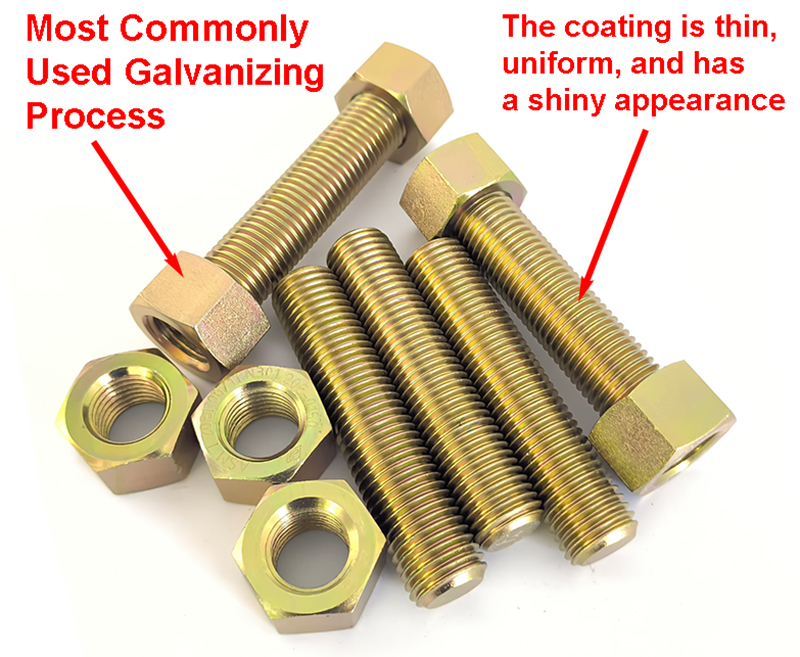
Electro-galvanizing: most commonly used galvanizing process, The coating is thin, uniform, and has a shiny appearance.
Standard Thickness Requirements (taking ISO 4042 / GB/T 5267.1 as an example):
a) Standard Coating Thickness (Most Common)
a) Standard Coating Thickness (Most Common)
| Thread Nominal Diameter d (mm) | Local Thickness Minimum (μm) |
| d ≤ 6 | 6 μm |
| 6 < d ≤ 12 | 9 μm |
| 12 < d ≤ 20 | 12 μm |
| d > 20 | 15 μm |
Example: An M10 bolt requires a minimum local electroplated zinc thickness of 9μm.
b) Thin Coating Thickness
| Thread Nominal Diameter d (mm) | Local Thickness Minimum (μm) |
| d ≤ 6 | 3 μm |
| 6 < d ≤ 12 | 4 μm |
| 12 < d ≤ 20 | 5 μm |
| d > 20 | 6 μm |
Application: Used for threads requiring precise fits. Post-plating, there is minimal concern about thread go/no-go gauge issues.
c) Thick Coating Thickness
Thickness requirements are typically about 1.5-2 times that of the standard coating, with specific values defined in standards. For example, an M10 bolt with a thick coating might require ≥15μm. Commonly used for outdoor or highly corrosive environments.
Thickness requirements are typically about 1.5-2 times that of the standard coating, with specific values defined in standards. For example, an M10 bolt with a thick coating might require ≥15μm. Commonly used for outdoor or highly corrosive environments.
2. Hot-Dip Galvanized Fasteners
The coating is thicker, offering far superior corrosion resistance compared to electroplated zinc. However, the appearance is rougher, with zinc dross and runs. Thread precision is affected, often requiring post-galvanizing re-tapping or the use of oversize internal threads.
The coating is thicker, offering far superior corrosion resistance compared to electroplated zinc. However, the appearance is rougher, with zinc dross and runs. Thread precision is affected, often requiring post-galvanizing re-tapping or the use of oversize internal threads.
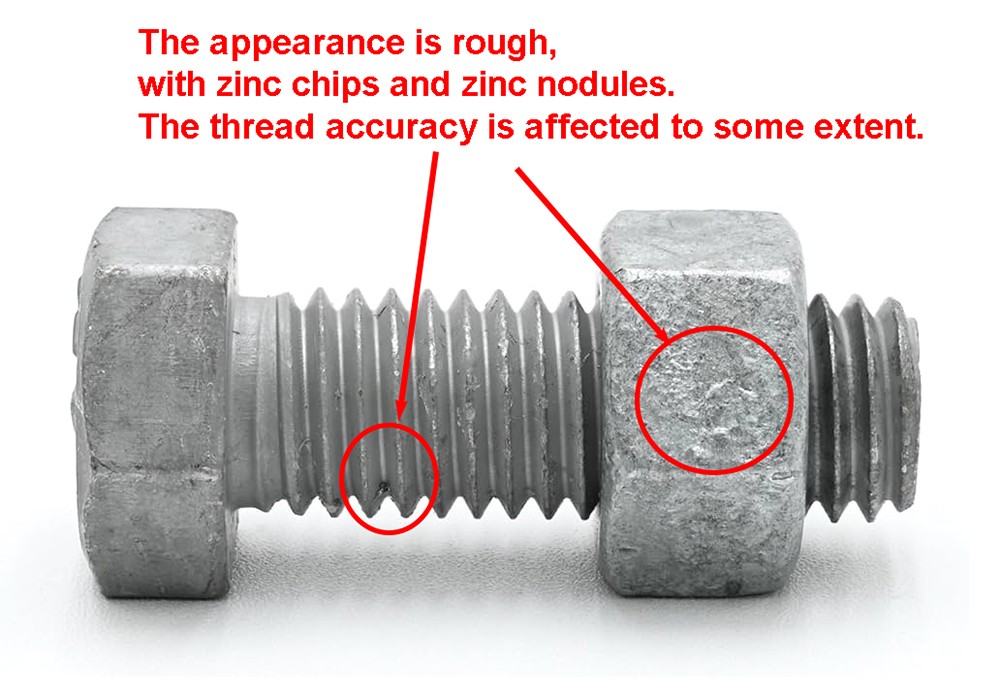
Hot-Dip Galvanized: The appearance is rough, with zinc chips and zinc nodules. The thread accuracy is affected to some extent.
Thickness is according to standards like ISO 10684 / GB/T 5267.2. Thickness relates to fastener size and material strength.
Typical Thickness Range:
For bolts with property class ≤ 8.8 (low or medium carbon steel), the average thickness is typically around 50μm, with a local minimum thickness usually not less than 40μm.
For high-strength bolts (e.g., class 10.9), hot-dip galvanizing is generally not recommended due to hydrogen embrittlement risk.
For bolts with property class ≤ 8.8 (low or medium carbon steel), the average thickness is typically around 50μm, with a local minimum thickness usually not less than 40μm.
For high-strength bolts (e.g., class 10.9), hot-dip galvanizing is generally not recommended due to hydrogen embrittlement risk.
Characteristics: Long corrosion protection life, but poor aesthetics and thread precision. Commonly used in heavy-duty corrosion protection fields like power transmission towers, traffic guardrails, and outdoor steel structures.
3. Mechanical Zinc-Plated Fasteners
Suitable for high-strength fasteners (≥ class 10.9) sensitive to hydrogen embrittlement. The coating is uniform, with no hydrogen embrittlement risk.
Suitable for high-strength fasteners (≥ class 10.9) sensitive to hydrogen embrittlement. The coating is uniform, with no hydrogen embrittlement risk.

Mechanical Zinc-Plated: Suitable for High-strength fasteners that are sensitive to hydrogen embrittlement (Grade ≥ 10.9), with uniform coating and no risk of hydrogen
Typical Thickness: Generally between 10 - 30 μm, customizable according to requirements.
Summary and Selection Guide
| Process | Typical Local Thickness Range | Core Characteristics | Applicable Fasteners & Scenarios |
| Electroplated Zinc (Standard) | M6: ≥6μm, M10: ≥9μm, M16: ≥12μm | Most common, good appearance, colored passivation, strict thickness standards | General machinery, electrical appliances, indoor equipment, automotive interior parts. Thread fit must be considered. |
| Electroplated Zinc (Thin) | M6: ≥3μm, M10: ≥4μm | Thin coating, minimally affects thread precision | Precision instruments, threaded connections requiring tight fits. |
| Electroplated Zinc (Thick) | Approx. 1.5-2 times standard coating | Better corrosion resistance | Outdoor cabinets, environments with some corrosivity (non-severe). |
| Hot-Dip Galvanized | Avg. ~50μm, Local ≥40μm | Strongest corrosion protection, but rough appearance, zinc runs affect threads | Outdoor infrastructure (towers, bridges, highways), heavy-duty corrosion protection steel structures. Often used for bolts ≤ class 8.8. |
| Mechanical Zinc Plating | 10 - 30 μm | No hydrogen embrittlement, uniform, appearance fall in between | High-strength fasteners (class 10.9 and above), automotive chassis parts, applications where hydrogen embrittlement fracture must be prevented. |
Conclusion: The zinc coating thickness on fasteners is not an arbitrary value but a systematic choice closely related to size, strength, environment, and assembly requirements. Engineers or purchasers should first refer to the product drawing's specified standards and technical requirements.
FAQ
1. Q: What is the standard zinc thickness for an M10 bolt?
- A: For electroplated standard coat, minimum 9 microns (local thickness). For thin coat, 4 microns.
1. Q: What is the standard zinc thickness for an M10 bolt?
- A: For electroplated standard coat, minimum 9 microns (local thickness). For thin coat, 4 microns.
2. Q: Is hot-dip galvanized stronger than electroplated?
- A: Yes, for corrosion. ~50 microns vs ~9 microns. But it ruins thread precision and looks rough.
- A: Yes, for corrosion. ~50 microns vs ~9 microns. But it ruins thread precision and looks rough.
3. Q: Can I hot-dip galvanize a Grade 12.9 bolt?
- A: No. Hydrogen embrittlement risk is too high. Use mechanical zinc plating instead.
- A: No. Hydrogen embrittlement risk is too high. Use mechanical zinc plating instead.
4. Q: Does zinc thickness affect thread gauge?
- A: Absolutely. Thicker coating reduces pitch diameter. Always use the "tolerance class" (standard, thin, thick) per ISO 4042.
- A: Absolutely. Thicker coating reduces pitch diameter. Always use the "tolerance class" (standard, thin, thick) per ISO 4042.
5. Q: How do I convert g/m² to microns?
- A: Roughly 7.1 g/m² = 1 micron. Use this for spec sheet conversions.
- A: Roughly 7.1 g/m² = 1 micron. Use this for spec sheet conversions.
6. Q: What if I need corrosion resistance but cannot lose thread fit?
- A: Use "thin coating" electroplating (3-6 microns) plus a high-quality sealant or topcoat.
- A: Use "thin coating" electroplating (3-6 microns) plus a high-quality sealant or topcoat.
Qishine is ideal choice for EPC companies and project contractors.
Website: www.qishine.com
Email: qishine@qishine.com
Tel: 0592-5225595
Email: qishine@qishine.com
Tel: 0592-5225595
WhatsApp: +86 15985833169
How to measure the pitch of a bolt thread
Zinc Plating for Fasteners - How Much Do You Know
Related Article

Insights from a Case Study on Exporting B8M Fasteners.Recently, during our final outgoing inspection of a batch of B8M stainless steel fasteners destined for Portugal, we discovered varying degrees of burrs on the edges of the bolt hex heads.
How to Efficiently Remove Burrs from Bolt Edges

Insulating Gasket Procurement Pitfalls: From "Price Traps" to "Supplier Selection"
What pitfalls should you watch out for when purchasing insulating gaskets

As a classic modified PTFE gasket material from Garlock, Gylon 3500 is widely used in petrochemical, chemical, and other industries for its excellent resistance to strong acids, solvents, and anti-creep properties.
How to Buy Genuine Gylon 3500 Insulating Gaskets at Competitive Prices in China

