
Do Stainless Steel Fasteners Rust
author: www.qishine.com
2026-03-26

1. Do stainless steel fasteners rust?
Answer: Yes, they can rust.
As a supplier with deep roots in the fastener industry for many years, we can tell you clearly: stainless steel fasteners can indeed rust under specific conditions. This is a frequently misunderstood topic. Many people see the name "stainless steel" and assume it means "steel that never stains." This perception is inaccurate.
Answer: Yes, they can rust.
As a supplier with deep roots in the fastener industry for many years, we can tell you clearly: stainless steel fasteners can indeed rust under specific conditions. This is a frequently misunderstood topic. Many people see the name "stainless steel" and assume it means "steel that never stains." This perception is inaccurate.
The full name for stainless steel is "stainless and acid-resistant steel." It refers to steels that have the ability to resist atmospheric oxidation (staining) and resist corrosion from certain chemical media (acid-resistance). However, this does not mean it remains unharmed in all environments. When the environmental conditions exceed its inherent corrosion resistance limits, stainless steel fasteners can also exhibit corrosion, primarily manifested as localized corrosion such as pitting, crevice corrosion, or stress corrosion cracking.
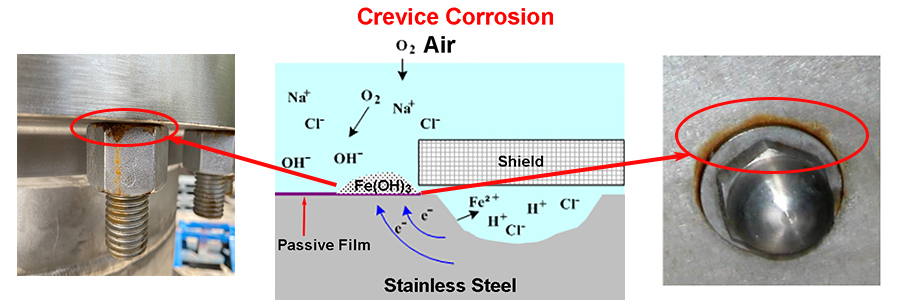
Crevice Corrosion
2. What causes stainless steel fasteners to rust?
The reasons for rusting are multifaceted, but ultimately, they all involve damaging the protective layer on the surface or creating extreme corrosive conditions. Based on engineering practice, the main causes are:
The reasons for rusting are multifaceted, but ultimately, they all involve damaging the protective layer on the surface or creating extreme corrosive conditions. Based on engineering practice, the main causes are:
Chloride Ion (Cl⁻) Attack: This is the most common and dangerous factor. Chloride ions (mainly from salt spray, seawater, de-icing salts, etc.) possess strong penetrating power and can locally damage the oxide film on the stainless steel surface. Once the film is damaged, chloride ions hinder its re-formation, leading to localized "pitting" or "crevice corrosion." Especially in crevice areas like thread engagements or gasket contact surfaces, where oxygen replenishment is difficult, chloride ions concentrate, pH drops, and corrosion accelerates dramatically.

Pitting Corrosion
Galvanic Corrosion: When a stainless steel fastener is in contact with another metal having a more negative potential (e.g., carbon steel, aluminum alloy) in an electrolyte solution, a large corrosion cell forms. Here, the stainless steel acting as the cathode accelerates the corrosion of the anode metal (e.g., carbon steel). Conversely, if the fastener itself is in a passive state (cathode) but the contact area is in an active state (anode) due to oxygen deficiency, it can also lead to accelerated corrosion of the fastener itself at the contact area.
Surface Contamination and Processing Defects: During manufacturing or installation, if the fastener surface is contaminated with ordinary carbon steel dust (e.g., cleaning with a carbon steel brush), these foreign iron particles can form micro-galvanic cells with the stainless steel in humid conditions, triggering rust. Furthermore, improper heating (e.g., during hot forming) can cause chromium carbide precipitation in stainless steel within the 400-850°C temperature range. This leads to chromium depletion near the grain boundaries, a phenomenon known as "sensitization," thereby losing corrosion resistance.
Synergy of Mechanical Stress and Environment: Under the combined action of tensile stress and specific corrosive media (e.g., high-temperature environments containing chloride ions), stainless steel fasteners can suffer stress corrosion cracking. This is a brittle fracture that occurs without warning and is extremely hazardous, commonly found in marine engineering and chemical equipment.

How to prevent corrosion on stainless steel fasteners ?
3. The Principle of Stainless Steel's Corrosion Resistance
The fundamental reason stainless steel can resist corrosion is the presence of an extremely dense, only a few nanometers thick, chromium-rich oxide film on its surface (also known as the passive film).
The fundamental reason stainless steel can resist corrosion is the presence of an extremely dense, only a few nanometers thick, chromium-rich oxide film on its surface (also known as the passive film).
The principle of this film can be understood as follows:
1. Self-formation: The chromium (Cr) in the steel reacts chemically with oxygen in the air, naturally forming an oxide film primarily composed of chromium trioxide (Cr₂O₃).
1. Self-formation: The chromium (Cr) in the steel reacts chemically with oxygen in the air, naturally forming an oxide film primarily composed of chromium trioxide (Cr₂O₃).
2. Dense and Stable: This film is very thin, transparent, but dense, acting like armor to isolate the base metal from external corrosive agents.
3. Self-repair: This is the most remarkable aspect. When this film is mechanically damaged or locally damaged, as long as sufficient oxygen is available, the chromium in the exposed base metal will react again with oxygen, automatically repairing the protective film and re-forming the passive layer.
Therefore, the corrosion resistance of stainless steel largely depends on the stability of this film. Chromium is the primary element responsible for forming this film. It's generally accepted that the chromium content in the steel must exceed 12% to achieve good stainless properties. Additionally, nickel (Ni) helps stabilize the austenitic structure, and molybdenum (Mo) greatly strengthens the film's resistance to chloride ion attack. This is why molybdenum-containing 316 stainless steel is more resistant to seawater corrosion than 304.
Qishine is ideal choice for EPC companies and project contractors.
Website: www.qishine.com
Email: qishine@qishine.com
Tel: 0592-5225595
WhatsApp: +86 15960259563
+86 15985833169
Website: www.qishine.com
Email: qishine@qishine.com
Tel: 0592-5225595
WhatsApp: +86 15960259563
+86 15985833169
4. Suitable Environments for Stainless Steel Fasteners
Based on their corrosion resistance principle, we can clearly identify suitable environments for stainless steel fasteners:
Based on their corrosion resistance principle, we can clearly identify suitable environments for stainless steel fasteners:
Ideal Environments:
Dry and clean indoor environments: e.g., ordinary electronics, furniture, indoor machinery. In such environments, 304 material (A2 stainless steel) is sufficient to ensure no rust for decades.
Humid environments without chloride exposure: e.g., freshwater environments, ordinary atmospheric conditions.
Dry and clean indoor environments: e.g., ordinary electronics, furniture, indoor machinery. In such environments, 304 material (A2 stainless steel) is sufficient to ensure no rust for decades.
Humid environments without chloride exposure: e.g., freshwater environments, ordinary atmospheric conditions.
Harsh Environments (Requires Careful Material Selection):
Marine and Coastal Areas: Rich in sea salt particles (chloride ions). Structures, docks, and ships within several kilometers of the coastline must use molybdenum-containing 316 (A4 stainless steel) or higher-grade super austenitic stainless steels.
Marine and Coastal Areas: Rich in sea salt particles (chloride ions). Structures, docks, and ships within several kilometers of the coastline must use molybdenum-containing 316 (A4 stainless steel) or higher-grade super austenitic stainless steels.
Environments with De-icing Salts: Roads, bridges, parking lots in cold regions. The chloride ion concentration from de-icing salts is extremely high, posing a corrosion threat to fasteners that can even exceed that of marine environments.
Chemical Processing and Food Industries: Environments involving contact with acids, bases, or organic acids (like fruit juices, vegetable juices). While stainless steel resists corrosion, long-term exposure to high concentrations or temperatures of chemicals still requires selecting specific grades based on the medium.
Environments with Crevices Difficult to Clean: e.g., structural joints in food processing equipment, highly susceptible to crevice corrosion. It is advisable to choose grades with higher molybdenum content or use higher-strength alloys.
5. Alternative Materials: When Stainless Steel Isn't Enough
In some extreme environments, even primary 316L stainless steel may prove inadequate. Here, we need to consider high-performance specialty alloys:
In some extreme environments, even primary 316L stainless steel may prove inadequate. Here, we need to consider high-performance specialty alloys:
Nickel-Based Alloys:
Representative Grades: Inconel 625, Hastelloy C-276, etc.
Performance Characteristics: Nickel-based alloys offer unparalleled resistance to uniform corrosion, pitting, crevice corrosion, and stress corrosion cracking, especially in high-temperature, high-concentration chloride, and mixed acid media.
Application Scenarios: Fasteners for deep-sea marine engineering, seawater desalination equipment, flue gas desulfurization systems, nuclear reactors, etc. They represent one of the ultimate solutions to challenging corrosion problems.
Representative Grades: Inconel 625, Hastelloy C-276, etc.
Performance Characteristics: Nickel-based alloys offer unparalleled resistance to uniform corrosion, pitting, crevice corrosion, and stress corrosion cracking, especially in high-temperature, high-concentration chloride, and mixed acid media.
Application Scenarios: Fasteners for deep-sea marine engineering, seawater desalination equipment, flue gas desulfurization systems, nuclear reactors, etc. They represent one of the ultimate solutions to challenging corrosion problems.
Titanium and Titanium Alloys:
Representative Grades: Grade 2 (commercially pure titanium), Ti-6Al-4V, etc.
Performance Characteristics: Titanium alloys exhibit exceptional resistance to chloride ions, are virtually immune to pitting, and offer excellent corrosion resistance in seawater. They also possess an outstanding strength-to-weight ratio.
Application Scenarios: Deep-sea submersibles, ship components, biomedical implants, aerospace fasteners. Titanium alloys are not only corrosion-resistant but also non-magnetic.
Representative Grades: Grade 2 (commercially pure titanium), Ti-6Al-4V, etc.
Performance Characteristics: Titanium alloys exhibit exceptional resistance to chloride ions, are virtually immune to pitting, and offer excellent corrosion resistance in seawater. They also possess an outstanding strength-to-weight ratio.
Application Scenarios: Deep-sea submersibles, ship components, biomedical implants, aerospace fasteners. Titanium alloys are not only corrosion-resistant but also non-magnetic.
Other High-Performance Materials:
Duplex Stainless Steels: e.g., 2205, 2507. They combine the advantages of austenitic and ferritic stainless steels, offering high strength and significantly better resistance to pitting and stress corrosion cracking than ordinary austenitic grades. They are a cost-effective alternative in many cases.
Copper-Nickel Alloys: e.g., Cu-15Ni-8Sn. They find applications in some specific seawater environments, but their strength is relatively lower.
Duplex Stainless Steels: e.g., 2205, 2507. They combine the advantages of austenitic and ferritic stainless steels, offering high strength and significantly better resistance to pitting and stress corrosion cracking than ordinary austenitic grades. They are a cost-effective alternative in many cases.
Copper-Nickel Alloys: e.g., Cu-15Ni-8Sn. They find applications in some specific seawater environments, but their strength is relatively lower.
6. Summary
| Aspect | Conclusion | Technical Key Points & Recommendations |
| Can it rust? | Yes, it can rust, but typically not as generalized rust. | Manifests mainly as localized corrosion. It signifies material failure under specific harsh conditions, not general material degradation. |
| Reasons for Rusting | Chloride attack, galvanic effects, surface contamination. |
1. Crevice Corrosion: Fastener structures create crevices prone to oxygen depletion and acidification.
2. Galvanic Corrosion: Contact with dissimilar metals or formation of oxygen concentration cells.
3. Iron Contamination/Sensitization: Processing introduces impurities or improper heat treatment damages the passive film.
|
| Principle of Resistance | Dynamic balance of "formation-destruction-reformation" of the surface chromium-rich oxide film (passive film). | Film stability is key. Chromium is fundamental, nickel stabilizes the structure, and molybdenum (Mo) is the crucial element for resisting chlorides, significantly enhancing film stability. |
| Suitable Environments | From ordinary atmosphere to harsh marine environments; material selection follows a clear gradient. |
- Ordinary Environments: A2 stainless steel (e.g., 304).
- Marine/Chemical: Start with A4 stainless steel (e.g., 316); consider super austenitic grades if needed.
- Extreme Environments: Upgrade to duplex stainless steels, titanium alloys, or nickel-based alloys.
|
| Alternative Materials | Specialty alloys are the ultimate solution for extreme corrosion. |
When stainless steel is insufficient, consider:
- Nickel-Based Alloys: Solve stress corrosion cracking in high-temperature, high-chloride environments.
- Titanium Alloys: The "king" in seawater environments, combining light weight and high strength.
- Duplex Stainless Steels: A balance between high strength and high corrosion resistance.
|
Engineer's Advice:
During project material selection, one should not only focus on the procurement price of fasteners but also evaluate the lifecycle cost. For critical equipment or hard-to-access locations, a one-time investment in high-end materials is often far less costly than the expenses associated with production shutdowns, repairs, or even safety accidents caused by future corrosion failures. Be sure to consult with professional suppliers based on the specific service environment, medium composition, temperature, and stress conditions to select the most suitable fastener material.
During project material selection, one should not only focus on the procurement price of fasteners but also evaluate the lifecycle cost. For critical equipment or hard-to-access locations, a one-time investment in high-end materials is often far less costly than the expenses associated with production shutdowns, repairs, or even safety accidents caused by future corrosion failures. Be sure to consult with professional suppliers based on the specific service environment, medium composition, temperature, and stress conditions to select the most suitable fastener material.
Website: www.qishine.com
Email: qishine@qishine.com
Tel: 0592-5225595
WhatsApp: +86 15960259563
+86 15985833169
Email: qishine@qishine.com
Tel: 0592-5225595
WhatsApp: +86 15960259563
+86 15985833169
What is a High-Strength Bolt
Can Carbon Steel Bolts Be Used with Stainless Steel Nuts
Related Article

Insights from a Case Study on Exporting B8M Fasteners.Recently, during our final outgoing inspection of a batch of B8M stainless steel fasteners destined for Portugal, we discovered varying degrees of burrs on the edges of the bolt hex heads.
How to Efficiently Remove Burrs from Bolt Edges

Insulating Gasket Procurement Pitfalls: From "Price Traps" to "Supplier Selection"
What pitfalls should you watch out for when purchasing insulating gaskets

As a classic modified PTFE gasket material from Garlock, Gylon 3500 is widely used in petrochemical, chemical, and other industries for its excellent resistance to strong acids, solvents, and anti-creep properties.
How to Buy Genuine Gylon 3500 Insulating Gaskets at Competitive Prices in China

