
Difference Between Bolt Thread Rolling and Thread Cutting

Fastener manufacturing is a multi-step process. In brief, it includes material selection, forming, thread processing, heat treatment, surface finishing, inspection, testing, and finally packaging and shipping. When it comes to threads, they are typically produced by one of two processes—rolling or cutting. What are the differences between these two methods, and how does the thread manufacturing method affect your application?
What Are Rolled Fastener Threads?
Rolled fastener threads are manufactured by deforming the fastener material (typically metal) by rolling the workpiece between two dies that have the negative profile of the desired thread shape.
Rolled fastener threads are manufactured by deforming the fastener material (typically metal) by rolling the workpiece between two dies that have the negative profile of the desired thread shape.
Thread rolling uses a cold forming process to produce a strong, uniform thread profile. In this method, a blank is rotated between hardened steel dies with reverse-thread profiles. The dies form the thread roots, while the outward radial displacement of the material creates the thread crests.

Thread Rolling
This is a "chipless" forming process, relatively modern, and it promises improved processing for any industry that adopts it. Ultimately, it has become the preferred method for the following reasons:
- Precision: Thread rolling provides smoother and more uniform threads in long production runs.
- Cost: Thread rolling requires less raw material, saving money and eliminating material waste.
- Quality: Superior thread surface finish extends the service life of the part and results in a higher-quality finished product.
- Strength: Thread rolling is a cold-working operation, which means it offers superior tensile stress, tensile load, and structural integrity compared to other methods.
- Cost: Thread rolling requires less raw material, saving money and eliminating material waste.
- Quality: Superior thread surface finish extends the service life of the part and results in a higher-quality finished product.
- Strength: Thread rolling is a cold-working operation, which means it offers superior tensile stress, tensile load, and structural integrity compared to other methods.

Thread Rolled VS Thread Cut
During this precision process, threads are formed by displacing and reconfiguring the metal rather than cutting it, avoiding the structural weak points caused by material removal.
Rolled fastener threads are commonly used in applications requiring high strength and high reliability, such as the aerospace, automotive, and construction industries. They are widely applied in various fasteners, including bolts, screws, studs, and threaded rods.
What Are Cut Fastener Threads?
Cut fastener threads are manufactured by removing material from the fastener to form the thread shape, typically using cutting tools such as taps or dies.
Cut fastener threads are manufactured by removing material from the fastener to form the thread shape, typically using cutting tools such as taps or dies.
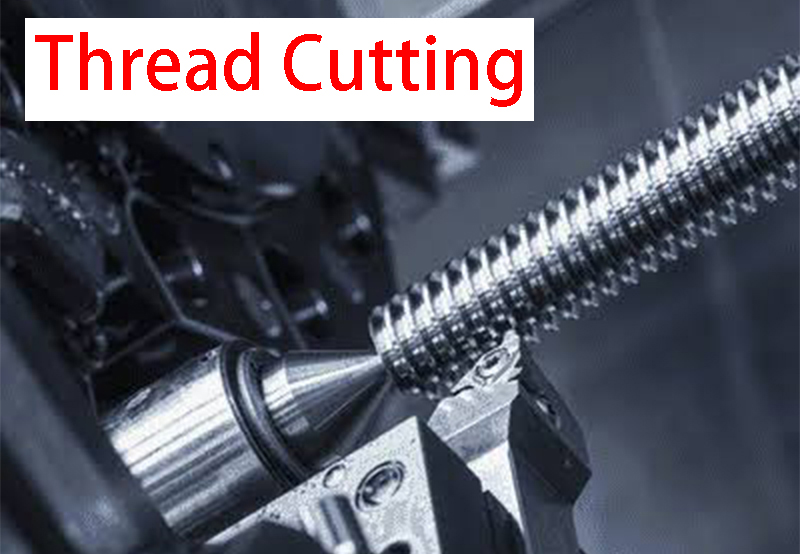
Thread Cutting
The advantages of cut threads include manufacturing flexibility, convenience, and the ability to produce a wide variety of thread sizes and shapes. Additionally, cut threads are relatively easy to repair or modify if needed.
However, compared to rolled threads, cut threads have some disadvantages. Because material is removed, their strength and fatigue resistance may be lower, and the thread profile and dimensional accuracy may be less precise than those of rolled threads. Furthermore, cut threads may produce burrs or other surface defects that can lead to stress concentrations or other serious issues.
Cut fastener threads are widely used in many industries, including automotive, construction, and general manufacturing, especially for smaller fasteners or applications where high strength is not as critical.
So, Which Option Is Better for Your Application?
Deciding whether rolled or cut threads are more suitable for your application depends on the specific requirements and considerations of your project, such as strength, durability, precision, and cost-effectiveness.
Deciding whether rolled or cut threads are more suitable for your application depends on the specific requirements and considerations of your project, such as strength, durability, precision, and cost-effectiveness.
- Rolled threads are generally stronger and more fatigue-resistant due to the compressive forces generated during the rolling process. They tend to have more precise thread profiles and dimensional accuracy, which can improve overall fastener performance. Rolled threads are commonly used in applications where high strength and high reliability are critical.
- Cut threads offer greater flexibility in terms of the range of thread sizes and shapes that can be produced. They are also easier to manufacture and can be repaired or modified when necessary. Cut threads are often used in applications where ultra-high strength is less critical, such as general manufacturing, construction, and automotive industries.
In high-technology industries like aerospace, parts made from high-strength metals with minimal thread variation are required. For this reason, aerospace-grade metals are not easy to machine into components. The necessary force required to form precision threads must be performed on specially designed equipment to ensure the required quality level is achieved.
Thread rolling is not required in every situation, but it is a process you may need from time to time. But don't worry—you don't need to invest in the expensive equipment this technology requires. Our company (Xiamen Qishine) already has it ready for you! Simply contact us, and we will be happy to assist.
If you have any questions, please feel free to contact us. We will provide you with an answer as soon as we receive your request.
Qishine is ideal choice for EPC companies and project contractors.
Website: www.qishine.com
Email: qishine@qishine.com
Tel: 0592-5225595
WhatsApp: +86 15960259563
+86 15985833169
Website: www.qishine.com
Email: qishine@qishine.com
Tel: 0592-5225595
WhatsApp: +86 15960259563
+86 15985833169
What is a rolling shutter door
Related blog


