
 Swage Nipple connects two different pipe sizes in one short fitting, supplied with bevelled or threaded ends in carbon or stainless steel.QS Pipe Fitting: Xiamen Swage Nipple
 A butt weld reducing tee that provides a smaller branch outlet directly from the run, in carbon, stainless or alloy steel.QS Pipe Fitting: Zhangzhou Reducing Tee
 High Pressure Elbow for demanding piping, the directional-change fitting that turns a line while keeping the pressure boundary intact.QS Pipe Fitting: Quanzhou High Pressure Elbow
 A carbon steel rolling door reel that winds the shutter curtain, transmits motor torque and carries the torsion spring.QS Pipe: Rolling Door Reel
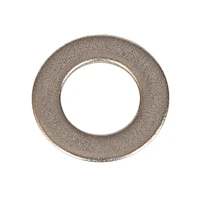
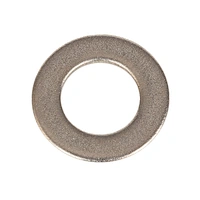
ASTM F436 Washer
One-Minute Overview
- Hardened steel flat washer to ASTM F436 for bolted flange and structural joints.
- Spreads clamp load under the nut or bolt head and protects the mating face.
- Pairs with studs, gaskets and sleeves in flange insulation and pipeline bolting.
- Diameter, grade and finish are confirmed per inquiry against the bolting spec.
A washer looks like the least interesting part of a bolted joint, but it is the part that decides whether the preload survives. An ASTM F436 washer is a hardened steel flat washer placed under the nut or bolt head: it spreads the clamp load over a wider area, keeps the nut from galling or embedding into the flange face, and gives the wrench a smooth, hard surface to tighten against. On flange insulation kits and pipeline studs it works alongside gaskets, sleeves and studs as one matched set. Qishine supplies it to suit the bolting rather than as a loose commodity item, because hardness and dimensions have to follow the stud grade and the joint design.
Name: ASTM F436 Washer
Type: Hardened steel flat washer for bolted joints
Material: Hardened carbon steel to ASTM F436, grade matched to the studs
Standard: ASTM F436
End: Flat bearing face under nut or bolt head
Feature: Even load spread, protects flange and joint faces
Diameters in inches, grades and finishes are confirmed per inquiry, and a detailed specification sheet is available on request.
Selection is driven by the bolt, not by the washer. Match the washer bore to the stud or bolt diameter, follow the hardness and grade of the fastener, and choose a finish compatible with the environment and the coating on the studs. A soft or undersized washer dishes under load, loses preload and can mark the flange face; an oversized one may foul the joint or the sleeve. In a flange insulation kit the washer also has to sit square against the insulating sleeve and gasket, so the whole stack compresses evenly. Every diameter, grade, hardness and finish is confirmed per inquiry against the bolting specification, so send the stud size and the joint class together.
Installation is simple but easy to get wrong. Put one washer under the nut and, where the design calls for it, one under the bolt head, with the flat, clean face bearing on the joint. Tighten studs in a cross pattern and in stages so the gasket compresses evenly and no single washer takes the whole pull. Do not reuse hardened washers that have dished, scored or corroded, and never stack washers to make up a gap. Used on flange insulation kits, studded outlets, valve bonnets and bolted pipe supports, a correct washer keeps the preload where the designer intended. Store them dry and sorted by size so the right grade reaches the right joint.
FAQ
Q1. What role does an ASTM F436 washer play in a bolted flange joint?
Q2. Can I reuse washers when I re-torque a flange, or mix sizes from the bin?
Q3. Is the washer really doing anything, or is it just there to fall on the floor?
Q4. What's the minimum I can order?
Send Message

Comprehensive score