
6 Commonly Used Butterfly Valves in the Petroleum Industry Pipeline
author: www.qishine.com
2026-03-01

Butterfly valves are critical fluid control components in the petroleum industry. Valued for their compact structure, quick opening and closing, ease of operation, and maintenance, they are widely used in various pipeline systems.
Selecting the appropriate type of butterfly valve is crucial for ensuring the safe, efficient, and long-term operation of pipeline systems. This article details six types of butterfly valves commonly used in the petroleum industry, including their design features, suitable operating conditions, and key selection points.

Butterfly Valve Connection Piping: Wafer butterfly valve, Lug butterfly valve, Flange butterfly valve
1. Lug Butterfly Valve
Lug butterfly valves feature a valve body with threaded lug holes (ears) on both sides. During installation, these lugs allow the valve to be directly bolted between the flanges at both ends of the pipeline, providing independent connection points. This design offers a key advantage: during system maintenance, the flange on one side of the pipeline can be removed while the valve remains reliably fixed and sealed on the other side, preventing downstream media leakage. This makes it ideal as an end-of-line valve or for applications requiring isolation of a pipeline section for maintenance.
Lug butterfly valves feature a valve body with threaded lug holes (ears) on both sides. During installation, these lugs allow the valve to be directly bolted between the flanges at both ends of the pipeline, providing independent connection points. This design offers a key advantage: during system maintenance, the flange on one side of the pipeline can be removed while the valve remains reliably fixed and sealed on the other side, preventing downstream media leakage. This makes it ideal as an end-of-line valve or for applications requiring isolation of a pipeline section for maintenance.
Due to their structural strength and contribution to system safety, lug butterfly valves are widely used in petroleum industry pipelines for water, oil, gas, and various chemical media.

Lug butterfly Valve: Threaded lug holes(ears) on both sides
2. Flange Butterfly Valve
The flanged butterfly valve is one of the most traditional and common types. Its valve body has integral flange plates at both ends, which are directly bolted to the pipeline flanges. This connection method is very robust and reliable, effectively withstanding pipeline system stress, vibration, and higher pressure loads.
The flanged butterfly valve is one of the most traditional and common types. Its valve body has integral flange plates at both ends, which are directly bolted to the pipeline flanges. This connection method is very robust and reliable, effectively withstanding pipeline system stress, vibration, and higher pressure loads.
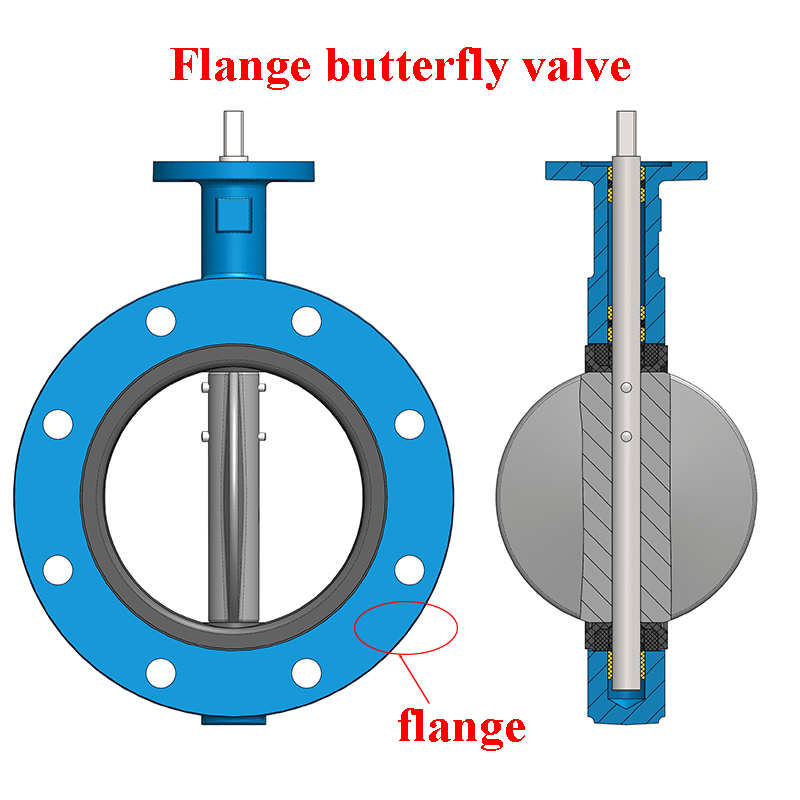
Flange butterfly valve
In the petroleum industry, flanged butterfly valves are typically used in main pipelines, pump station inlets/outlets, and storage tank connection lines that require higher pressure ratings or stricter sealing requirements due to their excellent sealing performance and structural strength.
3. Wafer Butterfly Valve
The wafer butterfly valve has a valve body without flanges, making it the most compact and lightweight design. During installation, it is "sandwiched" between two pipeline flanges and secured by long bolts passing through both flanges. This design saves significant space and material, reducing cost and weight.
The wafer butterfly valve has a valve body without flanges, making it the most compact and lightweight design. During installation, it is "sandwiched" between two pipeline flanges and secured by long bolts passing through both flanges. This design saves significant space and material, reducing cost and weight.

Butterfly Valve is a Valve that isolates or regulates the flow of a fluid. The closing mechanismis a disk that rottes.
Wafer butterfly valves are suitable for applications with strict space and weight limitations and where pipeline flanges are already aligned. In the petroleum industry, they are commonly used in auxiliary pipelines with relatively low pressure ratings (typically PN16 and below), cooling water systems, or areas requiring densely packed valves.
4. Double Eccentric Flange Butterfly Valve
The double eccentric butterfly valve, also known as a high-performance butterfly valve, incorporates two key eccentric designs: first, the valve stem axis is offset from the center of the disc sealing surface, and second, it is offset from the center of the pipeline channel. This design allows the disc to quickly disengage from the seat upon opening, significantly reducing friction and wear; during closing, a tighter seal is achieved through a cam action.
The double eccentric butterfly valve, also known as a high-performance butterfly valve, incorporates two key eccentric designs: first, the valve stem axis is offset from the center of the disc sealing surface, and second, it is offset from the center of the pipeline channel. This design allows the disc to quickly disengage from the seat upon opening, significantly reducing friction and wear; during closing, a tighter seal is achieved through a cam action.
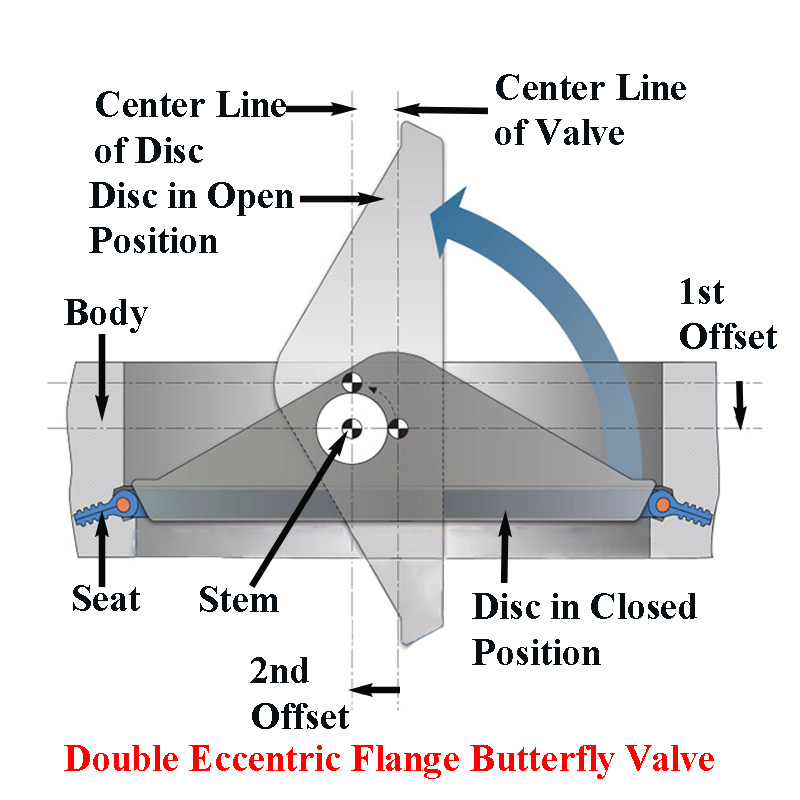
Double Eccentric Flange Butterfly Valve: incorporates two key eccentric designs
The double eccentric butterfly valve with a flanged connection combines the sealing advantages of eccentric technology with the stability of a flanged connection. It typically uses metal or reinforced polymer seats, capable of handling higher operating temperatures (up to 300°C or more) and pressures (up to PN40). It is suitable for petroleum refining and chemical processes requiring higher performance in on/off and regulating duties.
5. U-Type Metal-Seated Butterfly Valve
This is a high-performance butterfly valve with a special sealing structure. Its core feature is a seat that utilizes a metal elastic sealing ring with a roughly U-shaped cross-section. This U-ring uses its radial elastic force to form a metal-to-metal seal with the disc, providing not only a high sealing class but also insensitivity to the forward or reverse pressure of the medium, overcoming the drawback of traditional multi-layer soft seals being easily damaged by erosion.
This is a high-performance butterfly valve with a special sealing structure. Its core feature is a seat that utilizes a metal elastic sealing ring with a roughly U-shaped cross-section. This U-ring uses its radial elastic force to form a metal-to-metal seal with the disc, providing not only a high sealing class but also insensitivity to the forward or reverse pressure of the medium, overcoming the drawback of traditional multi-layer soft seals being easily damaged by erosion.

U-Type Metal-Seated Butterfly Valve: The valve seat isequipped with a metal elastic sealing ring whose cross-section is roughly in the shape of an "U".
Due to its pure metal elastic seal, it is particularly suitable for harsh conditions in the petroleum industry involving high temperature, high pressure, abrasion, or erosion, such as catalytic cracking units and high-temperature oil and gas pipelines. It offers longer service life and reliability compared to traditional soft-seated butterfly valves.
6. Triple Eccentric Butterfly Valve
The triple eccentric butterfly valve represents the pinnacle of butterfly valve technology. Based on the double eccentric design, it adds a third eccentric: the rotational axis of the seat is set at a conical angle relative to the pipeline channel axis. The ultimate effect of this design is that the disc achieves completely friction-free contact and separation from the seat during operation, completely solved the problem of wear and tear.
The triple eccentric butterfly valve represents the pinnacle of butterfly valve technology. Based on the double eccentric design, it adds a third eccentric: the rotational axis of the seat is set at a conical angle relative to the pipeline channel axis. The ultimate effect of this design is that the disc achieves completely friction-free contact and separation from the seat during operation, completely solved the problem of wear and tear.

Triple Eccentric Butterfly Valve: It adds a third eccentricity on the basis of the double eccentricity.
Utilizing a full-metal wedge-shaped sealing pair, the triple eccentric butterfly valve can withstand extreme conditions. Its applicable temperature range can cover from -196°C cryogenic to 700°C high temperature, with pressure ratings up to 2500 lbs. In the petroleum industry, it is widely used in core high-temperature and high-pressure pipelines in refineries, main valves for long-distance oil and gas transmission pipelines, offshore platforms, and critical safety systems requiring zero leakage. It is a modern high-performance alternative to traditional gate and globe valves.
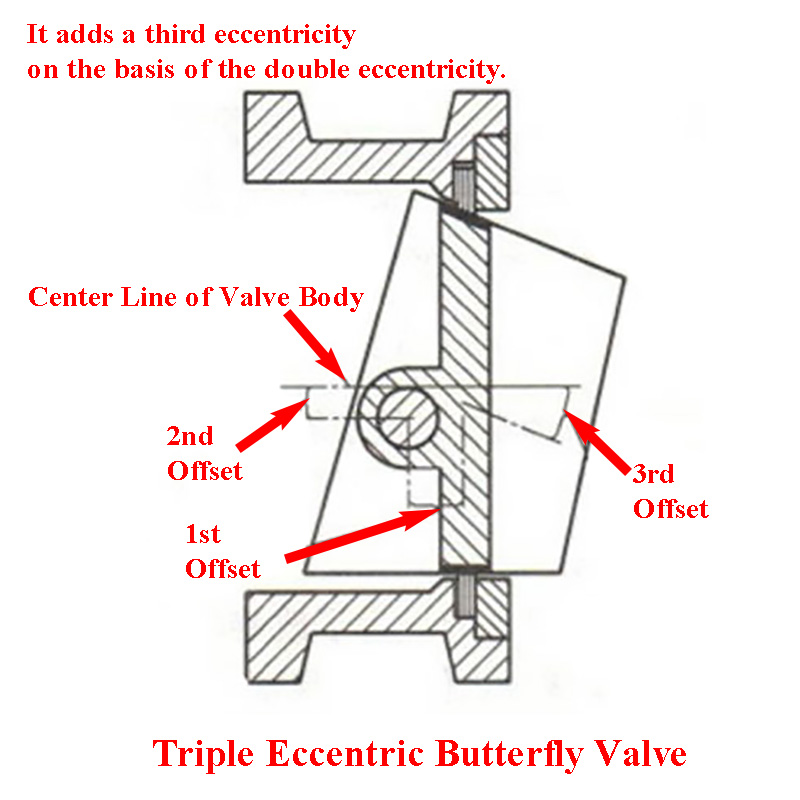
Triple Eccentric Butterfly Valve: Three Offsets
Selection and Application Comparison
For quick comparison and selection in petroleum industry projects, the following table summarizes the core characteristics of these six butterfly valve types:
For quick comparison and selection in petroleum industry projects, the following table summarizes the core characteristics of these six butterfly valve types:
| Valve Type | Connection / Core Structural Feature | Main Advantages | Typical Petroleum Industry Application Scenarios | Typical Capability Reference |
| Lug Butterfly Valve | Valve body with threaded lugs | Allows removal of one-side piping for maintenance; safe end-of-line sealing | Tank farm inlets/outlets, pipeline ends, branch lines requiring frequent isolation for maintenance | Pressure up to PN10-16, temperature depends on seal material |
| Flange Butterfly Valve | Valve body with integral flanges | Most stable connection, good stress handling, reliable sealing | Pump inlets/outlets, main pipelines, higher-pressure oil/gas/water lines | Pressure up to PN40, temperature typically below 300°C |
| Wafer Butterfly Valve | Flangeless body, sandwiched installation | Compact structure, lightweight, low cost | Auxiliary lines with space constraints, cooling water systems, low-pressure slurry lines | Pressure typically PN16 and below |
| Double Eccentric Flange Butterfly Valve | Double eccentric structure + flanged connection | Low operating torque, minimal wear, good sealing, long service life | Medium-temperature, medium-pressure process lines in refineries, product/chemical lines requiring regulation | Pressure up to PN40, temperature up to 300°C or higher |
| U-Type Metal-Seated Butterfly Valve | U-shaped metal elastic seat | Bidirectional sealing, erosion-resistant, withstands temperature/pressure variations | High-temperature oil/gas, media prone to coking or containing particles, harsh regulating conditions | Resistant to high temp/pressure, specifics depend on metal material grade |
| Triple Eccentric Butterfly Valve | Triple eccentric + metal conical seat sealing | Friction-free operation, extremely long life, withstands extreme temperatures and pressures | High-temperature, high-pressure reactor piping, main valves for long-distance pipelines, critical isolation valves, offshore platforms | Temperature -196~700°C, pressure up to 2500 lbs class |
Summary and Selection Recommendations
When selecting butterfly valves for the petroleum industry, comprehensively consider operating conditions, performance requirements, installation space, and budget.
When selecting butterfly valves for the petroleum industry, comprehensively consider operating conditions, performance requirements, installation space, and budget.
For conventional on/off and low-pressure regulation: Prioritize cost-effective wafer or lug soft-seated butterfly valves.
For medium-pressure main lines requiring stable connections: Flanged butterfly valves are a reliable choice.
For medium-pressure main lines requiring stable connections: Flanged butterfly valves are a reliable choice.
When facing higher temperatures, pressures, or requiring better sealing and lifespan: Double eccentric butterfly valves mark the starting point for a performance upgrade.
For the most demanding conditions, such as extreme temperatures, high pressure, abrasion, or requiring absolute sealing: Triple eccentric butterfly valves and U-type metal-seated butterfly valves are cutting-edge solutions to ensure long-term, safe, and stable system operation.
For the most demanding conditions, such as extreme temperatures, high pressure, abrasion, or requiring absolute sealing: Triple eccentric butterfly valves and U-type metal-seated butterfly valves are cutting-edge solutions to ensure long-term, safe, and stable system operation.
Qishine is ideal choice for EPC companies and project contractors.
Website: www.qishine.com
Email: qishine@qishine.com
Tel: 0592-5225595
Email: qishine@qishine.com
Tel: 0592-5225595
WhatsApp: +86 15985833169
How to Choose the Marking Method for Fasteners
4 Common Industrial Valves
Related Article

Insights from a Case Study on Exporting B8M Fasteners.Recently, during our final outgoing inspection of a batch of B8M stainless steel fasteners destined for Portugal, we discovered varying degrees of burrs on the edges of the bolt hex heads.
How to Efficiently Remove Burrs from Bolt Edges

Insulating Gasket Procurement Pitfalls: From "Price Traps" to "Supplier Selection"
What pitfalls should you watch out for when purchasing insulating gaskets

As a classic modified PTFE gasket material from Garlock, Gylon 3500 is widely used in petrochemical, chemical, and other industries for its excellent resistance to strong acids, solvents, and anti-creep properties.
How to Buy Genuine Gylon 3500 Insulating Gaskets at Competitive Prices in China

