
3 Common Types of Metal Steel Tubes Pipes
author: www.qishine.com
2026-03-04

As a supplier with 13 years of experience in the pipe and tube industry, these three types of "structural hollow sections"—commonly known as round tubes, square tubes, and rectangular tubes—are the most fundamental structural components in the engineering field.
Many newcomers in procurement easily confuse their applications, and some even think square tubes are simply round tubes pressed flat. In reality, from the rolling process to mechanical stress distribution, they are entirely different products. We will now break down the details for you from three aspects: shape characteristics, load-bearing behavior, and suitable applications.
I. Circular Hollow Section (CHS) / Round Steel Pipe
Shape:
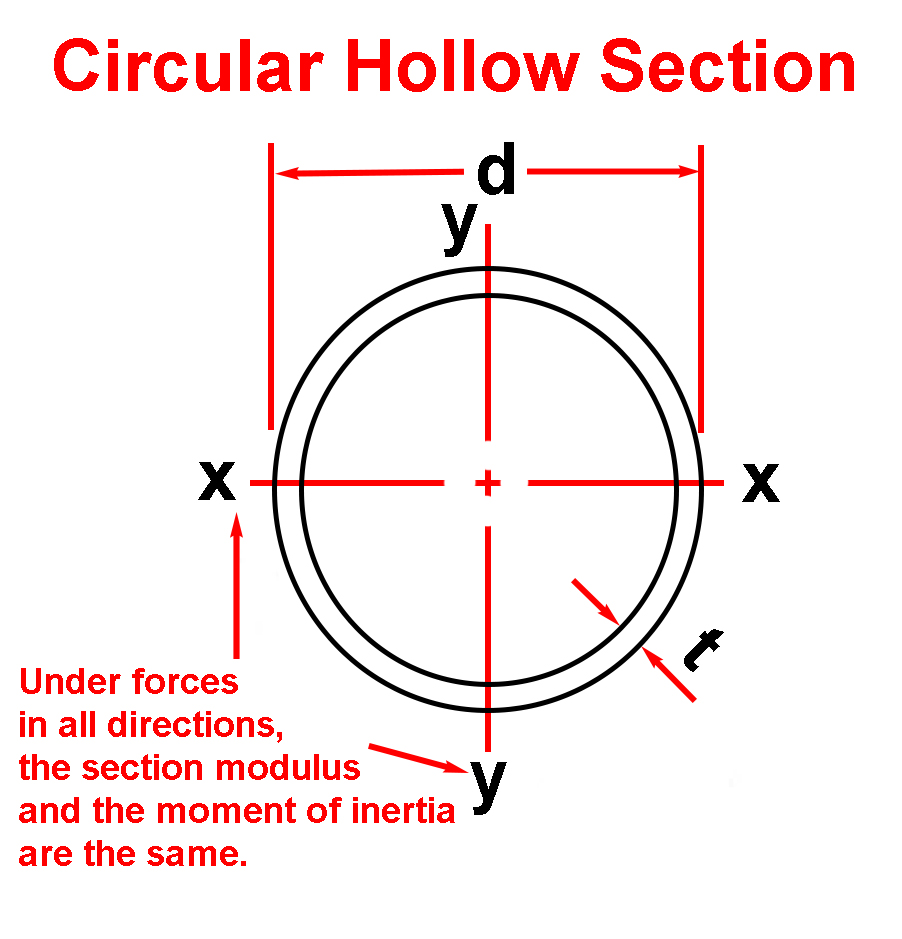
This is the most traditional tube shape. Its characteristic is isotropy, meaning its section modulus and moment of inertia are the same regardless of the direction of force. It has no sharp edges.
Shape:
This is the most traditional tube shape. Its characteristic is isotropy, meaning its section modulus and moment of inertia are the same regardless of the direction of force. It has no sharp edges.
Circular Hollow Section: under forces in all directions, the section modulus and the moment of inertia are the same.
Suitable Applications & Core Advantages:
Fluid & Pressure Scenarios: This is the primary application for round tubes. Whether for water pipes, natural gas pipelines, or hydraulic oil lines, round tubes are generally the preferred choice. This is because internal pressure is uniformly distributed in all directions, and the circular shape disperses stress most evenly. Its resistance to internal pressure is unattainable by square tubes.
Fluid & Pressure Scenarios: This is the primary application for round tubes. Whether for water pipes, natural gas pipelines, or hydraulic oil lines, round tubes are generally the preferred choice. This is because internal pressure is uniformly distributed in all directions, and the circular shape disperses stress most evenly. Its resistance to internal pressure is unattainable by square tubes.
Rotation & Transmission: For example, conveyor rollers, sports equipment (barbells), and axles. Due to its non-directional nature, it provides better dynamic balance during rotation.
Large-Span Buildings: Pipe trusses in stadiums and airport terminals. Although the connection at joints is less convenient than with square tubes, it excels in resisting wind loads (due to a smaller windward area) and torsional deformation.
Supplier's Advice: If the application involves burying underground or withstanding high internal pressure, please opt for seamless steel tubes or high-frequency straight seam welded pipes. In such cases, try to avoid using square tubes.
II. Square Hollow Section (SHS) / Square Steel Tube
Shape:
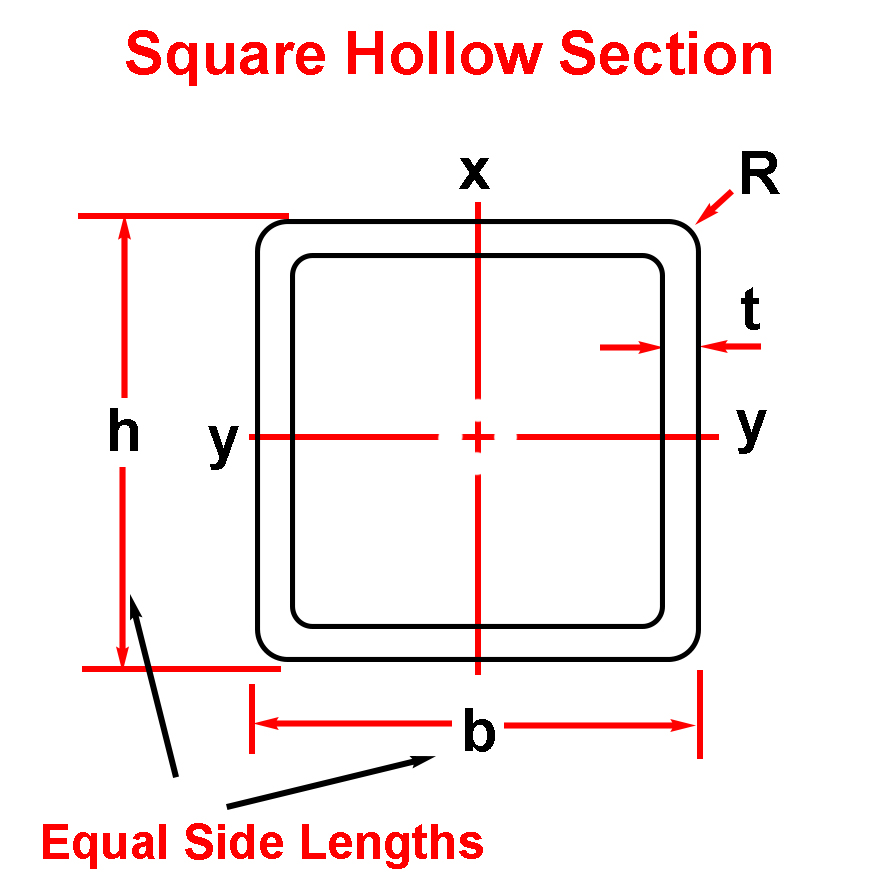
Equal side lengths with distinct corners. The four corners are typically rounded or have right-angle edges.
Shape:
Equal side lengths with distinct corners. The four corners are typically rounded or have right-angle edges.
Square Hollow Section: equal side lengths
Suitable Applications & Core Advantages:
Building Columns/Supports: Square tubes are commonly used columns in modern steel structure factories. With equal dimensions on all four sides, their slenderness ratio is the same on the X and Y axes. As a standalone column, they won't have the imbalance issue of being "stable in one direction but prone to buckling in another."
Building Columns/Supports: Square tubes are commonly used columns in modern steel structure factories. With equal dimensions on all four sides, their slenderness ratio is the same on the X and Y axes. As a standalone column, they won't have the imbalance issue of being "stable in one direction but prone to buckling in another."
Decoration & Light Steel Structures: Guardrails, flagpoles, landscape sculptures, simple carports. Square tubes have a good appearance and are easy to fit. When installing skirting boards or glass curtain walls, their flat surfaces are easier for applying sealant and fixing screws compared to round tubes.
Machinery Frames: Small equipment frames, photovoltaic supports. Due to their square cross-section, they offer more precise positioning when mating with other square components and won't roll around like round tubes, which are difficult to secure.
Supplier's Advice: The critical weakness of square tubes lies in the four corners. During cold forming, the corners undergo work hardening, and the wall thickness reduction rate is relatively high. For heavy-load or low-temperature environments, non-destructive testing on the corners is recommended.
III. Rectangular Hollow Section (RHS) / Rectangular Steel Tube
Shape:
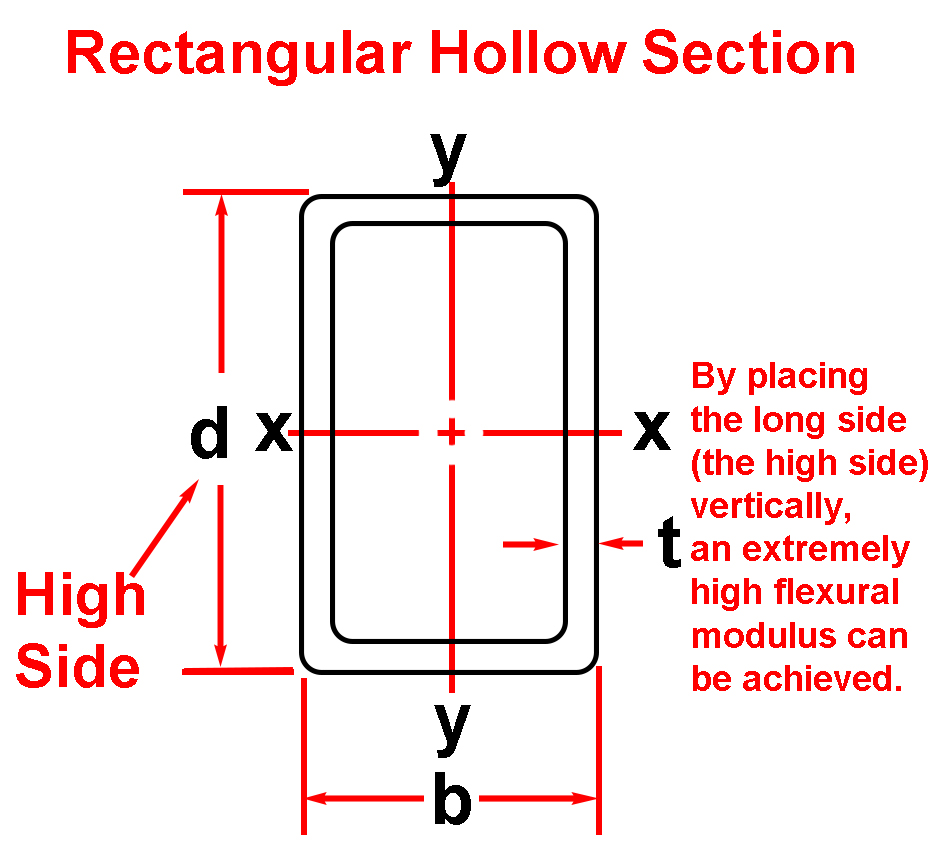
Unequal length and width. This is another variant of the square tube, typically defined by "height x width", e.g., 200x100mm.
Shape:
Unequal length and width. This is another variant of the square tube, typically defined by "height x width", e.g., 200x100mm.
Rectangular Hollow Section: By placing the high side vertically, an extremely high flexural modulus can be achieved.
Suitable Applications & Core Advantages:
Primary Beam Structures: This is the most common use for rectangular tubes. When bearing vertical loads, positioning the longer side (height) vertically provides a very high bending modulus. In other words, using the same 10kg of steel, a beam made from a rectangular tube will bend much less than one made from a round tube.
Primary Beam Structures: This is the most common use for rectangular tubes. When bearing vertical loads, positioning the longer side (height) vertically provides a very high bending modulus. In other words, using the same 10kg of steel, a beam made from a rectangular tube will bend much less than one made from a round tube.
Space-Constrained Areas: For instance, pipelines running within floor slabs or supports hidden inside suspended ceilings. The flat shape of rectangular tubes occupies less vertical space.
Pipe Racks/Galleries: Frames for large utility tunnels, using the height to provide rigidity and the width to provide a mounting surface.
Pipe Racks/Galleries: Frames for large utility tunnels, using the height to provide rigidity and the width to provide a mounting surface.
Supplier's Advice: Pay attention to distinguishing between the "strong axis" and the "weak axis." A rectangular tube placed vertically acts as a main beam; placed horizontally, it merely serves as a bracing member. The load-bearing capacity differs by several times. Please specify the direction of force when ordering.
🔧 Supplier's Selection Summary:
1. Consider the Force: For withstanding internal pressure, torque, or forces from any direction → Choose Round Tubes.
1. Consider the Force: For withstanding internal pressure, torque, or forces from any direction → Choose Round Tubes.
2. Consider Columns: For requiring equal stability in both directions → Choose Square Tubes.
3. Consider Beams: For needing bending resistance over large spans → Choose Rectangular Tubes (used vertically).
4. Consider Connections: The construction efficiency for on-site welding and bolting of square and rectangular tubes is significantly higher than for round tubes (which require complex profile cutting for intersections).
In our production scheduling, round tubes typically go through a continuous forming line, while square and rectangular tubes are usually formed by Squeezing sizing (squeeze sizing/reshaping) based on round tubes. If you need to make a purchase, please provide the side dimensions, wall thickness, and the applicable standard (e.g., Chinese National Standard GB/T 6728, British Standard EN 10219, or American Standard ASTM A500). Requirements for corner radius and yield strength vary significantly under different standards.
Qishine is ideal choice for EPC companies and project contractors.
Website: www.qishine.com
Email: qishine@qishine.com
Tel: 0592-5225595
WhatsApp: +86 15960259563
+86 15985833169
Email: qishine@qishine.com
Tel: 0592-5225595
WhatsApp: +86 15960259563
+86 15985833169
What are the common Types of Thread
Engineer's Cheat Sheet: Comparing 4 Common Industrial Pipe Flanges (WN, SO, Threaded, SW)
Related Article

Insights from a Case Study on Exporting B8M Fasteners.Recently, during our final outgoing inspection of a batch of B8M stainless steel fasteners destined for Portugal, we discovered varying degrees of burrs on the edges of the bolt hex heads.
How to Efficiently Remove Burrs from Bolt Edges

Insulating Gasket Procurement Pitfalls: From "Price Traps" to "Supplier Selection"
What pitfalls should you watch out for when purchasing insulating gaskets

As a classic modified PTFE gasket material from Garlock, Gylon 3500 is widely used in petrochemical, chemical, and other industries for its excellent resistance to strong acids, solvents, and anti-creep properties.
How to Buy Genuine Gylon 3500 Insulating Gaskets at Competitive Prices in China

